Sales Enablement Tools Buyers Should Evaluate
Align your tool choices to where buyers actually spend their research time.

Most sales enablement buying decisions start in the wrong place. A vendor shows up with a slick demo, drops a few AI buzzwords, and the evaluation becomes about features instead of outcomes. That's how teams end up with expensive software that reps barely open. The smarter move is to start with the four capabilities that actually move deals, then score every platform against those. Everything else is noise.
The market isn't making this easier. Depending on how broadly you define "enablement," the category sits somewhere between $4 billion and $6.5 billion in 2025, growing at roughly 17 to 20 percent annually. That growth has pulled in a flood of vendors. Platform suites. Point solutions. Coaching tools. Intent data overlays. CRM-native features. They're all calling themselves sales enablement now. And nearly every single one of them is leading with AI positioning, which means AI is basically useless as a differentiator at this point. Almost every vendor has it in the pitch deck.
The practical consequence is a wide field of tools making nearly identical claims, with no obvious way to filter for what actually works. A capability-first framework solves that. Evaluate against the outcomes you need. Not the feature list. Not the integration checklist. The outcomes.
The Four Capabilities That Actually Move Deals Forward
Not all enablement capabilities are created equal. Some affect pipeline directly. Others nudge efficiency or rep behavior at the margins. Those aren't the same thing, and your budget should reflect that.
The four capabilities that consistently show up in actual deal-moving outcomes are:
- Content delivery at the moment of need. Getting the right asset to the right rep during an active deal. Not after it closes. Not when they have time to browse a library.
- Seller credibility and trust-building. Equipping reps to show up as advisors who've done their homework. Not pitchmen reading from a script.
- In-market intent detection. Identifying buyers who are actively researching, especially those comparing you against competitors.
- Pipeline attribution. Connecting enablement activity to measurable revenue so the investment can be defended, not just renewed on faith.
Most platforms are genuinely strong on one or two of these. Few are strong on all four. Your job as a buyer isn't to find the perfect tool. It's to know which gaps you can live with and which ones will cost you pipeline.
Large enterprises tend to need strength across all four. Smaller and mid-market teams often start with content delivery and credibility, then layer in intent as they scale. That sequencing is fine. What isn't fine is buying a tool without knowing where it falls short before you sign.
This isn't a checklist. Think of it as a hierarchy of outcomes to pressure-test every vendor conversation against.
Content Delivery: What "The Right Asset at the Right Time" Actually Requires
Here's the thing about content problems in sales. Most reps don't actually lack content. They lack the ability to find the right piece quickly, in context, without leaving whatever tool they're already working in.
That's a retrieval and context problem. And it's different enough from a content-volume problem that you need to evaluate for it specifically.
Strong content delivery capability looks like this in practice:
- Deal-stage-aware surfacing. The tool recommends assets based on where the opportunity sits in the pipeline, not a generic browse through a shared drive organized by someone who left the company two years ago.
- Buyer-profile matching. Content filtered by industry, persona, and objection type. The rep working a mid-market fintech deal shouldn't be wading through case studies for enterprise manufacturing.
- In-workflow delivery. Assets reachable inside the CRM or communication tools reps are already using. Not a separate portal login that adds three steps and causes reps to just wing it instead.
Seismic's 2025 AI content management update automated collateral surfacing by deal stage and buyer profile. That's a signal that this capability is becoming table stakes at the enterprise tier. If a platform can't do this, it's already falling behind.
Highspot's Summer 2025 feature launch extended delivery logic into conversation preparation through AI-powered role play and personalized coaching. That's a meaningful evolution. It's not just about finding the right asset anymore. It's about helping reps show up ready for the specific conversation they're about to have.
Mediafly's July 2025 acquisition of Appinium (the top learning management system on Salesforce AppExchange) signals something worth watching: the market is converging content delivery and learning management into the same workflow. If your team has both training and enablement needs, that convergence matters.
When you're in a vendor demo, ask:
- How does the system know which content to surface, and what data drives that logic?
- Does it integrate natively with the CRM and communication tools your reps actually use today?
- Who maintains the content taxonomy, and how does it stay current as your products and messaging change?
That last question exposes more than most. Vendors love to show you the shiny surfacing logic. They're less eager to walk you through the ongoing content governance model.
Seller Credibility: Why Buyers Decide Before Reps Think the Conversation Has Started
This one is a little uncomfortable if you're in sales. According to a 2025 Buyer Experience Report, 94 percent of buying groups have already ranked their preferred vendors before they ever take a first call. The rep who thinks they're opening a relationship is often walking into a conversation where the ranking is already set.
That means first-contact credibility isn't exploratory. It's high-stakes. Buyers are evaluating whether the rep knows the domain, whether they've done account-specific research, whether their questions are informed or generic. Generic questions are a fast track to the bottom of the stack ranking.
Credibility at scale requires content. Thought leadership. Vertical-specific insights. Point-of-view material that reps can share or reference before and during calls, without having to invent it themselves or wait three weeks for marketing to send it over.
Enablement tools that actually support seller credibility do these things:
- Give reps pre-call briefing material. Account news, stakeholder context, recent signals. So the rep can walk in knowing something useful instead of leading with "tell me about your business."
- Make it easy to share relevant content without requiring a search safari. The rep shouldn't have to hunt. The tool should surface what's relevant.
- Track buyer engagement with shared content so the rep knows what the buyer actually read, watched, or clicked, and can follow up with something more specific than "did you get a chance to look at what I sent?"
Highspot's AI role play feature addresses the preparation side of this. Reps can practice the specific conversation before walking into it. That matters more than most teams give it credit for.
When evaluating any tool for this capability, ask:
- Does the tool help reps understand what the buyer cares about before the first call?
- Can marketing publish directly into the rep's workflow, or does the rep still have to go find it?
- Does the platform track buyer engagement post-send, and does that data flow back to the rep automatically?
Why 70% of the Buying Journey Is Invisible to Most Sales Teams (And What to Do About It)
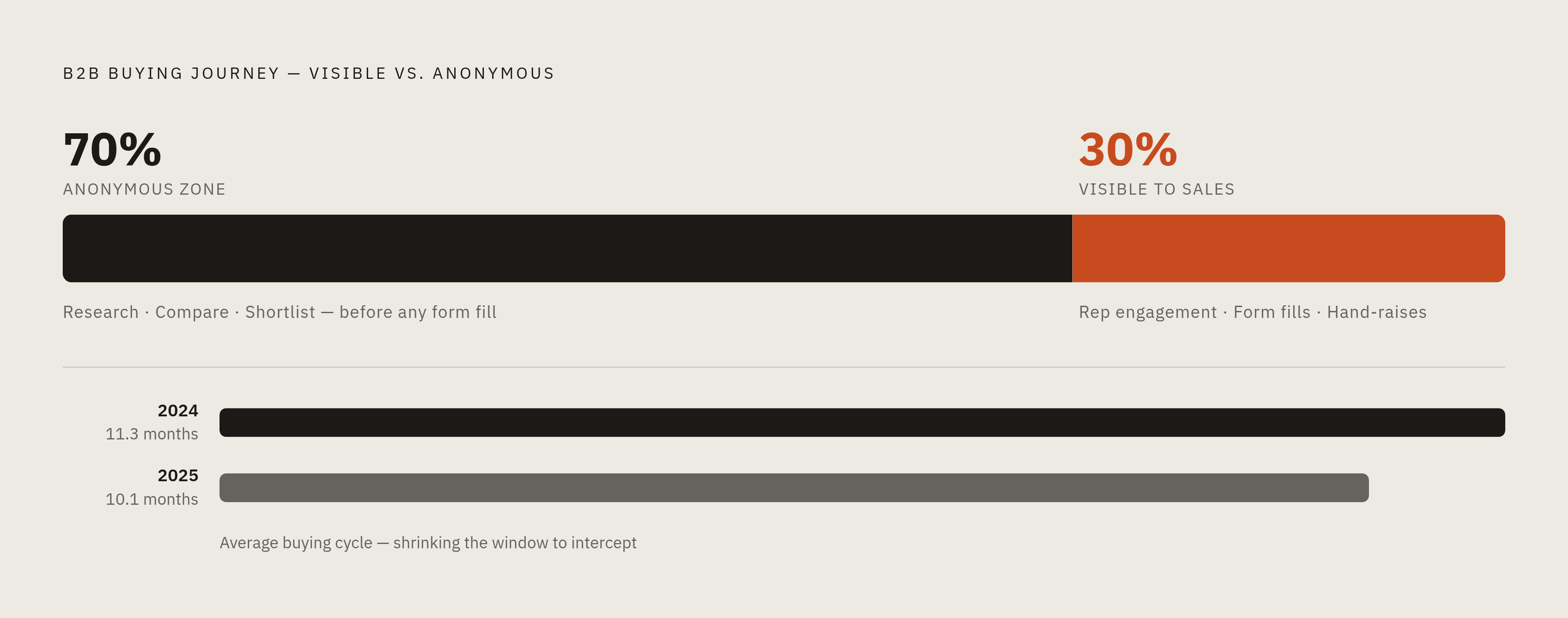
Seventy percent of the B2B buying journey happens anonymously. Buyers are researching, comparing, and shortlisting before they fill out a single form or raise a hand. That's not a small gap in your visibility. That's most of the game happening off your radar.
And it's getting faster. Average buying cycles compressed from 11.3 months in 2024 to 10.1 months in 2025, per the same report. Buyers move faster, which means the window to intercept and influence them is shorter than it was even a year ago.
Teams relying on inbound signals alone are entering deals that are effectively already decided. They're just not aware of it yet.
Intent data is the mechanism for detecting this invisible research. But here's where most teams get it wrong: signal quality is the actual differentiator, not signal volume.
An enormous percentage of intent signals turn out to be unreliable or inflated. Only roughly a quarter of signals convert to qualified opportunities. The edge comes from how signals are filtered and acted on, not from having more of them. Stacking signal types helps significantly. Behavioral intent combined with business-event triggers (funding rounds, headcount changes) combined with first-party website data dramatically outperforms any single source by reducing false positives.
Teams that prioritize outreach based on layered intent signals see measurably better lead conversion rates and shorter sales cycles for accounts reached during active research phases, according to recent market data. The difference isn't small.
When evaluating intent-capable tools, ask:
- What signal sources does the tool aggregate, and does it score composite intent or just surface raw data?
- Can it detect competitor research specifically, not just general category interest?
- How does it route detected signals to the right rep, and how quickly does that happen?
Competitor Intent as the Highest-Leverage Signal in the Stack
A buyer actively researching a competitor is mid-cycle, motivated, and already sold on the category. The only open question is which vendor wins. That situation is categorically different from top-of-funnel outreach, and the playbook should be completely different too.
The rep isn't building awareness. They're trying to change a preference that is already forming. There's urgency here that doesn't exist anywhere else in the funnel.
Here's how competitor intent shows up in practice:
- Review site signals. G2 Buyer Intent tracks visits to competitor profiles, category comparison pages, and alternative-product listings across an enormous base of software buyers. It routes multiple signal types with daily buying stage scoring. When someone is comparison shopping on G2, that's not a vague interest signal. That's a live evaluation.
- Technographic context. TrustRadius (acquired by HG Insights in June 2025) adds what the buyer currently runs in their tech stack to the review-site signal. Knowing who is comparing isn't enough. Knowing what they already use tells you a lot about what they need.
- Business event triggers. Companies that recently raised funding are significantly more likely to be evaluating new solutions. Funding alerts function as a proxy for active vendor evaluation. One data provider puts the multiplier at roughly 2.5x likelihood of adoption.
Demandbase's March 2025 Agentbase launch moved beyond passive signal delivery toward autonomous account engagement. The tool identifies in-market accounts and suggests outreach strategies without waiting for a human to review a report and decide what to do about it. That's the direction the category is moving.
The insight and the action need to be connected. That matters, because a signal that sits in a dashboard while the rep figures out what to do with it is mostly wasted.
When evaluating any platform for competitor intent, ask:
- Does the platform distinguish between general category interest and competitor-specific research?
- How quickly does a competitor-intent signal reach the assigned rep, and in what format?
- Does the tool suggest an action, or does it just log the signal and move on?
That last question is a good filter. Logging a signal is easy. Helping a rep act on it within the window that actually matters is hard.
How to Assess the Major Platforms Against These Four Capabilities
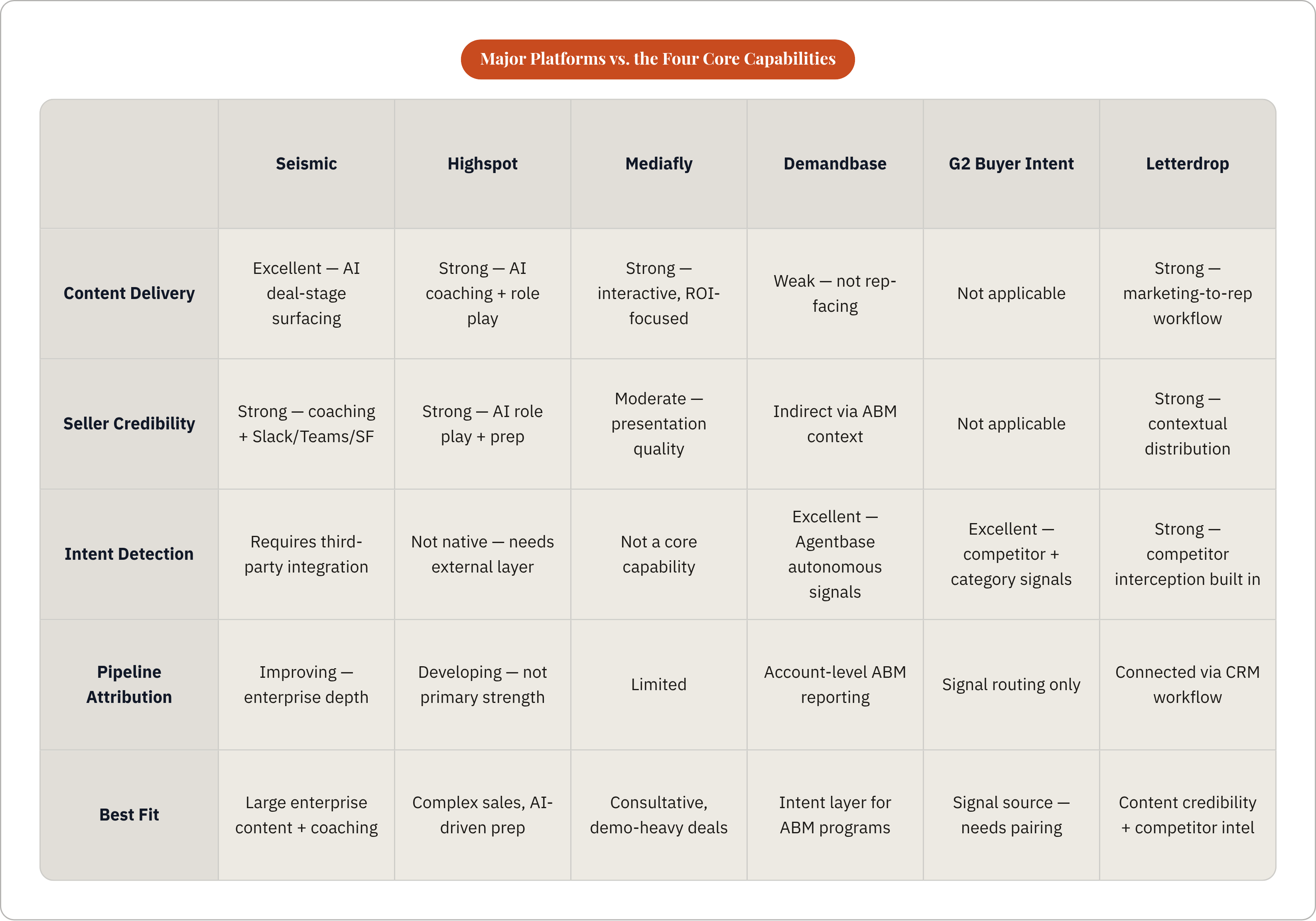
Here's how the major players stack up across content delivery, seller credibility, intent detection, and pipeline attribution. No tool wins every category. Know the trade-offs before you buy.
Seismic
Strong on: AI-driven content surfacing by deal stage and buyer profile. Aura Copilot expanding into Slack, Teams, and Salesforce Agentforce in 2025 gives it deep workflow integration that most platforms still can't match. Content delivery and seller coaching are genuinely excellent here.
Watch for: Intent data requires third-party integration. This is primarily an enterprise content and coaching platform. The customer profile skews large, which means the pricing reflects that. SMB buyers should look elsewhere.
Highspot
Strong on: Content delivery, AI coaching, and AI-powered role play (Summer 2025). The Consensus integration adds interactive demo capability, which is useful for complex sales.
Watch for: Intent detection is not native. You'll need to layer it in through your CRM or an external provider. Attribution reporting is improving but it's not the platform's primary strength yet.
Mediafly
Strong on: Interactive content and ROI-based selling tools. The Appinium acquisition (July 2025) adds LMS capability, which is valuable for buyers who need training and enablement in the same workflow.
Watch for: Intent data and competitor interception are not core to this platform. It's a stronger fit for complex, consultative deals where how you present content matters more than detecting who is researching.
Demandbase
Strong on: Intent detection and ABM orchestration. Gartner Magic Quadrant Leader. The Agentbase launch in March 2025 moves toward autonomous signal-to-action, which is ahead of most of the field.
Watch for: Content delivery to individual reps is not where this platform shines. It works best as an intent layer feeding into a separate rep-facing enablement tool. Enterprise pricing puts it out of reach for smaller teams.
G2 Buyer Intent
Strong on: Competitor and category intent signals sourced from real review and comparison activity across a massive base of software buyers. Nine signal types with daily buying stage scoring. Routes signals into CRM and marketing automation.
Watch for: This is a signal source, not a full enablement platform. It needs to be paired with a tool that can deliver that signal to reps in a usable format with a suggested action attached.
Letterdrop
Strong on: Connecting content creation, seller distribution, and intent detection in a single platform. Marketing publishes, reps distribute, and mid-cycle intent signals (including competitor research) surface to the right rep with context. The gap this closes is the one most teams paper over by stitching together three separate tools with manual handoffs between them.
Best fit for: Revenue teams that want content credibility and competitor interception working together, not as separate workflows. Particularly useful when the marketing-to-sales content handoff is a consistent friction point and when competitor intent is a priority signal.
The Attribution Problem That Makes Most Enablement Investments Hard to Defend
Here's the uncomfortable truth about enablement spending: most of it is hard to defend at renewal time because the measurement is genuinely broken.
A majority of B2B marketers cite difficulty attributing ROI to content efforts as a top challenge, per CMI's 2025 research. Only about one in five describe their content marketing as highly successful. Those aren't great numbers for a category claiming to move revenue.
The measurement gap is structural. It's not just a reporting problem.
Most revenue teams still rely on traditional lead scoring and manual signal tracking. Those methods are static, reactive, and easy to game. They tell you what already happened. They don't tell you what enablement activity caused it.
There's also a buying group problem. Most attribution models focus on a single contact. But B2B decisions involve multiple stakeholders. If your attribution model can't connect individual journeys across an account, you're missing most of the picture.
What good attribution capability in an enablement tool should actually look like:
- Content interaction tied to pipeline stage. Not just opens and clicks. Did engagement with a specific asset precede or accelerate an opportunity moving forward? That's the question that matters.
- Multi-stakeholder tracking within an account. Single-contact attribution is not account-level attribution. They are not interchangeable.
- CRM-connected reporting. The data needs to live where pipeline is managed. Attribution that lives in a separate dashboard, disconnected from the CRM, will not get used consistently, and it will not be trusted by leadership when it matters.
When you're evaluating attribution capability, don't let vendors show you a metrics dashboard and call it attribution. Ask what specific enablement activities connect to specific pipeline outcomes, and ask to see how that data flows into the CRM your team already uses. If they can't answer that cleanly, the attribution story isn't real yet.
The teams that win this category long-term will be the ones that can prove, not just assert, that their enablement investment is doing something to pipeline. That proof requires the right measurement infrastructure from the start, not something bolted on after the fact.