Value-Based Selling Techniques for Complex B2B Deals
Each stakeholder needs a tailored value argument, not a single pitch to the whole room.

Let me be direct: "leading with outcomes" is not a strategy. It's a starting point most sellers mistake for the finish line.
Enterprise buying committees routinely include a dozen or more cross-functional decision-makers. Finance, IT, operations, end users, procurement. Each one has a completely different definition of value. A message optimized for the CFO quietly alienates the ops team. A pitch built around the champion collapses the moment it reaches someone with actual budget authority. Deals stall not because the solution is wrong, but because internal alignment inside the buying group breaks down. That's the structural trap value-based selling has to navigate, and most sellers are walking right into it.
What value-based selling actually requires in a multi-stakeholder context
Here's the real definition. The one that holds up once the deal gets complicated:
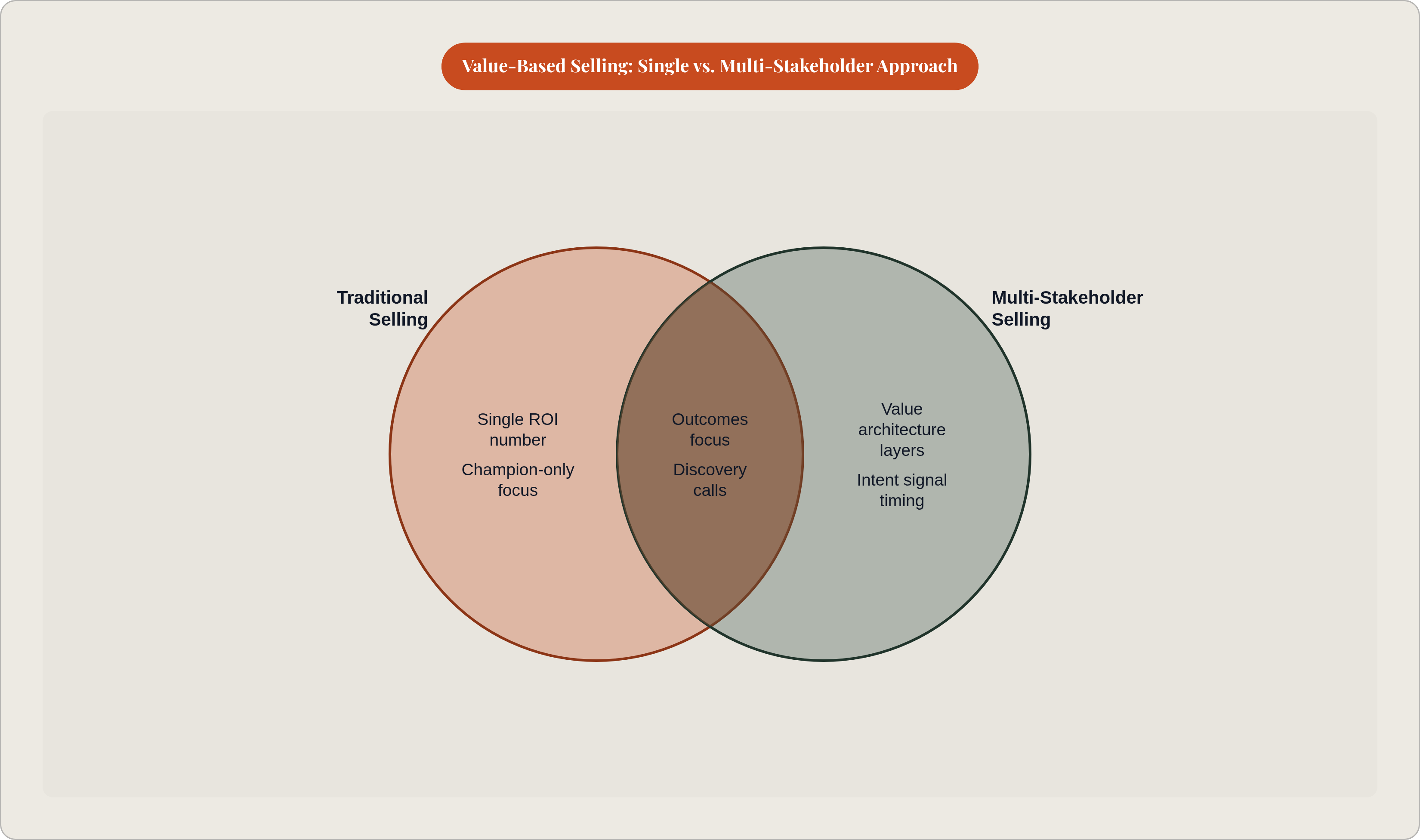
Value-based selling means translating your solution's impact into terms that map to each stakeholder's actual performance criteria, risk tolerance, and political reality.
That's a lot more work than "leading with value."
What it is not:
- A single ROI number presented to the whole room
- A feature list with the word "benefit" glued to the front
- A price justification exercise you save for the negotiation stage
What it actually requires:
- A stakeholder-by-stakeholder read on what each person is trying to protect, achieve, or avoid
- A connected set of arguments that reinforce each other across functions
- Ongoing recalibration, because buyers change their problem definition multiple times during a complex purchase
That last one is where most sellers fall apart. They run a solid discovery call, build a narrative around what they heard, and then ride that narrative straight into a closed-lost. The buying group moved on. The seller never noticed. You can have the right solution and the wrong argument because you stopped listening three months ago.
Imagine a ship's navigator who plots a perfect course on day one, then locks the wheel and goes below deck. The water moves. The wind shifts. The destination drifts. Sellers who fix their value argument at discovery and never look up again are navigating the same way.
Diagnosing what each stakeholder function actually values
The faces change deal to deal. The roles are always recognizable.
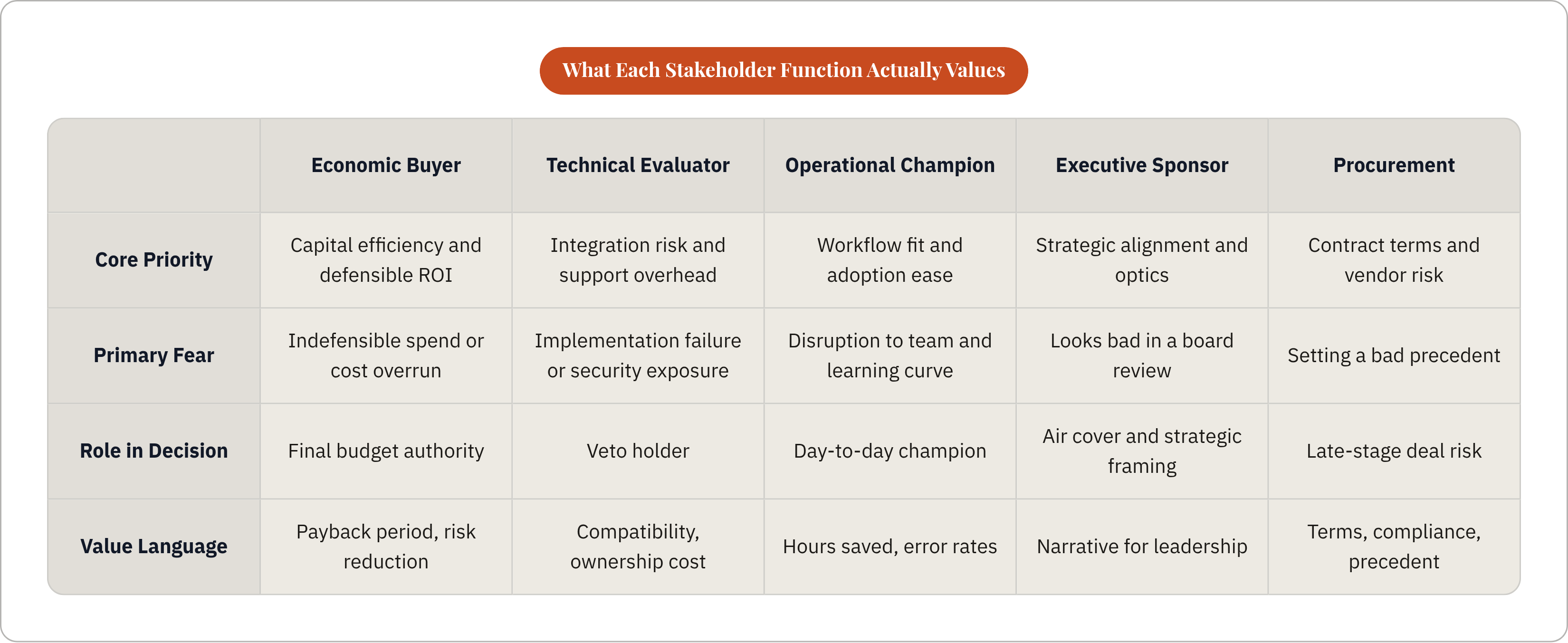
- Economic buyer (CFO, VP Finance): Capital efficiency, risk reduction, defensible ROI. Decision gate, not just an influencer.
- Technical evaluator (IT, security, architecture): Integration risk, implementation burden, support overhead. More veto holder than champion.
- Operational champion (actual users): Workflow fit, learning curve, and whether adoption is going to be a disaster for their team.
- Executive sponsor: Strategic alignment and how this looks six months from now in a board review.
- Procurement: Contract terms, vendor risk, and precedent. Shows up late and can absolutely blow up conversations everyone thought were closed.
For each one, you need answers to four questions:
- What metric does this person get measured on?
- What failure mode are they most trying to avoid?
- Who do they need to justify this to?
- What does "good enough" look like versus "great"?
These answers have to come from direct discovery. You cannot infer them from job titles.
The most common mistake is over-indexing on the champion because they're the person who actually returns your calls. They are often not the person controlling final approval. Sellers build their entire value case around the champion, and it falls apart the moment it reaches the economic buyer, who has completely different criteria nobody bothered to surface. Problem-focused discovery beats solution-focused pitching every time. You see that pattern constantly in deals that go sideways.
Consider a seller who spent six months building a meticulous case for an operations director — workflow diagrams, time-savings models, user testimonials — only to have it land on the CFO's desk like a foreign-language document. The CFO didn't care about minutes saved per transaction. She cared about capital at risk if the implementation ran over. Nobody had ever asked her. The champion assumed. The deal went to a competitor who had done the work to find out.
Building a value architecture that holds across functions
The goal is not a different pitch for every stakeholder. That creates inconsistency, and when stakeholders compare notes (they will), the contradictions erode trust fast.
A value architecture is layered:
- A core strategic claim every stakeholder can agree with in principle
- Functional translations of that claim for each role. Same underlying logic, different vocabulary and evidence
- A shared vocabulary your champion can use when they advocate internally without you in the room
What those translations look like in practice:
- CFO: Capital efficiency, payback period, risk reduction. Not features.
- IT: Implementation effort, integration compatibility, what owning this looks like a year from now.
- Operations: Hours saved, error rates reduced, workflow simplified. Concrete and near-term.
- Executive sponsor: Strategic narrative. How does this decision look in a board review?
The internal champion problem is real. The person most excited about your solution usually has less influence than you'd like. You have to equip them to speak to audiences they don't naturally talk to. That means stakeholder-specific talk tracks and one-pagers, not a single deck you hand them and quietly hope for the best.
The architecture also needs to flex. Buyers revise their own problem statement multiple times during a complex purchase. If your value argument can't absorb those shifts, you end up starting over every few months chasing a target that's already moved.
Multi-threading the deal so value conversations reach the right people
Single-threading a complex deal through one contact is one of the most reliable predictors of a loss. Full stop.
Multi-threading is not about collecting contacts. It's about deliberate coverage of the stakeholder map you built in discovery.
How to thread intentionally:
- Map the buying committee early and identify gaps. Who is shaping this decision but has never spoken to you?
- Use your champion to broker introductions. Cold-reaching stakeholders without a warm handoff can backfire politically.
- Show up with the right message for each new contact. Not a repeat of the champion's pitch. Their pitch.
- Track engagement across all contacts. Silence from a key stakeholder is a signal worth acting on.
The CFO multi-thread deserves specific attention. Most significant B2B purchases require CFO approval, yet the CFO typically gets introduced late. By that point the value conversation has already been shaped by others, and it usually won't survive scrutiny at the financial level. Get in front of the economic buyer early, or get someone who speaks their language in front of them before the deal gets to budget review.
Multi-threading also creates resilience. If your champion leaves or loses internal influence, the deal doesn't die with them. A deal with one thread is like a chair with one leg — it stands until it doesn't, and when it goes it goes fast.
Staying relevant as the buying group's priorities shift mid-cycle
Sales cycles are long. Long enough for budgets to change, leadership to turn over, and the original problem definition to become something nobody on the buying group fully remembers. Deals above a certain revenue threshold routinely run for many months.
Buyers revise their problem statement repeatedly during that time. Value arguments anchored to the first discovery call can become irrelevant without the seller ever noticing. You end up making a compelling case for a solution to a problem the buyer stopped caring about two quarters ago.
Practical ways to stay calibrated:
- Scheduled re-discovery checkpoints. Brief, structured conversations at key intervals to ask whether priorities have shifted. Not a status call. An actual conversation.
- Trigger event monitoring. Leadership changes, budget announcements, competitive moves, or product launches at the buyer's organization all signal that the value conversation needs revisiting.
- Content as re-engagement. A relevant piece of analysis or a well-timed case study can reopen a stalled conversation without the awkwardness of a cold follow-up.
Stalling is worth understanding correctly. It's usually not a price objection. It's a symptom of internal misalignment inside the buying group. Sellers who align on the problem definition with the buyer, rather than racing to present the solution, consistently see higher win rates. That recalibration work is not a soft relationship activity. It is a direct win-rate lever.
How intent signals help sellers time value conversations to actual buying activity
Here's an underrated problem: sellers deliver value arguments when it's convenient for them, not when the buying group is actually in decision mode.
Intent signals fix that. When an account is actively visiting review sites, reading competitor comparisons, or consuming category content, those behaviors indicate a live buying cycle. A buyer mid-evaluation is far more receptive to a precisely framed value argument than one in passive research mode. The same message lands completely differently depending on where the buyer actually is in their process.
Competitor intent is especially useful. When a buying group is actively evaluating a competitor, they've already defined the problem. They've already agreed internally that something needs to change. Sellers who intercept at that moment enter a pre-qualified value conversation. The pitch becomes comparative by nature: not just "here is what we do," but "here is what we do that the alternative doesn't, in terms that matter to your specific role."
The operationalization challenge is real. Access to intent data doesn't automatically translate to better timing. Without a clear response protocol, signals expire unused. Each signal type should trigger a specific outreach with a role-appropriate value framing attached. Not a generic follow-up. Speed matters too. Response time from signal to outreach is a measurable variable with real impact on conversion.
Some platforms support this interception logic by helping sellers connect content and value framing to the specific moment an account is actively evaluating alternatives. That connection between content and buying activity is a different and more useful output than a raw list of accounts showing general category interest.
What thought leadership content does that a sales pitch cannot
A significant share of the buying journey happens before a seller is ever contacted. Stakeholders are forming views, ranking vendors, and shaping the problem definition long before a discovery call gets scheduled. If your value argument only exists inside a sales conversation, it's arriving too late for the people who already did their research independently.
Thought leadership reaches the buying committee during the anonymous research phase. C-suite decision-makers regularly report that strong thought leadership has prompted them to reconsider an existing vendor or research a solution they hadn't previously considered. Most sellers are not taking that opportunity seriously.
The trust gap matters here. Decision-makers trust independent analysis and peer perspectives more than vendor-produced materials. Thought leadership that reads like genuine analysis earns more credibility with skeptical stakeholders than anything that smells like a brochure. This is not a branding observation. It's a practical one with measurable deal impact.
What this means for content design:
- Content should speak the value language of specific functions. A CFO-oriented piece on financial risk is a different asset from an operations-oriented piece on implementation complexity.
- Generic best-practices content doesn't move the needle. Most decision-makers report that most thought leadership they consume fails to give them anything genuinely useful. Actual insight is the differentiator.
- Distribution is as important as creation. Content must reach the right stakeholder function through the channels they actually use during research.
Sellers backed by a recognized content program arrive in conversations with credibility already established. The value argument starts from a higher baseline, and that compresses the credibility-building work that currently adds months to complex cycles.
The organizational alignment that makes value-based selling executable at scale
Here's where it all breaks down at the company level. Not because sellers lack skill, but because the infrastructure isn't built for it.
Value-based selling fails at scale when:
- Marketing builds personas and messaging that sales never uses because it doesn't match what sellers actually hear in the field
- Sales has no access to content assets mapped to specific stakeholder functions at specific deal stages
- Intent signals sit in a marketing platform and never reach the seller with a clear action attached
- Win/loss learning stays inside the sales org and never informs the content roadmap
The alignment requirement is structural, not cultural. Shared definitions of in-market accounts. Shared content mapped to deal stages. Shared feedback loops between what sellers hear and what marketers produce.
Practical integration points:
- A stakeholder-specific content library organized by function and deal stage. Not by product feature.
- Intent signal routing that connects account-level activity to the seller responsible for that account, with a suggested value framing attached. Not just a notification.
- A regular cadence where sales surfaces objections and value questions that marketing converts into content.
Teams with real account-based practices measure what actually matters: how content influences deal velocity and deal size. That enables continuous improvement rather than one-time campaign optimization.
The output of genuine alignment is straightforward. Sellers arrive in multi-stakeholder conversations already equipped with the right value argument for each function. Some of those stakeholders have already encountered the content independently. The credibility-building work that currently adds months to complex deals is done before the first meeting. That's what makes value-based selling executable at scale, and it's what separates the teams that win complex deals from the ones that keep wondering why their perfectly good solution keeps losing.