Demand Generation Campaign Structure for B2B Revenue Teams
Buyers make 69% of their decision before talking to sales, so demand gen must intercept earlier.

Most demand gen programs are built around the moment a buyer raises their hand. The problem is, by the time that hand goes up, the decision is basically already made.
Buyers are 69% through their purchasing process before they ever talk to a vendor rep. The comparing, the ranking, the preferring. All of it happens in places your demand gen team cannot see. Form fills and MQL thresholds are not capturing buyers mid-consideration. They are catching the tail end of a decision that is already substantially made.
It gets sharper. 94% of buying groups have already ranked their preferred vendors before first contact with sales, and they purchase from that preliminary favorite 77% of the time. Being absent at shortlist formation is not a nurture problem. It is structural exclusion from the deal before the deal even has a name.
So the campaign architecture has to change. Not tweaked. Rebuilt around intercepting buyers during evaluation, before a vendor shortlist locks in. Because once it locks in, you are not competing. You are auditioning for a role that was already cast.
ICP Precision Is Load-Bearing, Not a Kickoff Exercise
Most teams treat ICP definition as something you do once at the start of a project, nod at the output, and move on. In an intent-first structure, that is a mistake with real consequences. ICP precision is the foundation everything else sits on. Every channel decision, every budget call, every content type gets correlated back to which ICP accounts are in-market right now.
The campaign architecture starts with revenue targets and pipeline coverage ratios. You work backward from what you need to close, through conversion factors, to what pipeline coverage has to look like, to which in-market accounts can actually fill it. Audience personas are useful. They are just not the starting point. Working backward from revenue forces you to be honest about the gap between the accounts you want to reach and the accounts you can actually reach right now.
Replace MQL with High-Intent Accounts
MQLs measure activity. A downloaded ebook, a webinar registration, a form fill. That activity does not reliably signal purchase readiness. High-Intent Accounts are identified by behavioral signals of active evaluation, not just content consumption.
The practical consequence: sales only engages accounts that have cleared an intent threshold. Not volume-based lead counts. This makes the sales team more efficient, and it also means they stop chasing form fills from people who downloaded a guide out of curiosity and have no buying authority. That last part sounds obvious. Most orgs are still doing it.
Two Failure Modes That Show Up Almost Everywhere
The first is too many ICPs and too many channels at once. The complexity dilutes signal quality and execution quality simultaneously. You end up with thin presence everywhere and meaningful presence nowhere. Spreading budget across six channels to "stay visible" is how you become invisible on all six.
The second is only competing for the 5% of buyers actively searching right now. Every competitor is chasing the same 5%, on the same channels, with similar messages. The win rate in that environment is brutal, and the cost per acquisition reflects it.
What the Campaign Portfolio Actually Contains
An intent-first portfolio is not all demand capture. It is a deliberate mix.
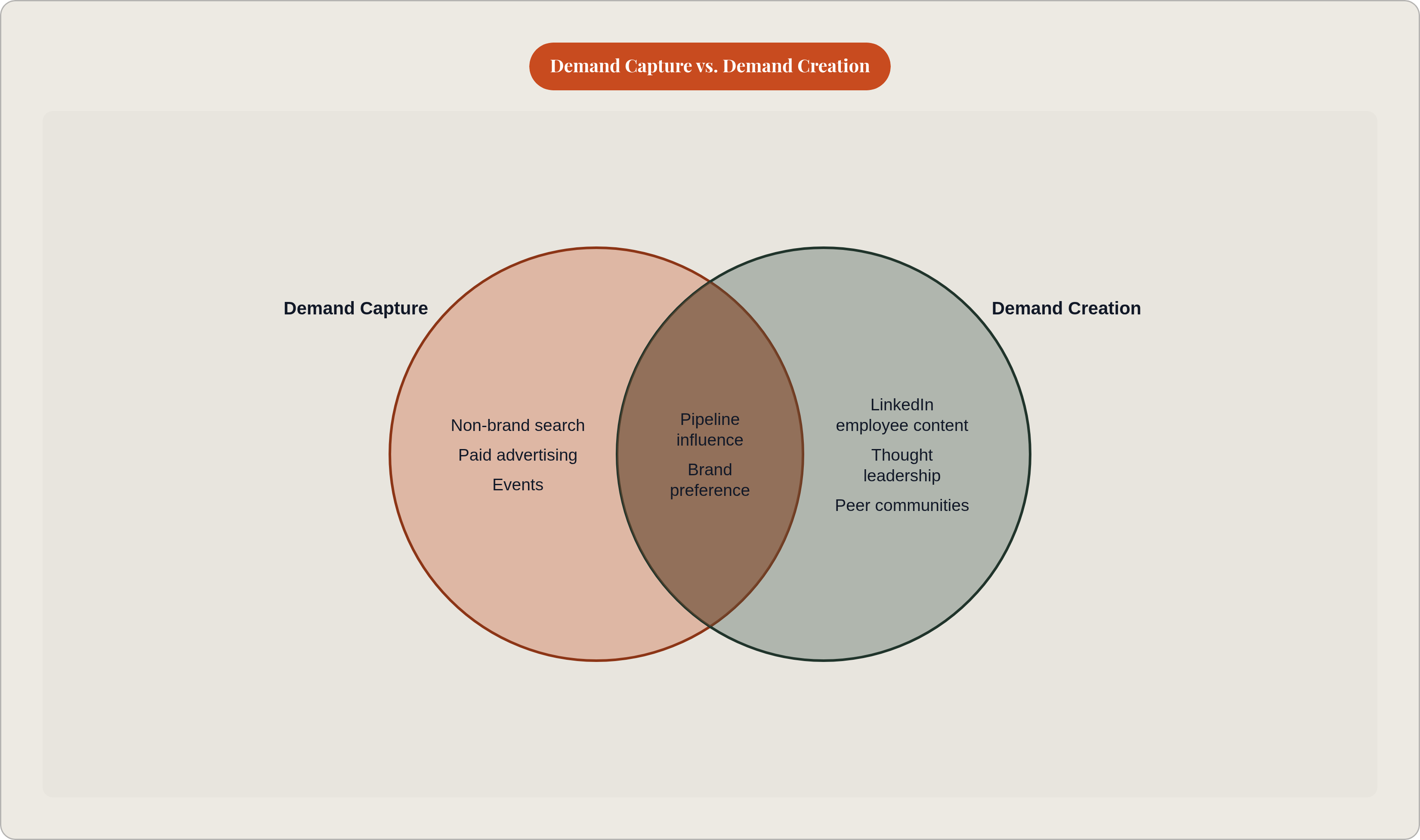
Demand capture covers non-brand search, events, and paid. These reach buyers in active evaluation.
Demand creation covers LinkedIn employee content, thought leadership, and peer community presence. The purpose is to shape preference before the evaluation phase begins, so that when a buyer does enter a recognizable buying motion, your brand is already in the mix.
Both matter. Demand creation without capture is just brand spend. Capture without creation means you are only competing for buyers already in market, which puts you right back in the 5% problem.
The Metrics That Actually Tell You If It Is Working
- LTV:CAC: targeting 3:1 to 5:1
- CAC payback: under 12 months
- Pipeline coverage: 4x or higher
- Win rate by marketing influence: marketing-touched deals versus non-touched deals
- Pipeline velocity: opportunities multiplied by win rate multiplied by deal size, divided by sales cycle length
On attribution: in a cookieless environment, last-touch is not just incomplete. It is actively misleading. Triangulate with blended multi-touch attribution and media mix modeling. Last-touch undercounts content's contribution across a long cycle almost every time, and if you build your strategy around it, you will defund the things that are actually working.
How Intent Signals Are Read and Where They Break Down
The B2B buyer intent data market is large and growing fast. Adoption is accelerating. What is not necessarily keeping pace is reliability, and the gap between those two things is where a lot of programs quietly fall apart.
The Three Signal Layers
First-party signals are your own site data: content consumption, pricing page visits, demo requests. Highest reliability. Smallest coverage. These are valuable, but there are not enough of them to run a program on their own.
Second-party signals come from review sites like G2 and TrustRadius. Verified buyer behavior, particularly useful for competitive intelligence. G2 captures signal types including Alternatives, Compare, and Competitive signals from a very large base of software buyers. When someone is on a competitor's G2 alternatives page, that is not ambient research. That is active evaluation happening in real time.
Third-party signals from data co-ops cover broad publisher networks. The coverage is wide, but quality degrades. The signal is noisier, and you will feel that in conversion rates downstream if you are not layering it carefully.
The Dark Funnel Problem
A growing share of early-stage research now happens inside ChatGPT, Perplexity, and Google AI Overviews. None of that is visible to any of the three signal layers above. Intent platforms are reading an increasingly partial picture of actual buyer behavior.
This is not a reason to abandon intent data. It is a reason to be honest about what it can and cannot see. If you treat the data as complete, you will make confident decisions based on an incomplete map, and the confident part is what makes it dangerous.
The Reliability Problem
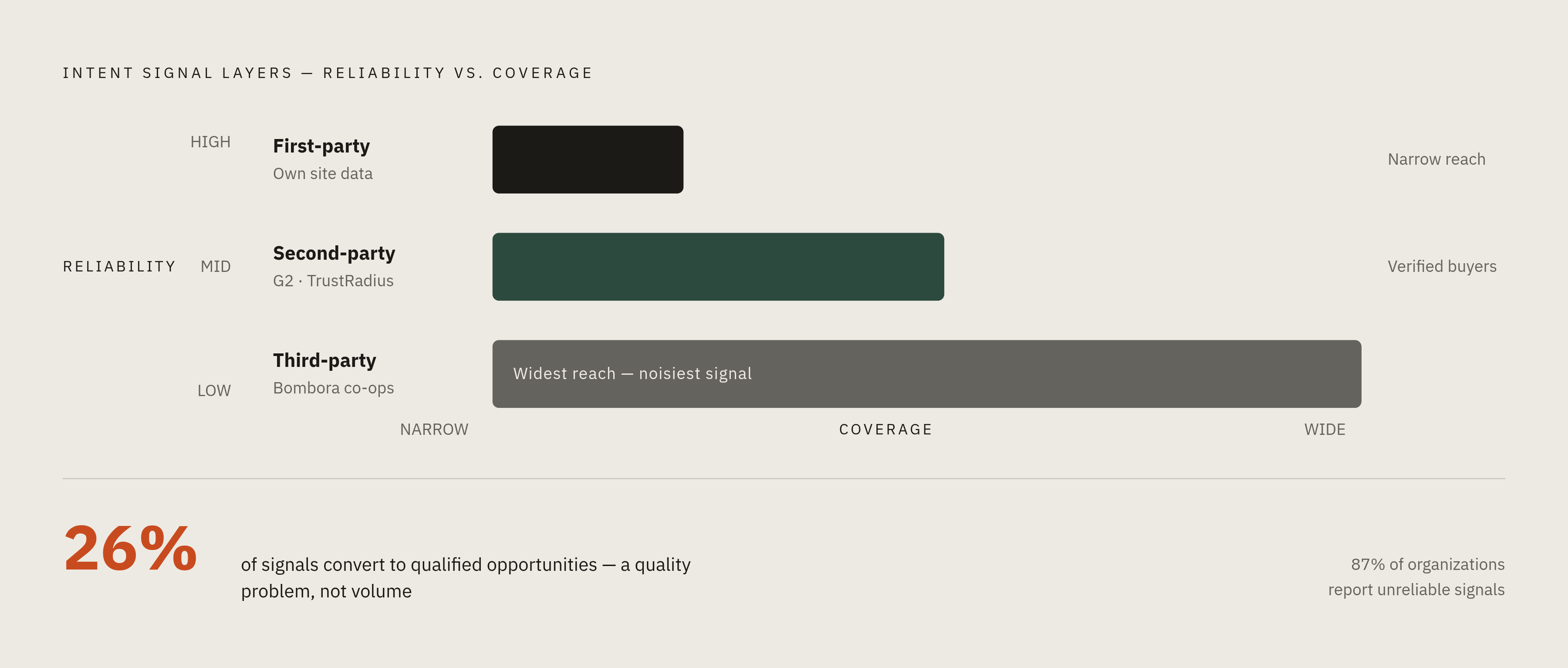
87% of organizations report unreliable or inflated intent signals, and only 26% of signals convert to qualified opportunities (DemandScience, State of Performance Marketing). That is a sobering number, and it should recalibrate how much weight you put on any single source.
This is not an argument against intent data. It is an argument against relying on any single signal source. Layering behavioral intent signals with business-event signals and first-party website activity dramatically reduces false positives. One signal is a hypothesis. Three corroborating signals are a reason to act. That distinction matters more than most people realize when they are first setting up the system.
What Signal Interpretation by Buying Stage Actually Enables
Early-stage awareness signals warrant content delivery, not sales outreach. A buyer at the top of the funnel who gets a call from a sales rep is not a warmed lead. They are an annoyed prospect who now associates your brand with bad timing.
Mid-funnel signals, something like third-party research on a category term combined with a first-party guide download, warrant a coordinated sequence. Coordinated, not immediate.
Late-stage signals, a pricing page visit, an alternatives page hit, a competitor comparison, those warrant direct sales engagement within hours. Not days. The window at that stage is real and it closes faster than most sales teams move. This is one of those places where the process matters as much as the strategy.
What the Data Shows When Intent Prioritization Actually Works
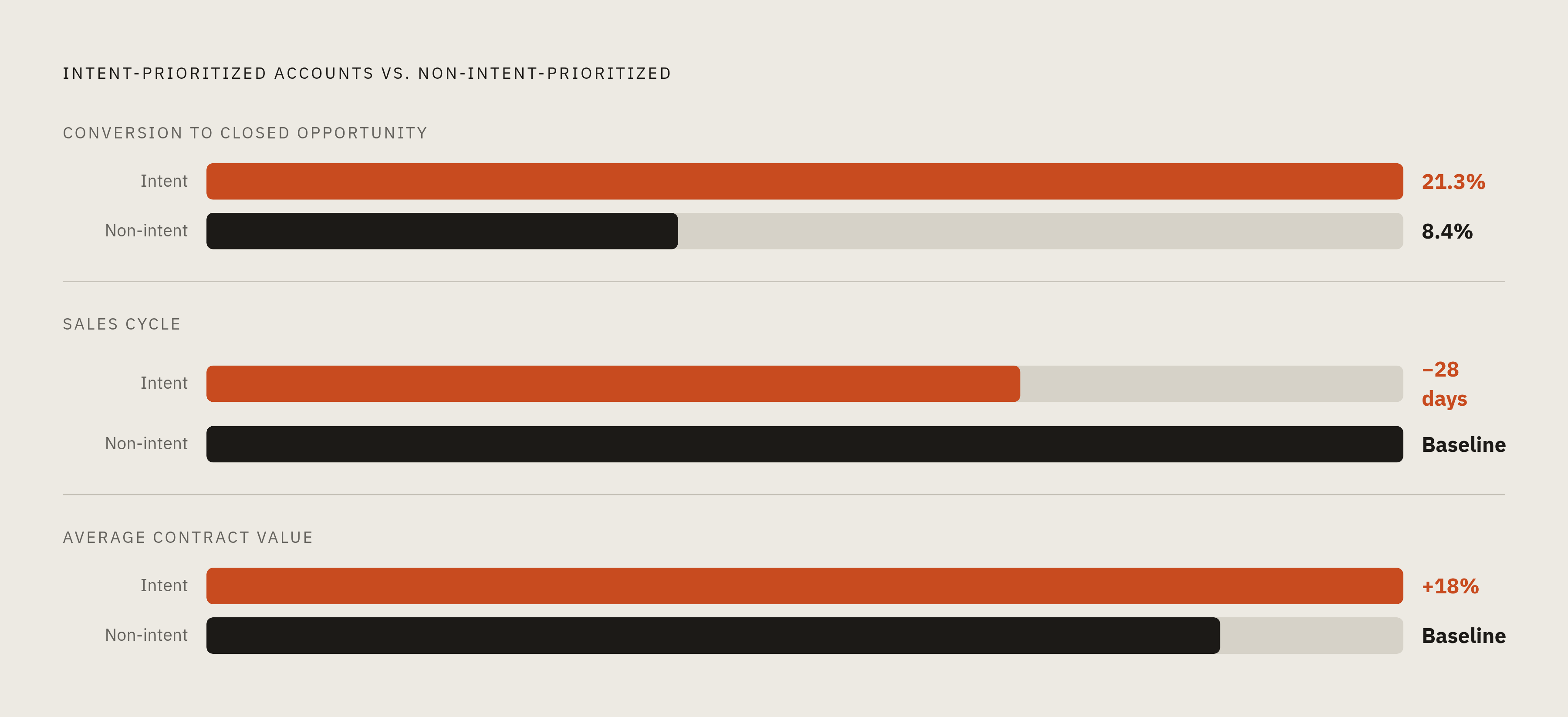
Intent-prioritized accounts converted to closed opportunity at 21.3% versus 8.4% for non-intent-prioritized accounts. Median sales cycles compressed by 28 days. Deals carried 18% higher average contract value. Those are not marginal gains. The compounding effect across a full year of pipeline is significant enough that the retooling investment usually looks obvious in retrospect, even when it feels like a lot up front.
The Highest-Leverage Interception Moment: Buyers Actively Evaluating a Competitor
Competitive displacement is not harder than net-new prospecting. It is structurally easier, and most teams are underinvesting in it.
The buyer has already committed budget. They validated the category internally. They went through an approval process. The selling work you would normally do in a net-new motion is partially done for you. Well-executed displacement campaigns convert at roughly 3x the rate of net-new prospecting, and those customers tend to carry higher lifetime value. Despite this, most demand gen programs treat displacement as a secondary motion rather than a primary one. That is backwards.
The Signal Stack for Competitor Targeting
You are layering three things.
Technographic data identifies which accounts are running a specific competitor's technology. Adoption dates let you model when renewal windows are likely to open.
Intent signal analysis layers on top of that. Which of those accounts are now researching competitive comparison terms? Who is visiting alternative solution pages? Who is showing product evaluation behavior?
Review site signals from G2, Capterra, and Clutch, specifically Alternatives, Compare, and Competitive signal types, surface accounts in active competitive consideration right now.
Stack all three and you have a specific, actionable list. Not a broad audience. Accounts in a particular moment that you can actually reach with something relevant. The difference between a broad ABM list and a signal-stacked list is the difference between fishing in a lake and fishing where someone just told you the fish are.
Segmenting by Intent Intensity
Not every competitor's customer is in the same moment.
- High intensity: actively seeking alternatives. Immediate multi-channel engagement.
- Moderate: researching but not urgently. Content-led nurture with a sales alert queued.
- Low: using the competitor, appears stable. Low-touch monitoring until a trigger event fires.
Treating all three the same wastes both sales time and budget. The high-intensity accounts get diluted attention they deserved more of. The low-intensity accounts get pressure that pushes them away before they were ready to move. Most teams default to treating the list as uniform because segmenting it requires more setup. That setup pays for itself quickly.
Timing the Renewal Window
Most B2B SaaS contracts renew annually. The evaluation window opens 60 to 90 days before renewal. Set alert thresholds at 120, 90, and 60 days before the estimated renewal date. The 90-day mark is your primary outreach window.
There is another trigger worth watching: a new VP of Sales, CRO, or Head of RevOps joining a competitor's customer account. New executives evaluate the existing tech stack within their first 90 days. Almost universally. It is not a rough guess. It is a pattern that repeats reliably enough to build a playbook around, and once you have seen it a few times you start watching for leadership changes the same way you watch for renewal signals.
Review Mining as Displacement Intelligence
Competitor reviews on G2 and Capterra surface the specific, recurring frustrations that the vendor's own marketing will never acknowledge. These are not vague dissatisfactions. They are documented, specific, and shared publicly by people who are currently using the product.
The messaging principle: name the specific frustration the prospect already feels. Not "we're better than Competitor X." A demonstration that you understand their situation better than the vendor they are currently paying. That is a very different conversation, and it lands very differently. Signal-personalized outreach earns reply rates in the 15 to 25% range versus 3 to 5% for generic cold outreach. When multiple signals are stacked with context, that number climbs further.
Multi-Threading Displacement Campaigns Across the Buying Committee
A displacement campaign that only reaches one person at an account is not really a displacement campaign. It is cold outreach with good intent data behind it.
The average B2B deal involves 10 or more stakeholders. In a displacement scenario, the incumbent vendor already has relationships with many of them. The existing champion will often actively resist switching. You are not just selling. You are overcoming internal inertia from people you have never met and who have no particular reason to want this change. That is the actual job, and single-threaded outreach is not built for it.
Minimum viable multi-threading: at least three engaged contacts across different roles.
Role-Specific Messaging
Each role cares about different things. This is obvious. Most campaigns ignore it anyway, usually because building three message tracks is more work than building one, and under deadline pressure, one wins.
Economic buyer: total cost of ownership, switching risk, renewal cost escalation patterns. They want to know what this costs them either way, including the cost of staying put.
Practitioner and end user: specific workflow frustrations surfaced from competitor reviews, feature parity or gap analysis. They want to know if it actually works better for the things they do every day.
IT and security: integration compatibility, implementation timeline, support quality signals. They want to know this will not just create a new set of problems to manage.
Content Sequencing for Multi-Threaded Displacement
Entry-point content should surface a specific competitor frustration. Not a generic comparison page. Something that speaks to the exact pain point you know this segment of their user base is experiencing.
Comparison content earns the highest pipeline influence among buyers already in active evaluation. It reaches fewer people, but the people seeing it are actively buying. That is a favorable tradeoff, and most content calendars do not reflect it.
Social proof gets sequenced by role. Practitioners respond to peer case studies. Economic buyers respond to ROI data. These are not interchangeable, and swapping them does not produce the same result. Getting this wrong is one of the more common ways a well-structured multi-threaded campaign stalls out in practice.
Re-Engaging Stalled Deals
Intent data surfaces renewed research activity, review site engagement, and competitor comparison queries from accounts that went dark. This gives sales a triggered, specific reason to reconnect. Not a "just checking in" email. A message rooted in actual signal: we noticed something relevant to you, and here is why we are reaching out now. That framing changes the dynamic of the outreach entirely. Sales reps who have tried both versions will tell you the difference in response rate is not subtle.
How Content Earns Its Place in an Intent-First Structure by Connecting to Pipeline, Not Traffic
56% of B2B marketers cite difficulty attributing ROI to content as a top challenge, and only 21% say they can measure marketing ROI with confidence (CMI, 2025). Those numbers explain why content strategy defaults to traffic metrics. Traffic is measurable. Pipeline influence is not, unless you build the infrastructure to measure it. Most teams skip the infrastructure and then wonder why leadership keeps questioning the content budget.
Why Last-Touch Attribution Gets This Wrong
B2B buyers engage with more than 27 touchpoints across extended sales cycles. Last-touch assigns credit to the final interaction and ignores everything that built the preference up to that point. It systematically undercounts the work content does in the middle of a deal, which means the content that actually moves pipeline tends to be undervalued and underfunded. 67% of B2B marketing teams still rely on last-touch attribution (RevSure). That is part of why the problem persists, and why the content team is often the last one invited to the pipeline conversation.
The Insight That Should Reorient Your Content Strategy
Run a quarterly content performance review ranked by pipeline influence, not traffic. Almost every time, the top five traffic pieces and the top five pipeline-influence pieces are completely different lists.
High-traffic content tends to be early-stage awareness content. It reaches a lot of people, most of whom are not buying right now.
High-pipeline-influence content is comparison content, solution-specific content, and case studies. It reaches fewer people. Those people are actively evaluating. That difference matters enormously for how you prioritize content creation and distribution budget, and most content teams are optimizing for the wrong list. Not because they do not know better, but because traffic is easy to report and pipeline influence requires setup they were never asked to build.
The Metrics That Actually Connect Content to Revenue
- Pipeline influenced by content
- Time-to-close for prospects who engaged with content versus those who did not
- Win rate by marketing influence
- Customer acquisition cost by content channel
Thought Leadership as a Demand Creation Lever
Thought leadership influences vendor shortlisting and shapes buyer preferences during the invisible evaluation phase (Edelman-LinkedIn, 2025). LinkedIn employee creator content functions as persistent signal in channels your tracking tools cannot see. It reaches buyers in the feeds they are already reading, before they enter any recognizable funnel. This is not brand vanity. It is presence at the moment when preferences form, and it is one of the few levers that actually operates in the dark funnel. Which, given how much of the buying process now happens there, is worth taking seriously.
Distribution Is as Strategic as the Content Itself
Content that cannot reach buyers during the evaluation phase has no pipeline influence, regardless of quality. Distribution to the channels where evaluation actually happens, LinkedIn, review sites, AI-indexed sources, peer communities, is a strategic decision that needs to be made alongside content creation, not after it. The "we'll figure out distribution later" approach is how good content dies quietly with no measurable impact.
Connect Content to CRM, or None of This Works
Tagging content interactions in CRM against opportunity records, not just contacts, is what makes pipeline-influence reporting possible. Without that structural connection, content performance defaults back to traffic metrics and MQL proxies. The measurement infrastructure has to exist before the reporting can be trusted. Build the plumbing first. The insights follow. This is the part that usually gets skipped because it is unglamorous and requires cross-functional coordination, and it is also the part that determines whether any of the other work in this section is actually visible to the people who control the budget.
Building the Operational System That Sustains Intent-First Demand Gen Beyond the First Campaign
This is where most intent-first programs actually break down. Not in the strategy. In the operating system that is supposed to run it week after week, quarter after quarter, without someone having to reinvent it every time there is a personnel change or a missed quarter.
Alignment on What Readiness Means
Intent-first demand gen fails if sales and marketing are operating on different definitions of readiness. The HIA threshold, the signal types that trigger sales engagement, the timing of handoff. All of that needs to be defined together and agreed upon by both teams before the first campaign launches.
When sales and marketing define readiness differently, two things go wrong. Marketing passes accounts that sales will not touch. Or sales starts reaching out to accounts that are not ready, burning goodwill and signal. Neither outcome is recoverable without fixing the underlying definition problem. You can swap tools, rewrite messaging, and restructure the campaign. If the definition is still misaligned, the result will be the same. This is one of those situations where the people problem is dressed up as a process problem, and the fix requires actually sitting in a room together and agreeing on something specific.
The Review Cadence That Prevents Drift
Intent signal quality degrades over time. ICP definitions evolve as market conditions change. Messaging that worked in Q1 stops working in Q3. The operational system needs a structured cadence for reviewing signal quality, account coverage, and campaign performance against pipeline metrics.
Not a monthly email update. An actual review process with defined owners, specific inputs, and decisions that get made as a result. The difference between those two things is the difference between a program that compounds and one that slowly loses altitude until someone calls for a reset. Most teams know this. Most teams still default to the email update because it requires less coordination, and then six months later they are doing a postmortem wondering why the results stalled.
Technology Does Not Fix an Alignment Problem
The intent data platforms, the orchestration tools, the attribution software. All of it amplifies what your team does. It does not substitute for clear definitions, shared metrics, and a feedback loop between sales and marketing that is actually used.
The teams that get the most out of intent-first programs are not necessarily the ones with the best tools. They are the ones where sales and marketing are genuinely operating from the same information, toward the same outcome, and actually talking to each other about what is working and what is not. That last part sounds simple. In practice, it is the hardest part of the whole system to maintain, and it is the part that determines whether the results compound over time or reset every quarter.