Sales Enablement Strategy for Revenue-Focused Marketing Teams
Marketing must shape buyer preference before sales ever gets on the phone.

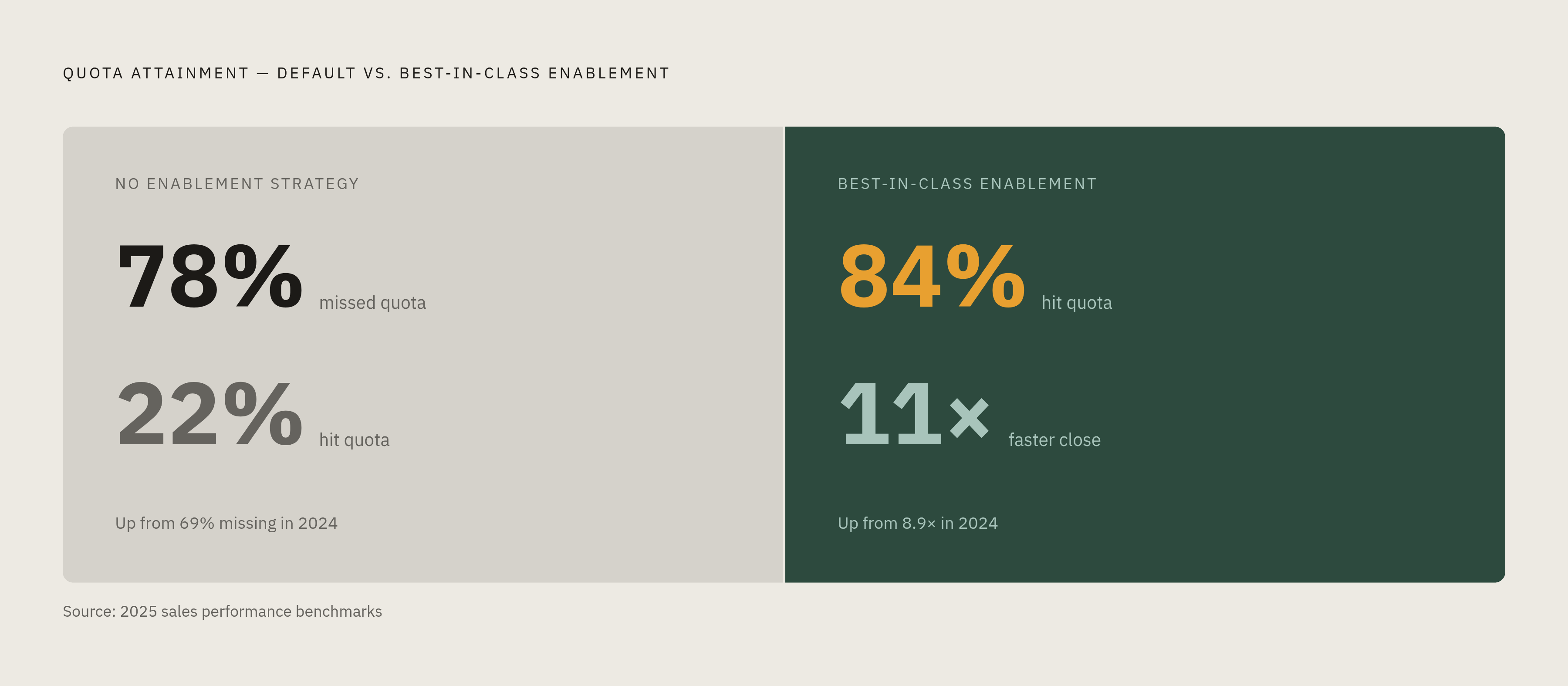
Start with this: in 2025, 78% of salespeople missed quota. That's up from 69% the year before, pulled from Ebsta and Pavilion's GTM Benchmarks Report covering $48 billion in pipeline data. Not a blip. One good quarter at one company this was not.
The reflex response is always the same. Look at the sales org. More coaching. Better territory splits. Tighter forecast calls. None of that is wrong exactly. But it's the equivalent of treating a cough while ignoring the pneumonia.
Here's what's actually going on under that number:
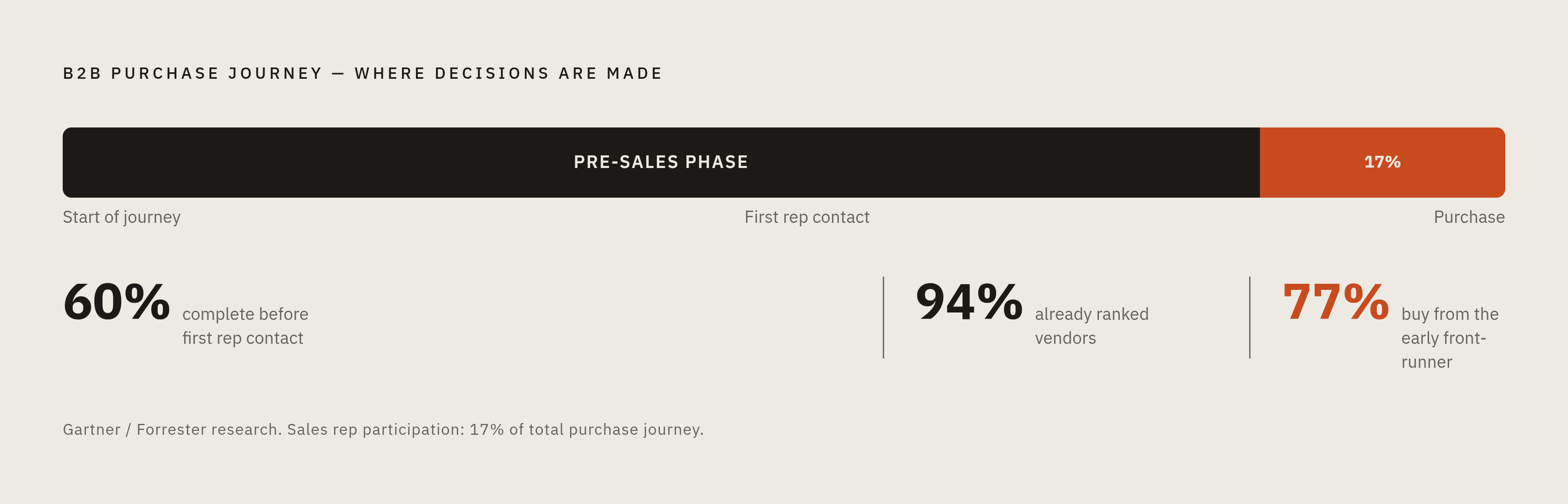
Tools that surface competitor intent signals for sales teams exist precisely because of what the data shows next.- Buyers now complete roughly 60% of their buying journey before they ever talk to a rep
- 94% of buying groups have already ranked preferred vendors before first contact
- 77% of buyers purchase from whatever vendor earned that early top spot
- B2B buyers spend only 17% of their total purchase journey talking to salespeople
By the time a rep gets on the phone, the ranking is basically set. The preference is formed. And the window where all of that happened? Marketing either showed up and shaped it, or it didn't show up at all.
Sales enablement has long been treated as a training problem that lives under the CSO. Onboarding decks. Call coaching. Rep certifications. That work matters. But the bigger failure isn't rep behavior during the meeting. It's what's already happened in the buyer's head before the meeting is ever scheduled. That's the gap. And marketing is the only function positioned to close it.
Revenue-focused marketing shapes buyer perception and equips sellers before the first conversation starts. That's a different job than what most marketing teams are currently hired to do. The 78% miss rate is, in part, the bill coming due.
What Sales Enablement Actually Means When Marketing Owns It
There's a version of this that sounds great in a strategy deck and does nothing useful by Thursday.
"Sales enablement is a shared revenue function." Fine. But what does marketing actually do differently on Monday morning?
Most organizations land here: 64% say their enablement strategy spans all revenue teams, yet fewer than one in four consider their approach truly unified. Broad in name, siloed in practice. Marketing says enablement is a shared priority. Sales says marketing sends them content nobody uses. Both are right. That's the uncomfortable part.
The old model treats enablement like an internal training program. Onboarding, certifications, call coaching. Useful, but that's not the problem marketing is positioned to solve. When marketing owns enablement in a real way, the work looks like this:
- Building and maintaining the assets sellers use in active deals. Not just blog posts. The one-pager a rep drops into an email thread when the buyer asks, "Why should we choose you over the incumbent?" at 4pm on a Tuesday.
- Feeding intent signals to sales. Which accounts are actively researching your category right now, and which ones are quietly evaluating your competitors.
- Owning competitive intelligence. Battlecards, comparison content, objection frameworks. And actually keeping them current, which is harder than writing them in the first place.
- Creating thought leadership that builds seller credibility before any formal meeting happens. So when the rep shows up, the buyer already has a sense of who these people are.
The distinction that actually matters is content that generates traffic versus content that moves deals. A buyer who downloads a whitepaper and never converts is a traffic metric. A buyer who reads a case study during active evaluation and then brings it into their internal stakeholder meeting is a pipeline metric. Marketing's enablement job is the second one. Most marketing teams are building for the first one.
About half of sales enablement professionals report no real C-suite alignment on which success metrics matter (Sales Enablement Collective, 2025). That's partly a definition failure. If leadership doesn't understand that marketing's enablement output should be measured in pipeline influence and deal velocity, it gets measured in page views by default. Then everyone wonders why marketing isn't contributing to revenue. The wrong thing is being measured. The gap between what marketing produces and what sales actually needs stays exactly where it is.
How Buyers Signal Purchase Intent Before They Contact Sales — and How Marketing Reads Those Signals
Intent data sounds almost too good to be true when you first hear about it. The idea that you can identify which companies are actively researching your category before they ever visit your site or fill out a form.
It's real. It's also widely misused, and it's more complicated in practice than any vendor pitch will tell you up front.
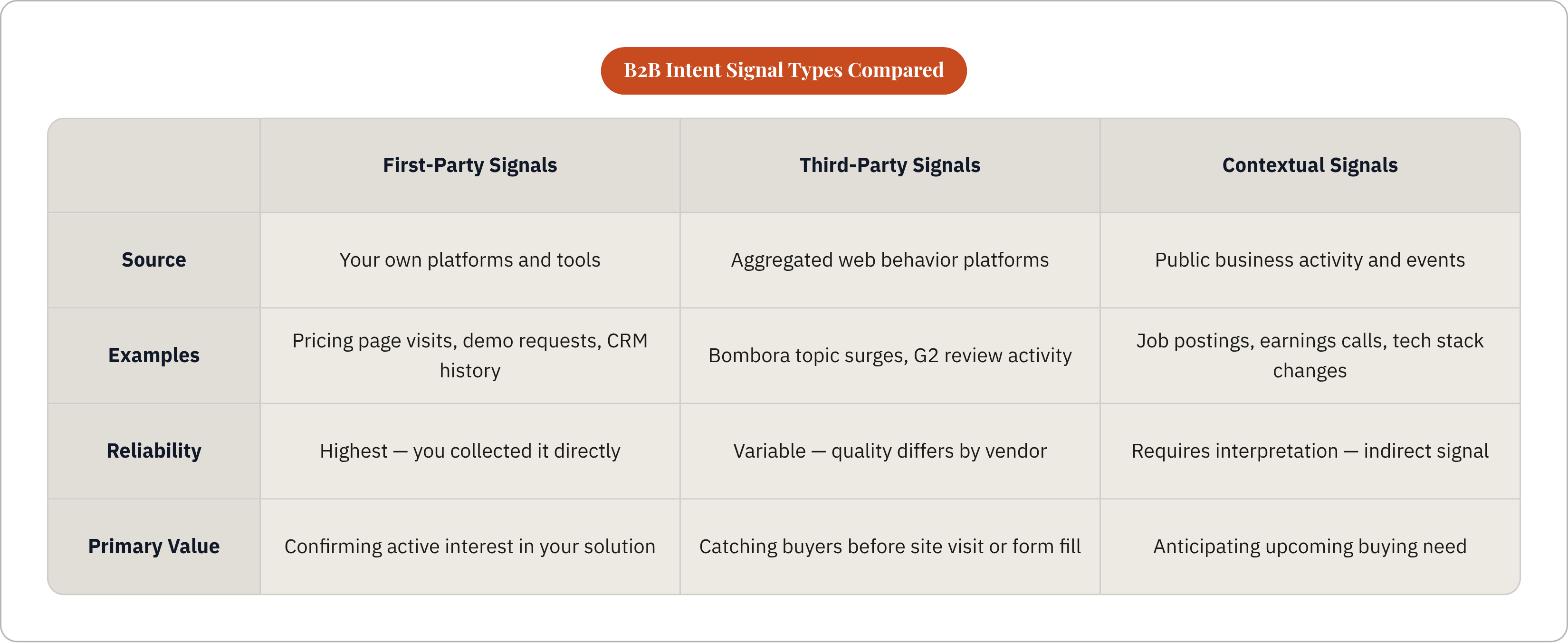
Three signal categories worth understanding:
First-party signals are the ones you own directly. Website behavior, pricing page visits, content downloads, demo requests, CRM history. Most reliable because you collected them yourself.
Third-party signals come from platforms that aggregate behavior across the broader web. These platforms track topic consumption across thousands of B2B sites. When an account starts consuming content on a topic well above its historical baseline, it surfaces as in-market, even if that account has never touched your site.
Contextual signals require a bit more interpretation. A company posts a job listing for a new CTO. An earnings call mentions a digital transformation budget. A competitor's logo disappears from a company's tech stack. These aren't intent signals in the traditional sense, but they tell you something real about what's coming.
Here's what the vendor decks don't spend much time on: signal reliability is a genuine problem. Only about a quarter of signals convert to qualified opportunities (DemandScience). The data exists. The quality varies significantly. Teams get excited, build a whole workflow around intent data, and then quietly abandon it six months later because the signal-to-noise ratio was terrible. That's usually a sourcing and layering problem, not a fundamental flaw in the concept. But the distinction matters, because most teams never stop to figure out which one they're dealing with.
The teams getting actual value from intent data layer multiple signal types rather than leaning on any single source. A pricing page visit from an account that's also surging on a competitor topic across third-party intent platforms and just posted three VP-level technical roles tells a coherent story. Any one of those signals in isolation is noise. Together they indicate something real.
One number worth knowing: accounts showing intent on G2 convert at 2.6x the rate of accounts without G2 signals. Review-site intent captures buyers who are actively comparing vendors, which makes it among the most actionable third-party signals available.
Speed kills intent data ROI faster than anything else. The response window is hours, not days. A weekly data review meeting is, for practical purposes, a place where intent signals go to expire. Only about a quarter of B2B teams report exceptional ROI from intent data investments (2025 Demand Gen Report), and most of that underperformance traces back to the same problem: signals get exported somewhere, nobody acts on them, and by the time someone does, the moment has passed.
Marketing's job is to build the routing infrastructure so intent signals trigger seller action automatically. Without that infrastructure, intent data is just an expensive report that makes for good slides.
Intercepting Buyers Who Are Actively Evaluating a Competitor
Most marketing teams skip this entirely. Partly because it requires coordination they don't have. Partly because it's uncomfortable to build content that explicitly acknowledges a competitor exists. But ninety-four percent of buying groups have already ranked preferred vendors before first contact. When a signal fires, competitor evaluation is often already underway. You're arriving in the middle of a decision, not the beginning of one.
Two distinct scenarios, and they require different plays:
Pre-pipeline interception. An account is showing competitor intent signals and their contract renewal is approaching. This is the displacement window. The goal is to enter the conversation before the renewal decision narrows to a foregone conclusion.
In-deal competitive response. A deal is already in your pipeline and it goes competitive. The rep needs assets immediately, not by end of week.
The timing logic for displacement is something most teams get backwards. A conversation eight months before renewal lands when the buyer is genuinely open to evaluating alternatives. One month before renewal is usually too late. Stakeholders have aligned internally. Switching feels risky. The cognitive door that was wide open six months ago is now almost closed. Showing up then isn't brave, it's just late. Most teams still fail to act on this because the trigger requires data and cross-functional coordination that isn't in place. So they do nothing, and then they wonder why competitive deals keep slipping.
For in-deal competitive response, the content layer includes:
- Battlecards refreshed monthly. A polished battlecard updated annually is genuinely worse than no battlecard, because a rep who uses outdated information with a buyer who knows more is actively destroying trust in real time.
- Customer voice positioned for the competitive context. Not generic success stories. Stories from customers who evaluated the same competitor, chose you, and specifically why.
- Switching cost frameworks. Pre-emptive content that addresses the "it's too hard to change" objection before the buyer raises it. They will raise it.
The win/loss loop is the piece most teams skip and then wonder why their competitive content keeps missing. Every deal generates signal. Why did you win? Why did you lose? What did the buyer actually say about the competitor? That information needs to feed back into the next version of positioning and content. The loop only works if the capture is systematic. If it's optional, it doesn't happen. That's a process design problem, not a culture problem.
Cross-functionally: RevOps governs the data layer. Marketing produces the content layer. Enablement embeds both into seller workflows. Each owns a piece. None of it works without the other two.
Building the Content Layer That Sellers Actually Use at Each Stage of the Buyer Journey
Here's the part that surprises people: your highest-traffic content is often your lowest-pipeline-influence content.
Awareness content drives volume and does real brand work. But the content that actually shows up in closed-won deals is comparison content, solution-specific guides, and case studies. Seen by fewer people, but by people who are actively making a decision. Those are different readers with very different needs.
Mapped to where the buyer actually is:
Consideration stage. Competitor comparison content. Solution-specific guides. Category explainers written for buyers who are evaluating, not just browsing. The goal is helping a buyer build their internal case for why your solution is the right one, because they're going to have to make that case to someone else before a deal ever closes.
Decision stage. Case studies positioned for specific buyer roles or verticals. ROI calculators. Third-party validation like G2 reviews and analyst coverage. This is the content that helps a champion sell you to their stakeholders when you're not in the room. That's a real job. Most marketing teams don't design content with that use case in mind.
In-deal. One-pagers a rep can drop into an email thread at a moment's notice. Executive-facing summaries for the economic buyer who materializes in the last 20% of the deal. Battlecards for the competitive objection that appears out of nowhere on a Thursday afternoon.
On volume: thirty to fifty assets that repeatedly support in-flight deals outperform five hundred blog posts that nobody in active evaluation reads. Depth of utility per asset beats breadth of library. Most content teams build the wrong kind of big.
Thought leadership deserves its own moment here because it gets written off as brand work when it's actually a deal-opening asset. Some numbers that reframe it:
- 73% of B2B buyers trust companies with strong thought leaders more than companies without (Edelman, 2025)
- 41% of target buyers were encouraged by a C-suite executive to consider a vendor after engaging with that vendor's thought leadership (Edelman-LinkedIn, 2025)
That second one is the one people miss. There are buyers involved in every deal who aren't visible in the formal buying committee. They find thought leadership on their own, form opinions on their own, and then influence the people who are formally named in your CRM. The content surface area extends well beyond whoever filled out the form.
One more thing that reframes the distribution problem: Millennial and Gen Z buyers involve an average of ten external influencers before talking to a salesperson (Forrester, 2025). The right content at the wrong moment enables nothing. Getting content into seller hands at the moment a signal fires, rather than buried in a shared drive nobody opens, is part of marketing's job.
How Marketing Measures Its Contribution to Pipeline and Revenue Without Defaulting to Last-Touch Attribution
Only 21% of B2B marketers say they can measure marketing ROI with confidence (2025 Demand Gen Report). The other 79% are estimating and hoping the estimate lands somewhere defensible.
Here's why the standard model breaks: most B2B marketing teams still rely on last-touch attribution. But B2B buyers engage with more than two dozen touchpoints across an extended sales cycle. Giving all the credit to the last touch before conversion ignores everything that happened before it. All the trust-building. All the early preference shaping. Last-touch attribution makes marketing look like it contributes less than it does, which triggers a funding cut, which makes marketing actually contribute less, which confirms the original assumption. Around and around it goes.
Two revenue metrics marketing needs to own and report together:
Marketing-sourced revenue. Deals that originated from marketing activity.
Marketing-influenced revenue. Deals where marketing content or signals played a meaningful role during the sales process, even if sales sourced the initial relationship.
Both numbers are necessary for an honest picture. Sourced-only makes marketing look smaller than it is. Influenced-only can be stretched to claim credit for almost anything. Together they tell something closer to the truth, which is harder to argue with.
Practical attribution models worth using:
Linear attribution splits credit equally across all touchpoints. Better than last-touch, but it treats a blog visit and a pricing page review the same way, which doesn't reflect how buying decisions actually happen.
Time-decay attribution weights touchpoints closer to conversion more heavily. A better fit for late-stage content like case studies and comparison pages. Still imperfect, but more honest about how B2B deals close.
Pipeline metrics that connect to real seller outcomes:
- MQLs generated by specific content assets, not just aggregate MQL counts
- Pipeline influenced by content, broken out from pipeline sourced
- Time-to-close for prospects who engaged with specific assets versus those who didn't
- Customer acquisition cost broken out by content channel
The quarterly content performance review is where this becomes operational. Rank assets by pipeline influence, not traffic. Then allocate production capacity toward the topics and formats showing up in that ranking. This is the feedback loop that makes content investment compound over time rather than reset to zero every quarter.
One number worth sitting with: a thought leadership SEO campaign built around deep keyword research, audience intent analysis, and authoritative content delivers approximately 748% ROI with an average nine-month break-even (FirstPageSage, 2025-2026). Nine months. That's why most marketing teams underinvest in it. They're measuring at month three, seeing nothing, and moving on.
The Structural Changes That Make Sales Enablement a Permanent Marketing Responsibility
Intentions don't change org behavior. Structure does.
Sixty-four percent of organizations say their enablement strategy spans all revenue teams. Fewer than one in four consider it truly unified. The strategy exists on paper. The operational reality doesn't exist anywhere. And a strategy that lives only on slides gets nodded at in quarterly reviews and then ignored until the next planning cycle, when someone proposes the same strategy again.
Three structural changes that make marketing's enablement role actually stick:
Signal routing infrastructure. Intent signals need to trigger seller workflows automatically, not sit in a weekly report waiting for someone to notice them. RevOps governs the data layer. Marketing defines what signals mean and what content fires alongside them. When a signal fires, the rep has context and content in hand before the next sync. Not after someone exports a spreadsheet and emails it around.
Shared pipeline metrics. Marketing's success gets measured in pipeline influence and deal velocity, not MQLs in isolation. This requires a shared CRM view with sales and a joint review cadence. If marketing and sales are reviewing different numbers in different meetings, they're effectively working different jobs that happen to share a building. The numbers define what people optimize for. Shared numbers produce shared behavior.
Content governance tied to deal stages. The content library is mapped to sales stages and buyer roles. It gets reviewed quarterly for actual utility, not volume. It runs on a refresh cadence that matches how fast competitive and market conditions move. Which is fast. Annual content reviews produce content that's outdated before the year is over.
On AI: 84% of executives say AI has strengthened their sales enablement strategies and overall GTM performance (Highspot, 2025). Organizations using AI to automate manual tasks and surface insights are three times more likely to improve sales productivity. AI doesn't replace the structural work described above. It removes the friction that was preventing the structural work from scaling. Routing signals, surfacing relevant content, flagging competitive triggers. These used to require a person checking a dashboard. That's no longer a reasonable use of a person.
The alignment prerequisite that everything else depends on: marketing and sales leaders need to agree on what "in-market" means, what a qualified signal looks like, and what counts as a deal-ready asset. Without that shared definition, signal routing produces noise and content libraries go unused. This conversation needs to happen before any tooling gets purchased. It usually doesn't, which is why the tooling underperforms.
The performance gap that puts all of this in context: 84% of sales reps achieve quota when their employer runs a best-in-class sales enablement strategy. Top performers are closing 11 times faster than lower performers in 2025, up from 8.9 times in 2024. The gap between companies that do this well and companies that do it poorly is not closing. It's widening.
The shift here isn't additive. Marketing doesn't layer sales enablement on top of existing campaign work like it's a new project with a new Asana board. It reorients around a different central question: not "how do we drive more traffic?" but "what does a seller need to be credible in this specific conversation, and how does marketing make that happen before the conversation starts?" Letterdrop, a content marketing and sales enablement platform that connects content creation to pipeline and revenue attribution, is built to answer exactly that question. Everything else follows from that question. Including, eventually, the quota numbers.