SPIN Selling Applied to Intent-Qualified Buyer Conversations
Compress your pre-call research into sharper problem questions that close the buyer faster.

When Neil Rackham and his team analyzed over 35,000 sales calls across 23 countries, they built the most empirically grounded sales methodology that has ever existed. SPIN Selling wasn't invented at a whiteboard. It was observed in the wild, across industries, deal sizes, and buyer types. That matters, because it means when something in the environment changes structurally, the methodology can absorb it. It just needs to be recalibrated.
Here is what has changed: a serious seller in 2025 can walk into a call with roughly 80% of the situational context already mapped before they dial. LinkedIn, intent platforms, review site behavior, technographics. The buyer has done their own homework too. Per a 2025 Buyer Experience Report, 94% of buying groups have already shortlisted vendors before they ever talk to a seller. And buying cycles have compressed, from 11.3 months in 2024 down to 10.1 months in 2025. Less runway. More pressure.
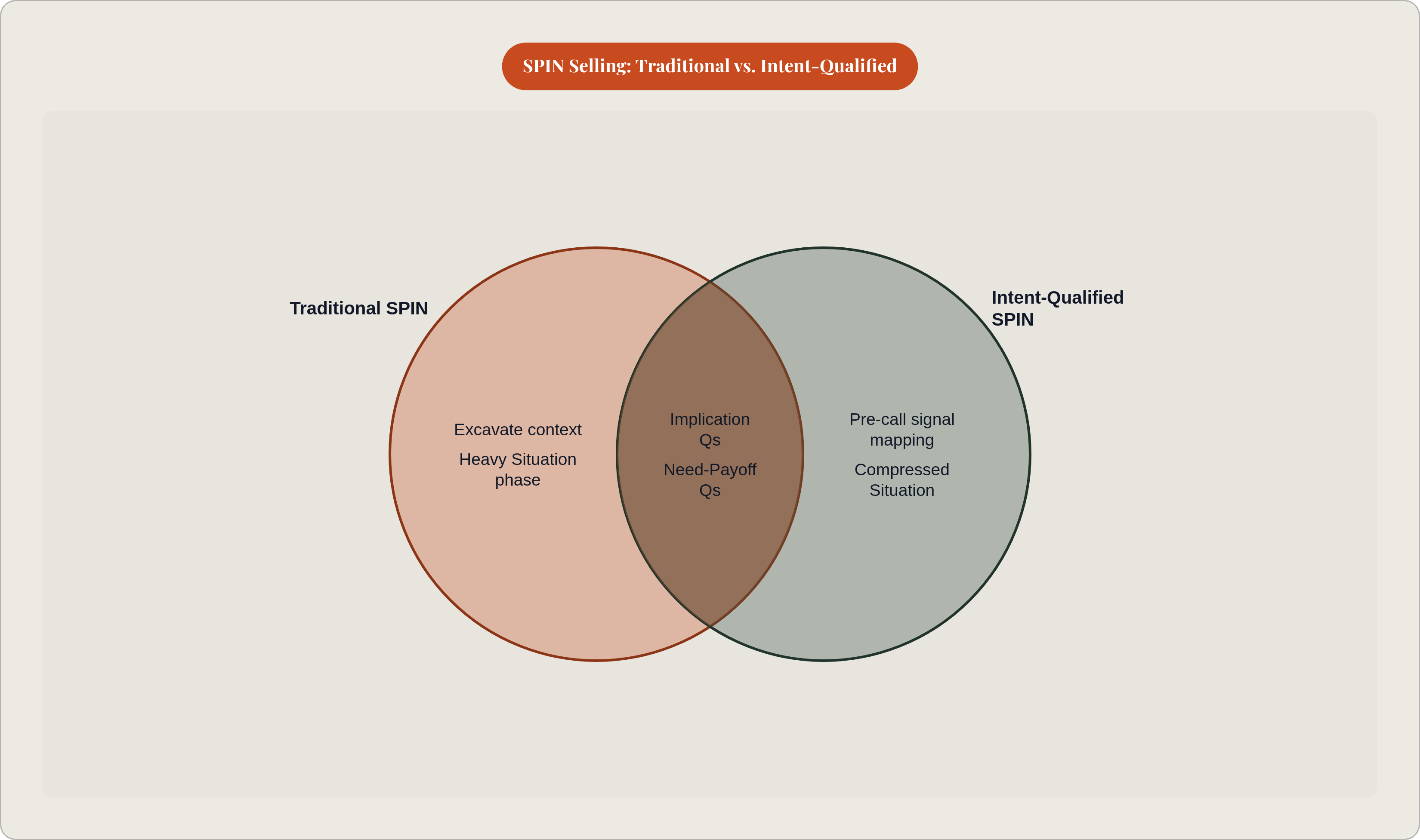
None of this breaks SPIN. It shifts its center of gravity. Situation questions were designed for an era when sellers had limited pre-call knowledge and needed to excavate context from scratch. That era is over. The methodology still works. The question is which questions earn the most time when the buyer already has buying intent. That is what this article is about.
What Intent Signals Actually Tell You Before the Call Starts
There are three layers of signals, and they tell you different things.
First-party signals come from your own site. Pricing page visits, return visits, what content they consumed and in what order. This tells you category interest and how far along in their evaluation they probably are.
Second-party signals come from review platforms like G2 and TrustRadius. When an account is researching your product against named competitors on one of those sites, that is not casual browsing. G2 reports that accounts showing this type of intent convert at 2.6x the rate of accounts without it. They are in active decision mode.
Third-party signals come from platforms like Demandbase. These track topic surges across publisher networks and tell you when an account is researching a category at scale, even before they land on your site.
One signal is noise. A pattern is intelligence. A homepage visit alone tells you almost nothing. That same account visiting your homepage, then your pricing page, then reading three competitor comparison posts, then showing G2 category activity? That is a call worth making today.
Then there are contextual signals layered on top. A new CRO in their first 90 days. A recent funding round. A shift in the language on an earnings call. A new product launch. These matter because they often explain why the intent signals are firing right now. And here is the practical edge: most competitors are buying the same intent feeds you are. Far fewer are tracking leadership changes. That asymmetry is yours to exploit.
Competitive intent is the highest-priority signal class for SPIN application. A buyer comparing you to three alternatives on G2 already has a problem, already knows it, and is actively weighing solutions. That is a different buyer than someone reading a category thought leadership post.
One caveat worth naming before you over-index on any of this: DemandScience data shows 87% of organizations report unreliable or inflated intent signals. Signal stacking and source triangulation are not optional. They are the quality filter that separates actionable intelligence from expensive noise.
What you can realistically know before dialing: the account's approximate stage, the competitors in their consideration set, the operational context around leadership and funding, and which content they have already consumed. That pre-call map is what compresses the Situation phase and unlocks the deeper SPIN stages.
How to Run Situation Questions When You Already Know Most of the Answer
The temptation when you have done serious pre-call research is to skip Situation questions entirely. Skip the pleasantries, skip the context-setting, get right to the problem. Logical. Also wrong.
Buyers who feel a seller has done their homework respond with trust. Buyers who feel a seller is reading their mind respond with suspicion. There is a difference between "this person is prepared" and "how do they know that." Situation questions, done briefly, let the buyer feel heard. They also give the seller a chance to confirm whether the pre-call read is accurate or outdated.
The reframe: use Situation questions to validate, not excavate.
Instead of "Can you walk me through your current sales process?" try something like: "Based on what I've seen about your stack, it looks like you're running [X]. Is that still the setup, or has something shifted recently?" That question signals preparation. The answer either confirms your map or updates it.
What to confirm versus what to skip:
- Confirm: team structure changes since the signal fired, whether the new CRO signal reflects an actual mandate shift, which alternatives they are genuinely evaluating
- Skip: company size, tech stack basics, budget cycle timing. These are researchable. Asking them cold wastes the buyer's patience and signals you did not prepare.
Time discipline matters here. Situation should not exceed 5 to 10% of the call. Two or three targeted questions, maximum. The payoff is that a brief, well-prepared Situation exchange establishes the seller as credible before the Problem stage even begins. And credibility at that moment matters. Forrester's 2024 State of Business Buying Survey found that 37% of B2B sellers cite failure to quickly read and adjust to buyer behavior as a top growth challenge. Reading the room before you enter it is the structural advantage.
Where Problem Questions Land Differently on an Intent-Qualified Call
On a cold discovery call, Problem questions are exploratory. You genuinely do not know what is broken, so you are fishing. On an intent-qualified call, the signal already implies a dissatisfaction. The Problem question names it precisely and invites confirmation. That is a different job.
A buyer researching "marketing automation ROI" is not generally dissatisfied. They are dissatisfied with something specific about return, measurement, or how they justify the spend internally. A buyer on G2 comparing your product to a named competitor has already defined the problem space. Your job is to figure out which version of the problem stings most.
Here is a practical translation map:
- Competitor comparison page activity → Problem likely involves a current vendor gap on a specific capability, switching friction, or a failed renewal negotiation
- Pricing page plus ROI content → Problem likely involves budget justification, cost-of-status-quo math, or internal selling pressure from a CFO
- Leadership change signal → Problem likely involves a new leader who inherited a tool they did not choose and is evaluating whether it fits their own playbook
Effective Problem questions on intent-qualified calls are hypothesis-driven. Something like: "A lot of teams in your position find that X is what's creating the friction. Is that resonating, or is it coming from somewhere else?" That phrasing does two things. It shows pattern recognition, which reads as credibility. And it gives the buyer an easy path to correct you, which opens a real conversation rather than a one-sided interrogation.
What to avoid: generic Problem questions that a competent seller should have been able to anticipate from the signal. Asking "what are your biggest challenges with your current solution?" to someone who just spent three sessions comparing you to competitors on G2 is a waste of the intelligence advantage you built. Name the likely problem. Let them confirm or redirect.
Why Implication Questions Are the Core of the Intent-Qualified SPIN Conversation
Rackham's original finding on this was unambiguous: Implication questions are what separate top performers from average sellers in complex B2B sales. They do not pitch the product. They magnify the cost of inaction. That distinction is everything.
Here is why this stage matters even more when intent is already established.
A buyer doing active competitor research already knows they have a problem. You do not need to convince them the problem exists. What they often lack is a clear picture of what continuing with the status quo actually costs them. Financially. Operationally. Competitively. Implication questions make that cost vivid and concrete. That is what compresses the decision timeline from the inside out.
The intent signal tells you which domain to probe for implications. Work from the signal:
- Competitor evaluation signal → Implication domain: What does choosing the wrong vendor cost in switching expenses, team disruption, or delayed outcomes? What happens if this evaluation drags out another quarter?
- ROI and pricing intent → Implication domain: What does failing to justify the budget cost internally? Headcount, program spend, credibility with the CFO?
- New CRO signal → Implication domain: What does the inherited tool's underperformance cost this new leader in their first 90-day window to prove impact?
Implication questions and Need-Payoff questions combined should occupy roughly 70% of the call on an intent-qualified conversation. That is the inverse of the Situation-heavy distribution Rackham observed in average performers.
The craft point worth spending time on: Implication questions should feel like thinking alongside the buyer, not pressing them. "If that gap persists through Q3, what does that mean for [specific outcome they've been indexing on]?" Not aggressive. Just concrete. You are asking them to do the math out loud.
And here is the payoff Rackham documented. When prospects feel they arrived at the solution through their own reasoning, through a well-run Implication sequence, they push back far less on price or features. Urgency becomes self-generated. That is the mechanism. It works because it is not a trick. It is genuine problem exploration, run rigorously.
How Need-Payoff Questions Close the Loop Between the Buyer's Intent Signal and Your Solution
Need-Payoff questions invite the buyer to articulate the value of solving the problem in their own words. The seller is not pitching here. The seller is prompting the buyer to make the case. That is a subtle distinction with enormous practical consequences.
On an intent-qualified call, the buyer's signal often reveals what payoff they are already reaching for. A buyer who consumed three pieces of ROI content wants to be able to tell their CFO a number. A buyer on competitor comparison pages wants to know which solution wins on the dimension they care about most. The seller who knows this can frame the Need-Payoff question around the payoff the buyer is already thinking about. That is not manipulation. That is meeting people where they are.
Signal-to-payoff translation in practice:
- "If you could show your team a reduction in [the specific cost the Implication questions surfaced], what would that change about the decision?" The buyer answers with their own justification language. You did not give them the words.
- "What would it mean for this quarter's targets if you had [capability they're evaluating competitors on] in place by [date]?" The buyer quantifies the urgency themselves.
When the signal shows active competitor evaluation specifically, Need-Payoff questions surface what the buyer most needs the chosen vendor to deliver. That is both qualification intelligence and the closing argument. And it was given by the buyer, not the seller.
There is a supporting data point worth including here. A marketing automation platform that shifted to calling only accounts showing intent around "marketing automation ROI" and "lead scoring" saw cold call success rates move from 2% to 18%. The intent context made the Need-Payoff conversation immediately relevant rather than hypothetical. The signal told them what payoff to prompt for. The buyer responded to a question that already matched what they were thinking about.
One more lever at this stage: well-placed thought leadership assets shared before the call. A sector-specific data study, a framework built around the buyer's domain. When the buyer reads it ahead of the call, they carry that language into the Need-Payoff exchange. They arrive already thinking about the payoff in terms that favor your solution. The conversation feels like a natural continuation of their own thinking.
The Call Structure That Follows From This Resequencing
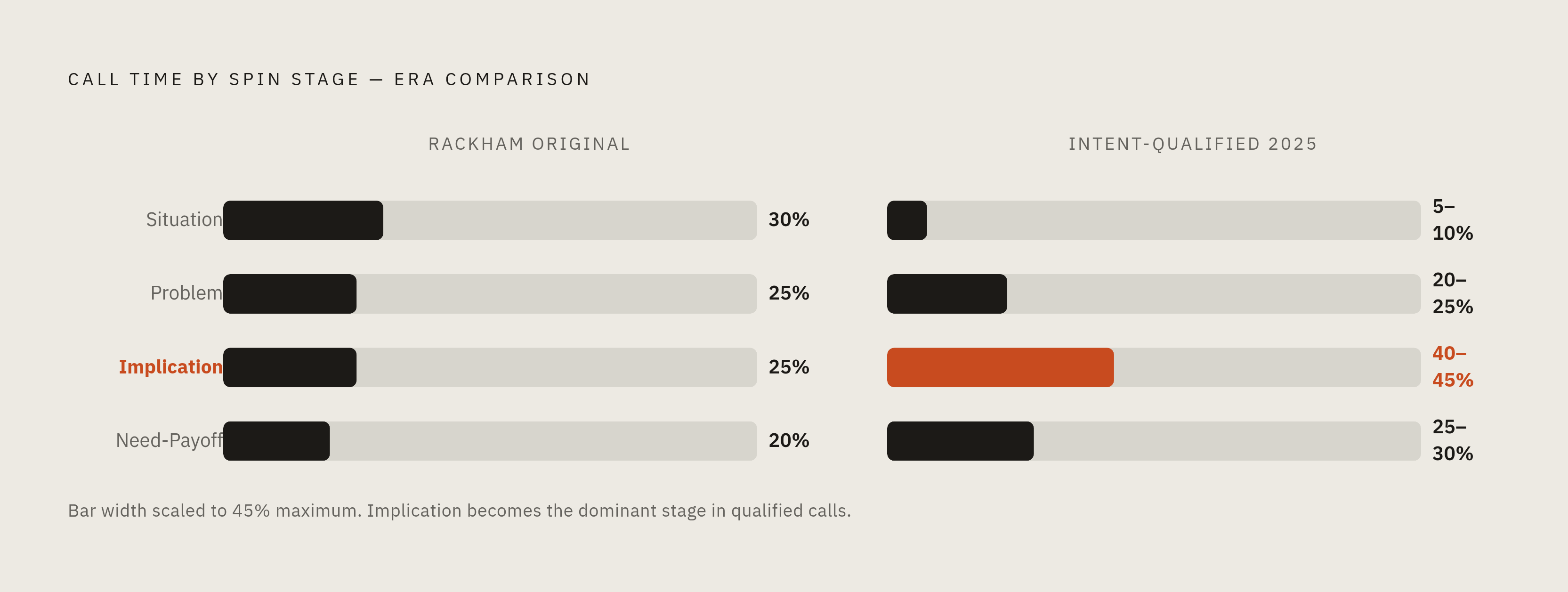
Here is the before and after, stated plainly.
Rackham's original distribution (pre-intent era):
- Situation: ~30%
- Problem: ~25%
- Implication: ~25%
- Need-Payoff: ~20%
Intent-qualified distribution:
- Situation: 5–10%
- Problem: 20–25%
- Implication: 40–45%
- Need-Payoff: 25–30%
The shift is not arbitrary. It reflects what the seller already knows coming in and where the buyer actually needs work done.
Pre-call preparation checklist. This is what earns the right to compress Situation:
- Signal stack reviewed: which signals fired, in what sequence, over what timeframe
- Competitor set identified: which alternatives are in the buyer's consideration set
- Contextual signals noted: leadership changes, funding, earnings language shifts
- Content consumed by account: what they have already read, because this shapes which Implication domain is most primed
- Hypothesis formed: what is the most likely version of their problem, and what are the two or three highest-stakes implications
The call itself runs like this:
One or two Situation questions confirm the hypothesis and signal preparation. Not a full intake. Just validation.
Transition to Problem questions. Hypothesis-driven, specific to the signal, inviting correction rather than demanding agreement.
The Implication block is the longest section of the call. Probe the financial, operational, and competitive cost of inaction across the domains the signal implies. Think alongside the buyer. Do not press.
The Need-Payoff close prompts the buyer to articulate the value of solving the problem. Your product enters the conversation as the answer to a question the buyer just answered themselves.
Where this structure fails: too many questions without visible forward momentum exhausts buyers. Every question should move the thinking, not probe for something the seller could have found before the call. There is a version of SPIN-running that feels like an interrogation instead of a conversation. That version loses deals.
For teams using AI sales tools: Highspot's 2025 State of Sales Enablement Report found that teams using AI for pre-call preparation are 41% more likely to strengthen buyer engagement. The structure above is what that preparation makes possible. The AI does not run the call. It fills in the pre-call map that compresses Situation and unlocks everything downstream.
SPIN still works. It just works differently when the buyer shows up already knowing what they want. The seller's job is not to discover the problem from scratch anymore. It is to show the buyer what that problem is really costing them, and let them talk themselves into solving it.