Social Selling Fundamentals for B2B Sellers
Become recognizable to buyers before they're ready to talk to you.

Most sellers are losing deals they don't even know they're in. The product is competitive. The pricing is right. But by the time a buyer picks up the phone or responds to an email, the shortlist is already set. LinkedIn Sales Solutions data shows that social selling leaders create 45% more opportunities and are 51% more likely to hit quota. They became a known name before the conversation ever started. That is what social selling actually does.
And yet most sellers still think social selling means blasting connection requests or pasting their email cadence into LinkedIn DMs.
It doesn't.
Social selling is trust-building work. It's the discipline of making yourself a recognizable, credible name to buyers before they're ready to talk to you. People confuse it with a lot of things:
- Sending 50 connection requests a day
- Copy-pasting your email cadence into LinkedIn DMs
- Measuring success by follower count
- Posting your company's press releases and calling it "content"
Those behaviors share almost nothing with what social selling actually requires.
90% of decision-makers never answer a cold call. A stranger asking for thirty minutes has no credibility to spend. They're starting from zero. Meanwhile, buyers are already doing their research. They're on LinkedIn, in industry forums, reading content, forming opinions, quietly building shortlists. Research from the 2025 buyer experience landscape shows that 95% of B2B purchases go to a vendor already on the buyer's shortlist before the first sales call is ever made.
So the question becomes: how does a seller get on that shortlist before the sales conversation starts?
Social selling answers that through four things:
- Optimizing your profile so it speaks to buyers, not recruiters
- Sharing relevant content so buyers encounter your thinking before they meet you
- Listening to public signals so you know when and why to reach out
- Reaching out with context instead of cold intent
Each one closes the gap between "cold name" and "person worth talking to."
The Seller's Profile as a Buyer-Facing Credential, Not a Resume
Go look at your LinkedIn profile right now. Does it read like a resume? Past titles, company logos, quota percentages?
Useful for a recruiter. Almost useless for a buyer.
A buyer landing on your profile has exactly one question: does this person understand my problems, and are they worth listening to? Your last three job titles don't answer that. Think of your profile as a storefront window. If it only shows what you've sold before rather than what you can solve today, buyers walk right past.
Here's what a buyer-facing profile actually looks like:
- Headline: Names the problem you solve, not your job title. "Account Executive at Acme Corp" tells a buyer nothing. "I help SaaS ops teams reduce tool sprawl and fix their data pipeline" tells them something real.
- Summary: Written for the buyer's situation, not your career arc. What problems do you keep seeing? What do you actually help people figure out?
- Featured section: Surfaces relevant perspectives, useful content, or client context. Not awards. Not "I'm excited to announce..." posts.
- Recommendations: The ones that matter describe how you helped someone solve a real problem, not how pleasant you were to work with.
A strong majority of B2B buyers say they're more willing to engage with a salesperson they already recognize as a credible voice in their space. The profile is usually the first place they check to see if that's true.
To make this concrete:
Before (resume): "Senior Account Executive | SaaS | ARR Growth | Team Lead | above quota FY2023"
After (credential): "I help RevOps teams at mid-market SaaS companies untangle their attribution mess before it costs them a board conversation"
One of those makes a buyer feel seen. The other one doesn't.
Your profile is also a living signal, not a one-time task. It should reflect what you're thinking about right now, what problems you're watching, what you're helping people work through. If it looks the same as it did two years ago, it's doing no work for you.
How Content Sharing Builds Familiarity With Buyers Who Are Not Yet in a Conversation
The 75% of B2B buyers who use social media in their purchasing decisions aren't on it to network. They're using it as a research tool. They're watching who posts what, forming opinions about who actually gets their world, and quietly deciding who's worth talking to. All before any conversation starts.
Sharing content is how you show up in that process. Most reps don't do it, or they do it badly. So the bar is lower than you'd think.
What this actually looks like in practice:
- Original perspectives on buyer problems. Something like: "I keep seeing mid-market ops teams skip this step when they build their first sales process, and it always costs them later. Here's what they miss."
- Substantive comments on conversations in your buyer's network. Something that adds a layer, challenges an assumption, or drops a relevant experience.
- Curating third-party content with an actual point of view. If you share an article, say why it matters. Say where you agree and where you don't. You're not a retweet machine.
A few things worth knowing:
Consistency beats volume. A seller who posts once a week on a tight set of topics is more recognizable than one who posts five times in one week and then goes dark for a month. You want buyers to start associating your name with a specific problem space. That takes repetition, not bursts.
It doesn't need to be long. A sharp, specific observation in four sentences does more for trust-building than a polished long-form article that shows up every few months.
You also shouldn't be producing everything yourself. If your marketing team creates content, share it with genuine context added. Marketing makes the content. You make it relevant by adding your real take.
Social selling has been shown to reduce average sales cycle length by around 18%. When a prospect enters a conversation already familiar with your thinking, you're starting from a position of trust rather than zero. You're confirming what they already sense.
And yet, research shows that more than nine out of ten sales executives have never received any formal training on social selling. Most sellers sharing content right now are improvising. Honestly, it shows.
What "good" looks like: a rep who has been posting for six months on a specific buyer pain point, so that when they finally reach out, the prospect has already seen several of their perspectives. That outreach doesn't feel cold. It feels like a natural next step.
Listening as a Selling Skill: Finding Buyers Through What They Signal Publicly
Social listening is a sales skill, and it's the step most reps skip entirely.
It's the discipline of watching what buyers say, ask, and engage with publicly before they ever raise their hand. Not glamorous work. The kind of thing that pays off weeks or months later, which is exactly why most people don't do it.
What sellers can actually surface through this kind of attention:
- Posts from target accounts describing a problem you solve
- Questions in industry groups that signal someone is actively evaluating options
- Engagement patterns: what a prospect is liking, commenting on, sharing
- Job changes at target accounts (a new VP of Sales or RevOps hire is almost always a buying signal)
- Public competitor mentions in your accounts' feeds
The practical version: keep a short list of target accounts and check their activity regularly. What are they posting? What are they engaging with? Who are they following? You are paying attention, not stalking anyone. Buyers notice when that shows up in your outreach.
One distinction worth making: social listening and intent data serve different purposes. Intent data is quantitative and useful for prioritizing at scale. Social listening is qualitative and relationship-oriented. Both matter. But social listening is available to every seller right now, with no platform budget required.
The payoff shows up in the next step. Listening is what makes outreach feel warm instead of cold.
Reaching Out With Context: What Separates a Recognized Name From a Cold Interruption
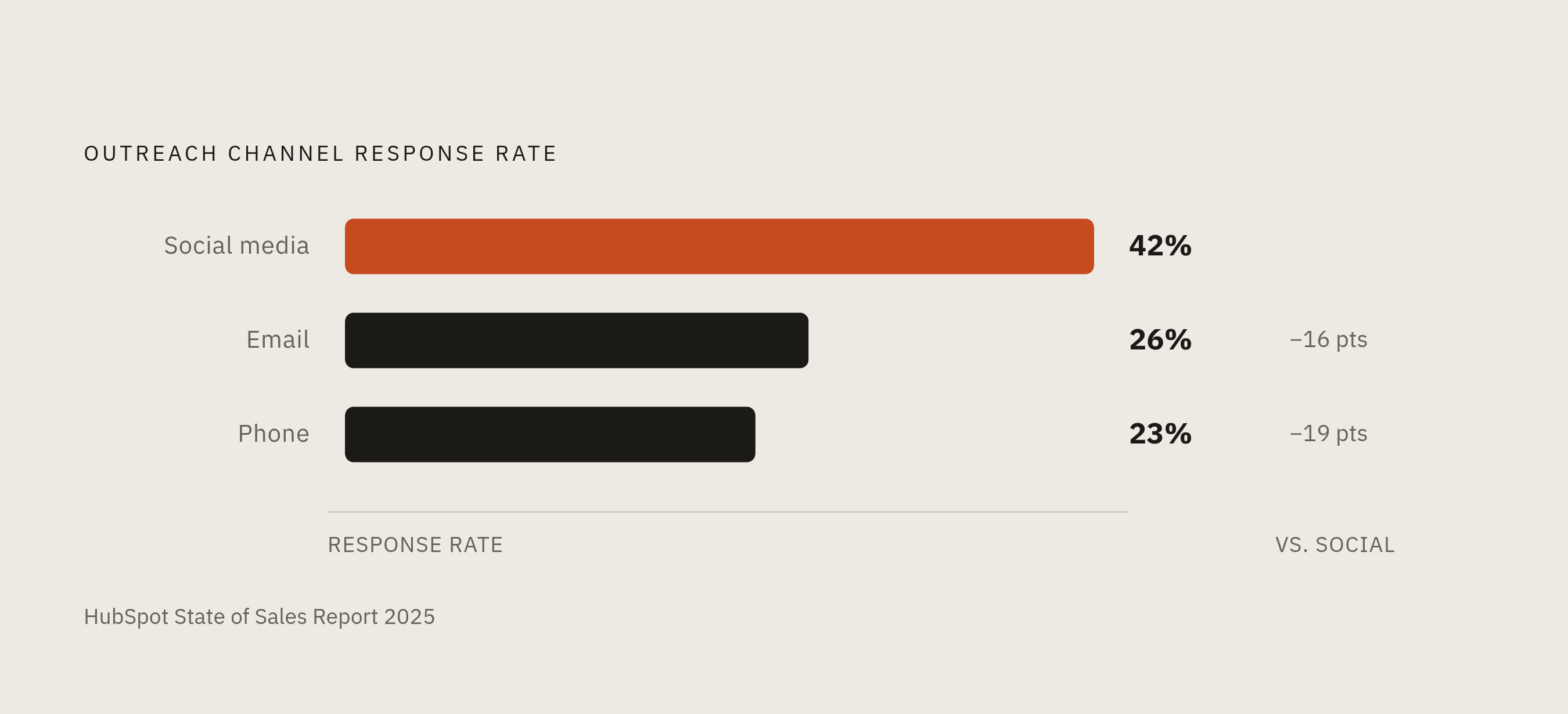
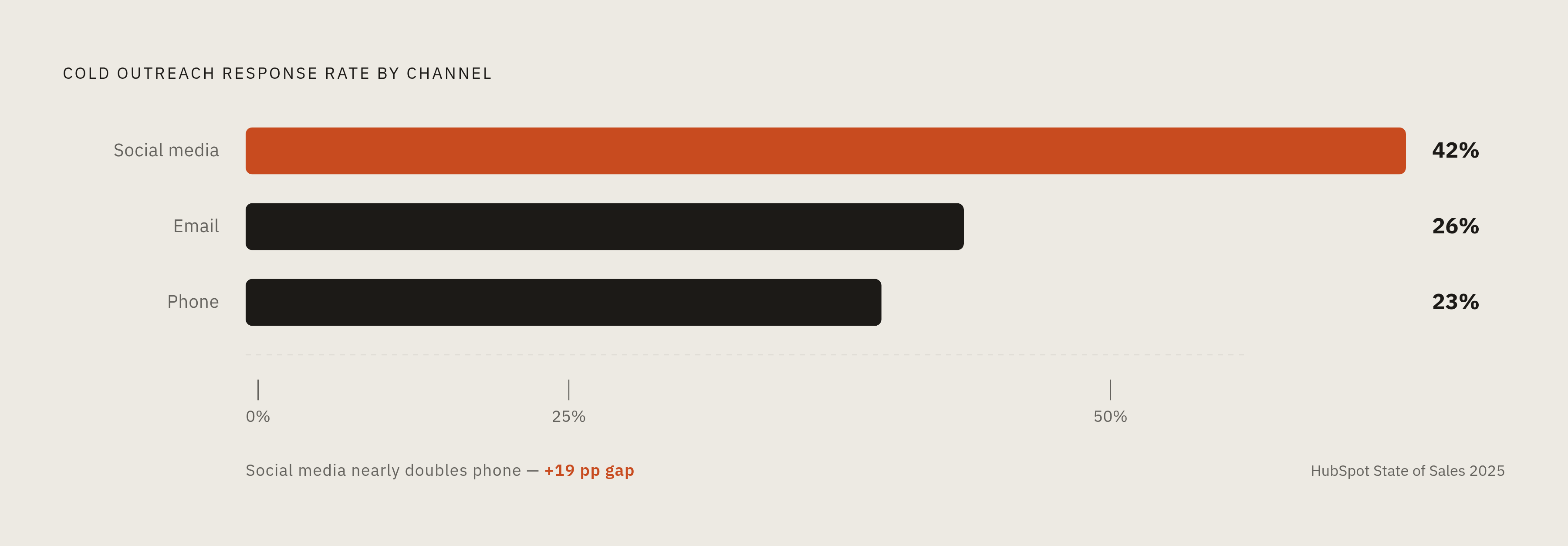
The HubSpot State of Sales Report 2025 puts it plainly: 42% of salespeople say social media delivers the highest response rate for cold outreach, ahead of email at 26% and phone at 23%.
That advantage only holds when the outreach actually uses the trust that social selling builds. Send a connection request followed immediately by a pitch, and you've made a cold call with a different icon next to your name. The channel alone doesn't save you. The context does.
What a context-led message actually looks like:
- Reference something specific: a post they wrote, a comment they made, a problem they named publicly
- Offer something useful before asking for anything
- Keep the ask small. A reaction, a thought, a resource. Not a meeting on the first contact.
- Never open with who your company is or what your product does
The profile work, the content, the listening — none of it is optional setup. It's the infrastructure that makes the message land. The prospect already has an impression of you. Your outreach confirms what they already sense.
Timing matters more than most sellers realize. A prospect who just posted about a challenge they're actively struggling with is in a completely different state than one who hasn't signaled anything. Listening surfaces the right moment. Reaching out in that moment doesn't feel like an interruption. It feels like good timing.
One thing to avoid: connect, wait two days, then send a message that starts with "I wanted to reach out because we help companies like yours with..." That's a cold pitch dressed in a social channel. The behavior undercuts whatever trust the channel could have provided.
How Content and Intent Signals Work Together to Make Social Selling Systematic
Everything described so far can work at the individual level. Some reps figure it out on their own and do well. But the organizations that pull ahead don't rely on individual heroics. They build systems.
LinkedIn's sales research is direct on this: 78% of organizations that use social selling outperform those that don't. Companies with high social selling adoption achieve 51% higher revenue attainment than those with low adoption. That gap isn't explained by one rep who figured out LinkedIn. It's explained by whether the organization built the infrastructure around it.
What systematic actually looks like:
- Marketing produces perspective content designed for sellers to share with genuine context. Content that helps sellers look like credible voices in the buyer's world.
- Intent signals route accounts to sellers at the right moment. When a target account surfaces as actively evaluating options, the relevant seller knows about it.
- Sellers are alerted when a target account engages with content related to a problem the seller solves. That is the highest-leverage outreach moment. Most organizations let it pass by unnoticed.
- Profiles, content, and listening triggers become team assets, not individual improvisation. The best rep should not be the only one who has this figured out.
This is where tools like Letterdrop become relevant. Letterdrop sits at the intersection of content marketing and sales enablement, surfacing buyer intent signals and equipping sellers with the content they need to build credibility at the right moments in the buying journey. It connects what marketing knows about buyers with what sellers need to say to them.
The alignment point is simple: social selling requires both marketing and sales. The infrastructure connecting them is what separates high-performing revenue teams from the ones where each rep is left to figure it out alone.
What to Measure to Know Whether Social Selling Is Working
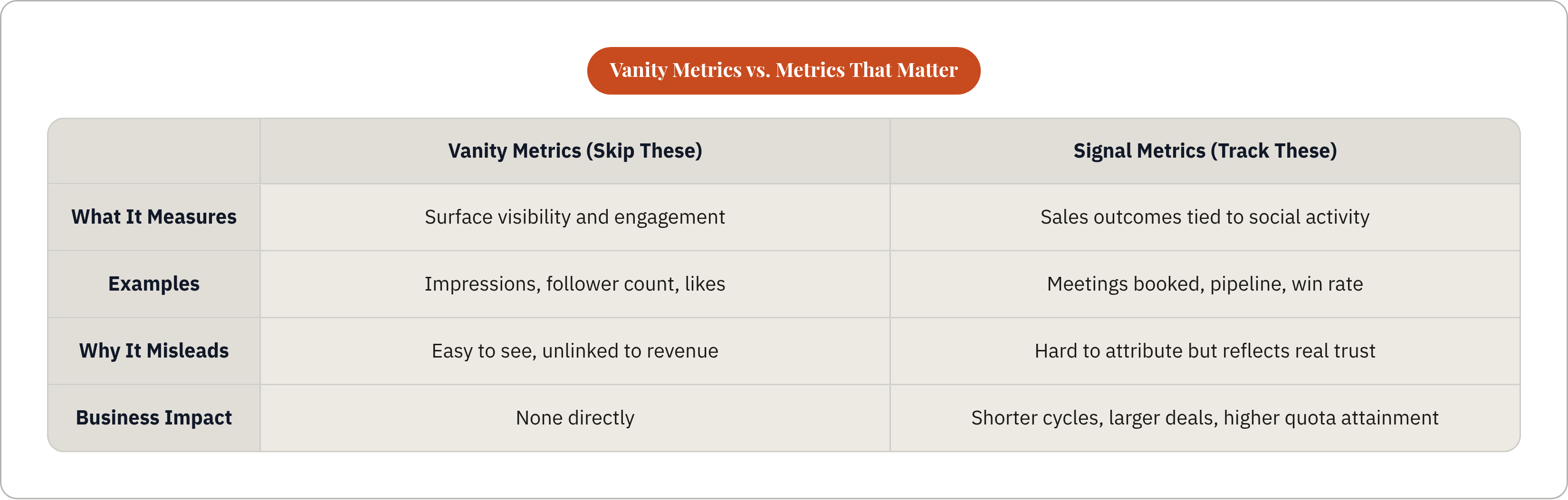
The common mistake is measuring social selling by impressions, follower counts, and likes. Those numbers are easy to look at and almost entirely useless as sales metrics.
The numbers that actually tell you something:
- Meetings booked from social-sourced conversations. Actually sourced from social engagement, not from cold calls that happened to mention a LinkedIn post.
- Pipeline where the prospect had prior exposure to seller content before outreach happened.
- Sales cycle length on social-sourced deals versus traditionally-sourced ones. The 18% reduction benchmark gives you something to test against your own data.
- Win rate on deals where the seller was already a recognized name to the buyer before the first call.
Deal size is worth tracking too. The relationships built before the first call tend to involve more senior buyers. Senior buyers tend to authorize larger deals. That pattern holds consistently.
Attribution is genuinely hard here. A buyer who read several of your posts over three months before replying to your outreach will not show up as "social-sourced" in your CRM. The system doesn't know that happened. You have to ask. One of the most useful questions in early discovery is simply: "What did you know about me, or our work, before we first connected?" You will be surprised how often the answer involves something they read that you posted six weeks ago. Most sellers never ask. So they miss out on understanding how much of the groundwork was already laid.
Trust is hard to measure directly. But its effects aren't. Shorter cycles. Warmer responses. Higher win rates. Better deals. Those are the outcomes social selling produces over time, and those are the numbers worth watching.