platforms that connect B2B content publishing to pipeline attribution
Platforms now connect B2B content to actual pipeline revenue instead of just measuring traffic.

B2B content marketing has a math problem. The average deal takes 211 days and 76 touchpoints to close, according to Dreamdata and LinkedIn's 2025 B2Believe Benchmarks, and most attribution tools still measure in 30-day windows. That's like trying to film a feature-length movie with a camera that only holds 90 seconds of tape. This piece is about the platforms built to fix that mismatch, and the difference between the ones that actually connect content to closed revenue versus the ones that just make a nicer-looking traffic report.
Here's the shape of the problem before getting into the fix. A buying committee at a mid-size company might have multiple people touching a vendor's content over many months: one reads a blog post in March, another downloads a report in May, a third watches a demo video in July, and none of them are the person who eventually fills out the "contact sales" form. Standard attribution windows catch only a fraction of that journey. The rest just evaporates, credited to nothing, even though it clearly happened.
Then there's the part of the journey nobody can see at all. Research from Green Hat APAC puts 73% of the B2B buying journey as anonymous, happening before a prospect ever talks to a vendor. Separate research found 83% of buyers fully define their requirements before that first sales conversation. Marketing teams call this the dark funnel, which is a dramatic name for a simple fact: the content doing the most persuading is often invisible in any session log a team will ever pull up.
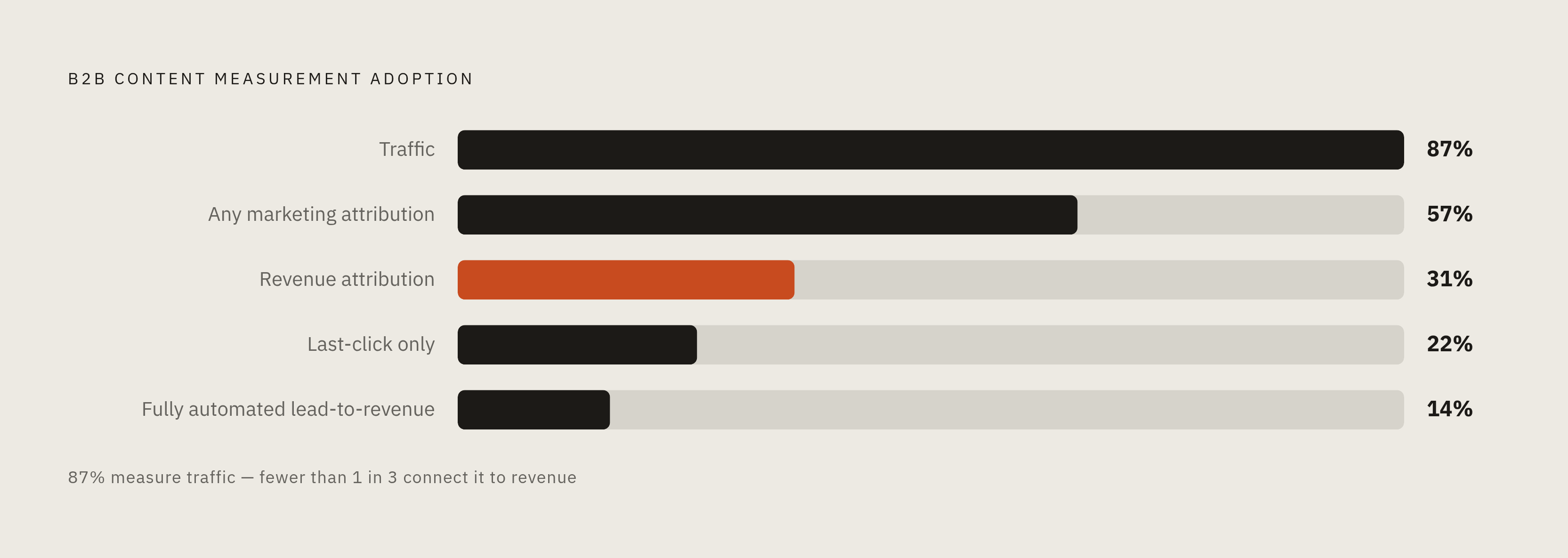
And the measurement habits haven't caught up. Most content teams (87%) track traffic. Far fewer, just 31%, track revenue attribution. Roughly 1 in 5 organizations (22%) still run on last-click attribution alone, which means one channel gets 100% of the credit for a deal that took 76 touches to close. Only 14% of companies have fully automated lead-to-revenue tracking. It's no surprise that 38% of marketers name attribution as their single biggest analytics headache. Every tool in the stack is generating signal. None of those signals are talking to each other.
What a content-to-pipeline attribution platform actually does differently from analytics tools teams already have
The distinction is simple to state and hard to build: a content attribution platform connects publishing activity to actual CRM objects, meaning leads, opportunities, deal stages, and closed-won revenue, instead of stopping at sessions, pageviews, or MQLs. A pageview tells a team someone showed up. A closed-won record tells them the visit turned into money. Those are very different sentences, and most tools only know how to write the first one.
Functionally, these platforms do four things that a standard analytics dashboard doesn't:
They stitch touchpoints together at the account level, across every contact in a buying committee, not just whoever happened to fill out a form. They connect directly into a CRM (Salesforce, HubSpot, whatever the team runs) so revenue becomes the actual output being measured, not some proxy conversion event. They track influence through deal progression, flagging which content touched accounts that are now sitting in late-stage pipeline, rather than just ranking blog posts by click count. And they support several attribution models running side by side, so a team can look at the same campaign through a first-touch lens, a multi-touch lens, and a revenue-weighted lens without re-pulling the data three times.
This is where GA4 runs into a wall it wasn't built to climb. GA4 and platform-native analytics remain the default for 62% of teams, and 44% of advertisers say GA4's attribution simply isn't good enough for decisions made at scale. That's not a GA4 flaw, exactly. It's a mismatch of units. GA4 is event-based and single-user by design. B2B buying is account-based and multi-stakeholder by nature. Asking GA4 to solve B2B attribution is a bit like asking a bathroom scale to measure a company's market cap: wrong instrument, wrong unit, no amount of recalibration fixes it.
Koka Sexton's content engine framework describes the closed-loop version of this: tag every asset consistently (source, campaign, content type), track what happens after the download or the click, not just at the moment of it, and feed what's learned back into the next round of editorial planning. That loop, tag, track, feed back, is the difference between a content team that guesses and one that knows.
Marketing mix modeling (MMM) fits alongside this rather than replacing it. Multi-touch attribution follows individual buyer journeys; MMM looks at how total spend across channels moves revenue in aggregate. Enterprise teams increasingly run both, because neither answers the other's question.
The attribution models in use and what each one actually measures
Single-touch models, first-touch and last-touch, are the easiest to set up and the most reliably wrong for anything resembling a long sales cycle. First-touch credits whatever content the buyer saw on day one, which overstates the value of awareness-stage content. Last-touch credits whatever they touched right before converting, which overstates bottom-funnel content. Neither reflects the reality of a buying committee where five people are looking at five different assets at five different points in the process.
Rule-based multi-touch models (linear, time-decay, W-shaped, U-shaped) split credit more evenly across the journey, but they're still assigning that credit by formula rather than by anything actually measured. A W-shaped model, for instance, always weights the same three touchpoints heavily regardless of whether those touchpoints did anything. Still, the shift matters: a large share of high-growth companies use multi-touch attribution, and moving from single-touch to multi-touch models generally produces meaningful gains in budget efficiency. Better math, even formulaic math, beats no math.
AI-powered and predictive attribution goes a step further, assigning credit based on a touchpoint's actual contribution to conversion probability rather than its position in the sequence. That matters most for the accounts that don't move in a straight line: the ones who revisit an old case study three months after first seeing it, or where the economic buyer and the technical evaluator each interact with entirely different content and never overlap. Predictive models can also score pipeline before deals close, which is valuable given that revenue often lands months after the marketing activity that produced it. That said, most teams aren't there yet. Traditional lead scoring and manual signal tracking remain dominant across much of the market, tools that simply can't produce reliable forward-looking visibility.
Hybrid models bring in self-reported data, the plain old "how did you hear about us?" question, to catch what tracking pixels never will: dark social, word-of-mouth, a colleague's Slack message with a link in it. Intentsify's 2024 commentary found hybrid models beat pure last-click on accuracy, though they take 15 to 20% of a team's analytics capacity to run properly. Nothing here is free.
Whatever model a team picks, the real test is whether the platform shows its work. A credit number with no explanation behind it isn't attribution, it's a black box wearing attribution's clothes. Teams should be able to ask why a given touchpoint got the weight it got, and get an actual answer.
The platforms built specifically for B2B content and pipeline attribution
SegmentStream isn't tied to an ad platform or a CRM vendor, so there's no built-in incentive to inflate any particular channel's numbers. It measures full-funnel, across paid, owned, and earned channels, tying all of it back to CRM revenue objects, and its AI-driven modeling assigns credit based on incremental conversion probability rather than fixed rules. A self-reported layer catches dark social and offline influence that tracking alone would miss. It fits mid-market and enterprise B2B teams running complex, multi-channel demand gen, and it holds a 4.7 out of 5 on G2. Worth noting: it delivers the most value to teams that already have established demand gen motions running, not ones just getting started.
Dreamdata rebuilds the entire buying committee's path at the account level, not just the one contact who happened to convert. Its data model is designed to be transparent, so a data team can actually dig into the logic instead of trusting a black box. It offers entry-level access options, which can help teams evaluate fit before committing to a full contract. Best fit: teams with a data engineer or a technical ops person who wants to own the underlying data rather than rent someone else's interpretation of it.
HockeyStack pulls marketing, sales, and product data into one revenue view, and its AI analyst (called Odin) surfaces insights without requiring BI work, meaning a demand gen marketer can run it solo. It's a strong fit for SaaS teams doing product-led growth, where product usage and marketing touchpoints need to be read together rather than separately. Pricing is quote-based only with no free tier; mid-market B2B attribution tools in this category typically run in the range of $1,000 to $2,500 a month depending on tracked contacts and integrations.
RevSure goes further into predictive territory: full-funnel AI attribution paired with pipeline forecasting that scores revenue scenarios before deals actually close. It processes marketing and sales touchpoints together to connect activity across the full go-to-market motion. It's built for enterprise teams that need attribution to feed directly into forward-looking pipeline calls, not just retrospective reporting.
Adobe Marketo Measure (formerly Bizible) runs rules-based attribution tightly wired into Marketo and Salesforce. It's a legacy platform at this point, most relevant for teams already fully committed to the Adobe stack. Its main limitation is baked into its architecture: rules-based models don't bend for non-linear journeys the way AI-driven alternatives do.
CaliberMind offers multi-touch analytics built specifically for B2B, with capabilities aimed at connecting activity across the buyer journey as contacts are identified. It competes directly with Dreamdata and HockeyStack in the mid-market.
A few platforms solve narrower problems well. Ruler Analytics is built for businesses where phone calls are a primary conversion path, tracing calls back to the campaign that drove them. Improvado works as a data aggregation and pipeline reporting layer, useful when a team needs to consolidate a pile of ad platforms into one place before attribution analysis is even possible. Fibbler handles account-level ad engagement tracking, and Factors.ai covers account-level intent and engagement for teams building toward a full attribution stack but not running one yet.
Letterdrop belongs in this conversation too. It connects content creation and distribution directly to CRM-tracked pipeline, stitching together multi-stakeholder touchpoints at the account level and looping performance data back into the editorial process, closing the gap between "published a post" and "moved a deal forward" that most tools leave wide open.
How to match a platform to a specific go-to-market motion rather than buying on feature lists
The first question isn't which platform has the fanciest attribution model. It's simpler than that: what unit of measurement does the revenue team actually need to see?
Teams needing account-level pipeline influence should look at Dreamdata, SegmentStream, HockeyStack, or RevSure. Teams already running Marketo and Salesforce and just need campaign-to-revenue visibility on top of that stack should look at Marketo Measure. Teams with sales cycles under 30 days, or where phone calls drive most conversions, are better served by Ruler Analytics than by any full multi-touch platform, which would be overkill.
Sales cycle length isn't a minor detail here, it determines whether the attribution window is even telling the truth. A 30-day window on a 211-day average journey is missing most of the story before it starts. Configurable or unlimited lookback windows aren't a nice-to-have for enterprise B2B, they're the baseline requirement.
Stack compatibility deserves more scrutiny than it usually gets. Does the platform write data back into opportunity records in the CRM, or does it just read from them? That one distinction decides whether sales can actually act on attribution data or whether it just sits in a marketing dashboard nobody in sales opens. Teams with an existing data warehouse should lean toward platforms with a transparent data model rather than ones that lock the attribution logic away in a proprietary black box.
Organizational readiness matters just as much as the platform's feature set, maybe more. Only 57% of companies use any form of marketing attribution at all, so most teams shopping for these tools aren't starting from a mature tagging baseline, they're starting closer to zero. A platform that needs a dedicated data engineer to run isn't going to help a two-person marketing team, no matter how elegant its methodology is on paper. Every team that does this well shares one unglamorous habit: consistent UTM tagging on every single asset, done before platform selection even enters the conversation.
The real test, at the end of all this evaluation, comes down to three questions. Which content touched accounts that are now sitting in late-stage pipeline? Which channels actually source pipeline, versus which ones just generate leads that go nowhere? And what's the time-to-close difference between prospects who engaged with content and those who didn't? A platform that can't answer those isn't worth the monthly invoice, regardless of how the demo looked.
What the revenue impact of getting this right actually looks like
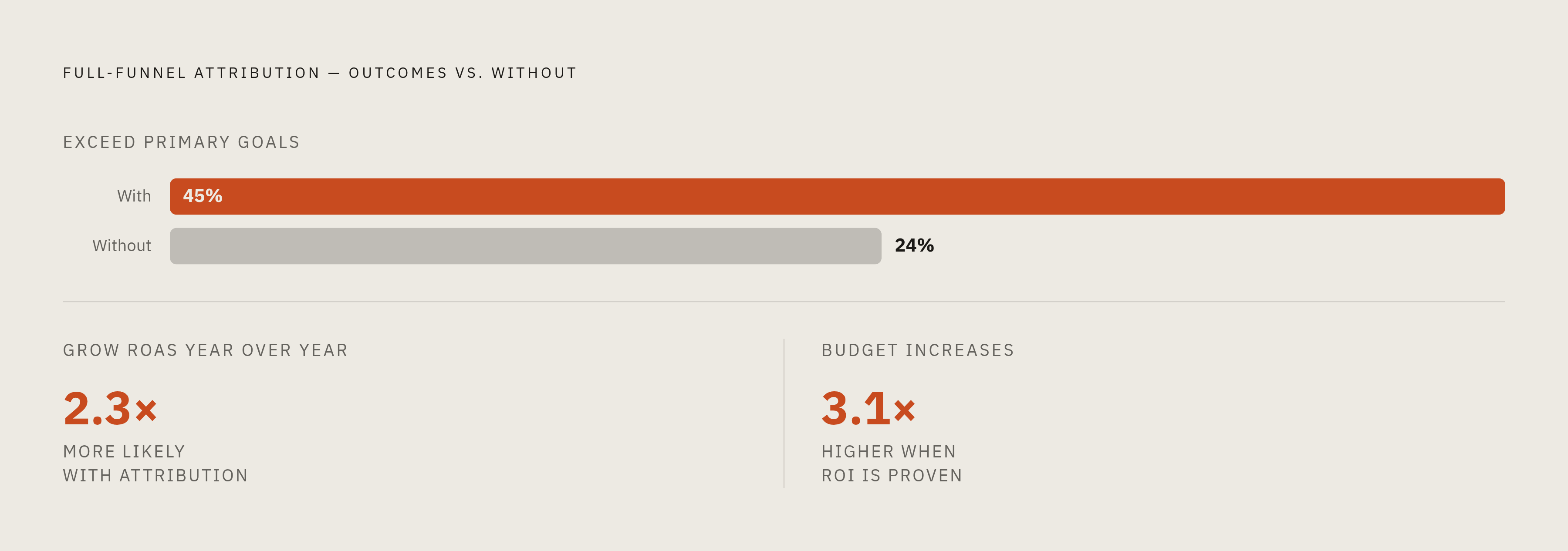
The gap between teams with full-funnel attribution and teams without one is now sitting in the data, not just in gut feeling. Anteriad's fifth annual B2B Marketing Edge report, surveying 631 marketing decision-makers across the US, UK, and APAC, found B2B marketers with full-funnel attribution are 45% likely to significantly exceed their primary goals, compared to 24% for those without it. That's nearly double. Marketers using attribution platforms are also 2.3 times more likely to grow ROAS year over year.
Budget defensibility is where this actually bites. Some 86% of B2B marketers report pressure to prove ROI, and companies that calculate ROI are 1.6 times more likely to see budget increases; teams that can prove ROI to leadership see budget increases run 3.1 times higher than teams that can't. The Influence Agency's 2024 B2B marketing benchmarks found pipeline attribution requests showing up in 68% of quarterly marketing reviews at companies above $50 million in revenue, up from roughly half two years earlier. Attribution has stopped being a nice chart for the marketing team's internal wiki. It's the actual language budget conversations are conducted in now.
The content-specific payoffs are just as concrete. Case studies factor into 26% of B2B closing-stage decisions, and attribution is the only way to know whether the case studies a team is investing in are actually reaching accounts at that stage or just sitting on a resources page nobody late in the funnel visits. Attribution also catches content decay 2.8 times faster than teams relying on traffic alone, meaning a post that used to convert well but has quietly gone stale gets flagged and refreshed before it drags down performance for months unnoticed. And educational content correlates with a 15% faster lead-to-close velocity, a number that simply doesn't exist until engagement data gets wired into deal timelines. Without that wiring, it's not that the content isn't working. It's that nobody can prove it, which in budget terms amounts to the same thing.