Intent Providers Compared for B2B Revenue Teams
Layering first-party, second-party, and third-party signals surfaces real buyers instead of noise.

"Intent data" is not one thing. The market talks about it like it is, like it's this monolithic product you either subscribe to or you don't. But there are three genuinely different signal types, and I've watched teams buy the wrong one because nobody explained the difference upfront.
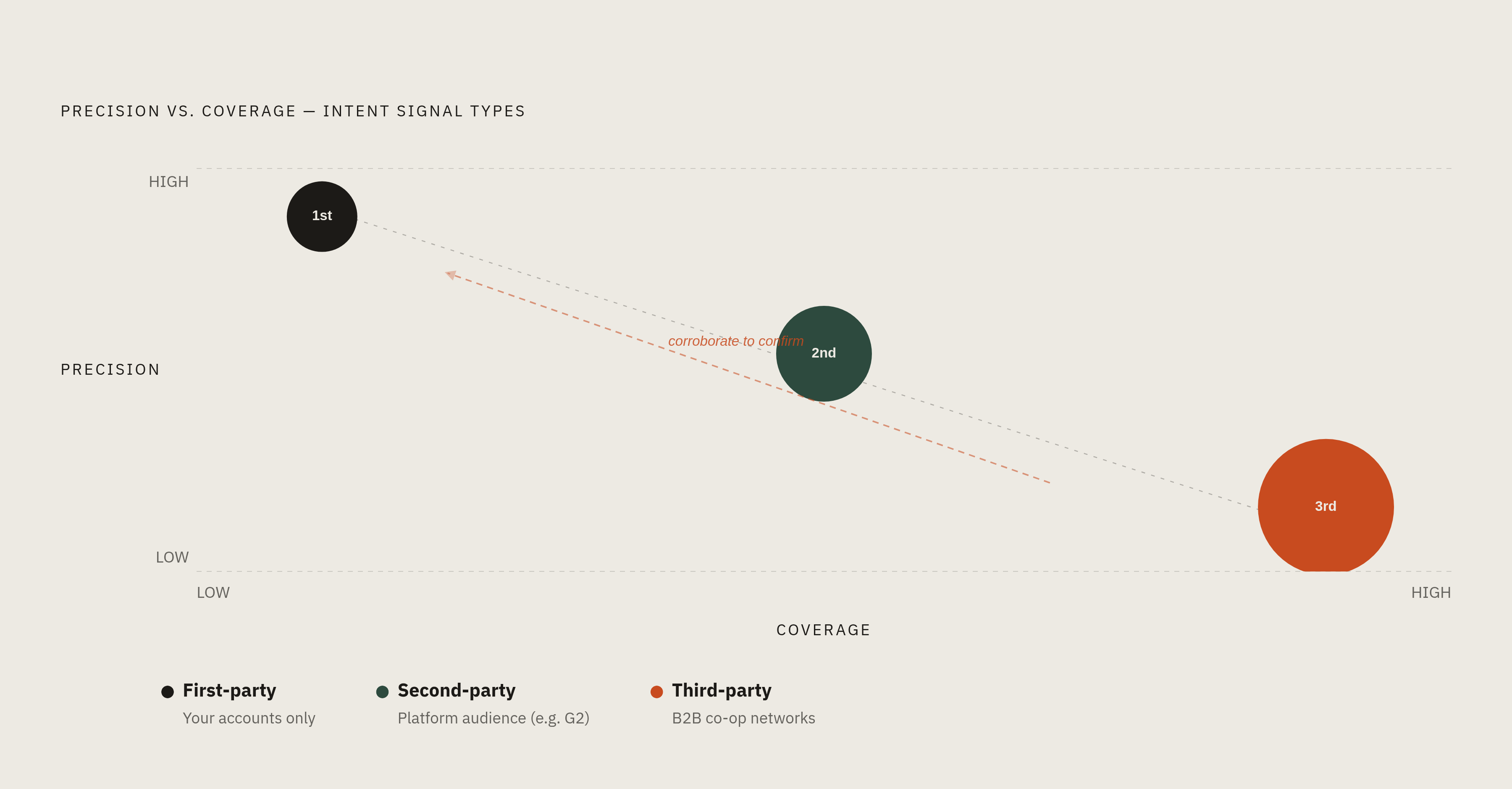
First-party intent is behavior on your own properties. Pricing page visits, demo requests, a prospect who has read four blog posts in the same week. This is the best signal you can get, full stop, because the behavior is unambiguous. They already know you exist. The catch is obvious once you think about it: first-party only captures accounts already in your orbit. Everyone doing anonymous research before they ever find your site is completely invisible to you.
Second-party intent is behavioral data from a third-party platform shared directly with you. The clearest example: a buyer on G2, running a side-by-side comparison of your product against a named competitor. That is a second-party signal. You know who. You know what they're comparing. You know they're already past "should we even look at this?" Coverage is limited to that platform's audience, but within that universe, the quality is genuinely high.
Third-party intent is the big one, and the messiest one. It's aggregated behavioral data from networks of B2B publisher sites. The idea is straightforward: track which companies are consuming content on certain topics across a large cooperative of business websites, then flag accounts researching significantly more than their baseline. Widest coverage by far. Surfaces accounts you have never touched.
But the precision is low on its own. An account spiking on "sales intelligence" is evaluating software, or a journalist writing about it. You genuinely cannot tell without more context, and that ambiguity is where the wheels come off for teams relying on third-party signals in isolation.
What this means in practice:
First-party only and you're missing most of your addressable market
Third-party only and you're acting on noise without corroboration
All three layered and you have something you can actually act on
Corroboration is what separates a real buyer from a false positive. The strongest intent stacks are built around it.
The buying-stage dimension providers rarely lead with
Here's where most evaluations go sideways. Teams get so focused on signal type that they forget to ask a completely different question: what stage of the buying journey does this signal actually represent?
Signal type and buying stage are independent of each other. A third-party signal can be early-stage or late-stage. So can a first-party one. They're different axes, and conflating them is where the real mistakes happen. I've seen reps cold-call accounts that just read a thought leadership article. Best case, mild annoyance. Worst case, you've now burned a warm account before the relationship started.
The stages are worth naming plainly:
Awareness: broad topic research, educational content. The account does not even have a defined buying project yet.
Consideration: solution comparison activity, competitor page visits, industry guide downloads. Active evaluation is underway.
Decision: pricing page views, demo form fills, review site comparison pages. These accounts are close.
A decision-stage signal has a response window measured in hours, not days. The first vendor to reach a buyer in active evaluation holds a real advantage, and that advantage shrinks fast. An awareness signal calls for content-led nurture, not a cold call asking for thirty minutes.
Teams that dump everything into a single "in-market" bucket lose all of this leverage. The stage determines the play, and the play determines whether you win or just show up late.
How the leading providers differ in what they actually surface
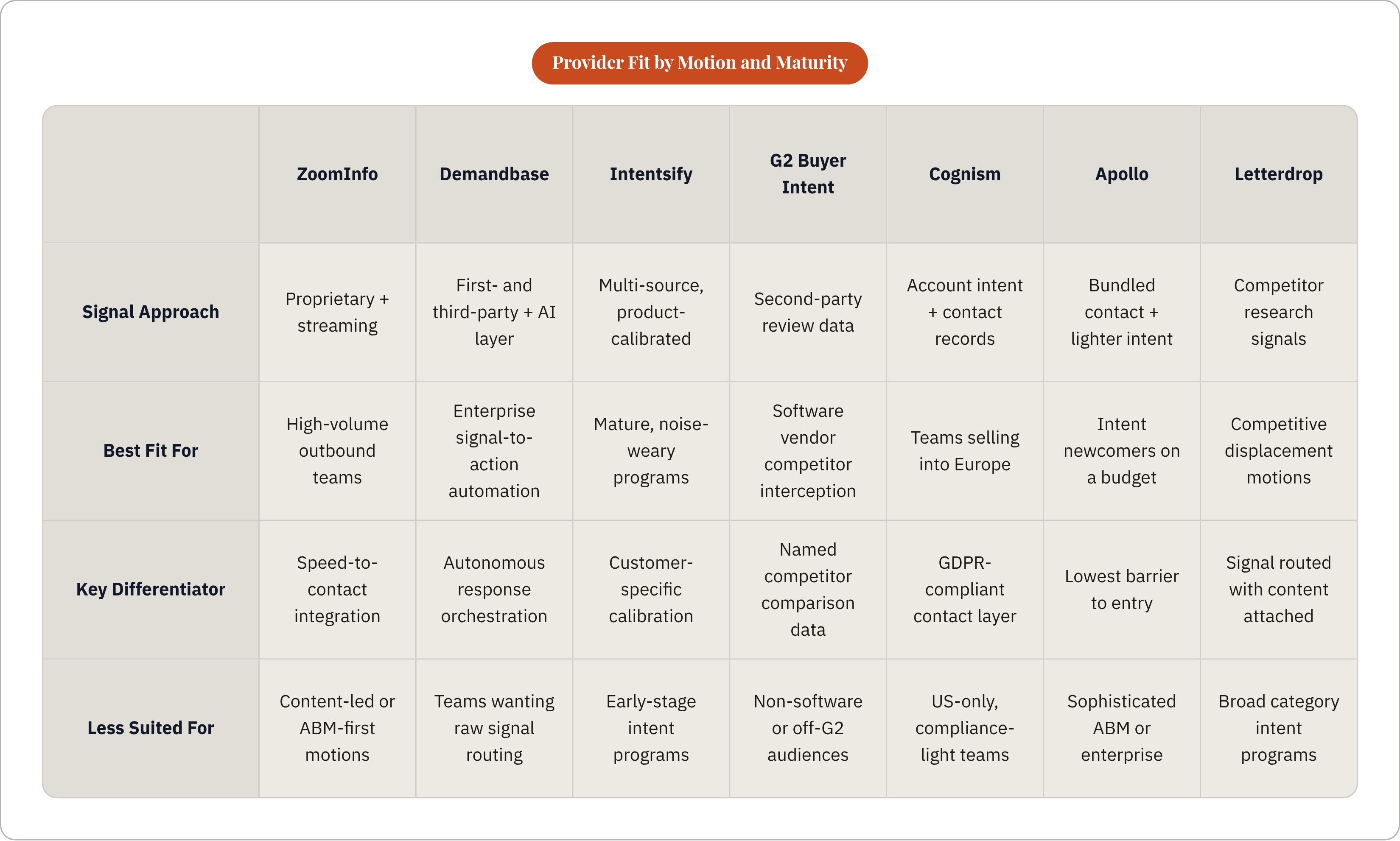
No provider is universally better. They're built differently, they surface different things, and the question worth asking is fit to your motion, not a global ranking.
ZoomInfo combines proprietary intent signals with a large contact and company database, including streaming signals for real-time triggers. Intent and verified contact data live in the same platform. For high-volume outbound teams where speed-to-contact is the primary lever, that integration matters. It's less well-suited to content-led or ABM-first motions.
Demandbase combines first- and third-party signals with an agentic AI layer called Agentbase, launched in 2025, that moves beyond surfacing signals toward autonomously suggesting and orchestrating responses. The platform tells you what to do next, not just who is in-market. Best fit for enterprise teams where signal-to-action latency is the core problem. Teams that want raw signal data to route into their own systems find it over-engineered for their needs.
Intentsify takes a precision-focused approach. Its multi-source signal aggregation includes calibration tuned to each customer's specific products rather than relying on generic topic categories. This matters a lot if you've already been burned by noisy signals, which most teams running intent programs for more than a year have been. It earned the top Current Offering score in the Forrester Wave Q1 2025 evaluation of intent data providers. Best fit for mature intent programs where generic topic signals have already proven too messy to act on reliably.
G2 Buyer Intent is second-party data from G2's own review platform. Comparison page views, category searches, competitor profile visits. Uniquely useful for competitor interception because it surfaces accounts actively comparing your product against named alternatives. Coverage is limited to G2's audience, so it's most valuable for software vendors with an active presence there.
Cognism layers account-level intent signals onto GDPR-compliant contact records. The compliance piece is a genuine differentiator for teams selling into Europe, where data regulations constrain a lot of US-headquartered providers in ways that only become obvious after you've already signed the contract.
Apollo bundles lighter intent signals with a large contact database at accessible price points. Lowest barrier to entry of this group. A reasonable starting point for teams newer to intent data who want to test signal-based prioritization before committing to enterprise-level spend. Less suited for sophisticated ABM or enterprise account orchestration.
Letterdrop is a content marketing and sales enablement platform that helps revenue teams tie content to pipeline. It supports competitive displacement motions by connecting content creation and distribution to the buying stage, so the material a rep sends is matched to where the buyer actually is in their evaluation, and marketing efforts can be attributed back to revenue. For B2B revenue teams building an inbound engine alongside their outbound motion, the fit is direct.
What the 2025 market consolidation means for teams evaluating now
The intent data market is consolidating fast, and it's changing what you're actually buying when you sign up for one of these platforms.
HG Insights acquired TrustRadius in 2025, merging review-based intent with technographic install data. HubSpot absorbed Clearbit into its Breeze Intelligence layer, bundling intent directly into the CRM rather than selling it as a separate product. Standalone signal providers are getting absorbed into broader go-to-market platforms. ZoomInfo shipped Copilot. Demandbase released Agentbase. The pattern is consistent: autonomous recommendation or outreach triggered by signals, with less human routing in between.
This changes the evaluation question. You're no longer just asking which provider has the best data. You're asking which platform will turn that data into pipeline action with the least operational overhead.
One thing worth knowing before you sign anything: multiple providers integrate or resell the same underlying co-op data. You are paying for the same base signal through different wrappers. The real differentiation increasingly lives above the data, in the modeling, calibration, routing logic, and action triggers. The raw signal is becoming a commodity. The layer built on top of it is not.
A provider chosen today for its data coverage will look quite different in two years as bundling continues. Evaluate platform stickiness and integration depth alongside current signal quality. Otherwise you'll be re-evaluating sooner than you planned, probably right around the time your contract auto-renews.
The operationalization gap and why signal quality alone does not close deals
Widespread adoption of intent data has not produced widespread pipeline results. This gap is well-documented, and it is almost always an execution problem, not a data quality problem. I've seen teams spend real money on solid intent data and then watch signals expire in a Slack channel because nobody defined who was supposed to do something about them.
The failure modes are predictable:
Signals get routed to a Slack channel or a spreadsheet with no defined owner and no response SLA. They decay before anyone touches them.
Reps receive account names flagged as "in-market" with no context on what the account was actually researching or what to say when they reach out.
Marketing treats intent signals as a source of new MQLs rather than a prioritization layer on top of existing pipeline and target accounts.
Speed is structural, not optional. When a buyer is in active evaluation, the first vendor to engage holds a disproportionate advantage. Days instead of hours and you're functionally out of the conversation before it starts. There's no clever messaging that compensates for being the third call a buyer takes on a Tuesday afternoon after two competitors already had the meeting.
Signal corroboration matters for the same reason. A single unverified third-party spike is a hypothesis. Third-party topic activity confirmed by first-party engagement data is something you can actually act on. The practical rule: require corroboration before routing a signal to a rep.
Closing the operationalization gap comes down to three things, none of which are complicated, all of which require someone to actually make a decision:
Defined routing rules: which signals go directly to sales, which go into marketing nurture, which need additional confirmation before anyone acts on them
Content matched to the signal: a rep acting on a competitor comparison signal needs completely different supporting material than a rep acting on a broad awareness signal
Structural alignment between marketing and sales: marketing sets the routing logic and creates the content; sales executes the outreach; without this, signals accumulate in dashboards and generate reports that nobody reads
How competitor intent signals work as a specific revenue motion
Competitor intent is not the same as category intent. Running the same playbook for both is how teams leave deals on the table.
When a buyer researches a broad topic, they do not have a defined project. When a buyer is actively comparing your product against a named competitor, the situation is different in every meaningful way. They've already identified the problem. They've already started shortlisting. The buying stage is implicitly higher, and the urgency is real. You are not trying to create awareness. You are trying to win a decision that is already in progress.
Two primary data sources feed this motion:
Review site comparison data (G2 Buyer Intent being the clearest example) tells you a named account is comparing your product against specific competitors. You know who. You know what they're comparing. You know approximately where they are in the process. Highest-specificity competitor signal available.
Third-party co-op signals surface accounts spiking on a competitor's brand name or on switching and replacement keywords. Lower specificity, but broader coverage. You'll catch accounts that aren't active on review platforms and would otherwise be invisible until they've already made a decision.
The motion that makes this work is routing the signal with context and with the right content attached. A rep who receives "this account is comparing you against Competitor X" and nothing else will improvise. Sometimes improvisation goes well. Usually it doesn't, and you find out too late.
Equipping reps with content matched to the buying stage ensures they arrive to competitor conversations prepared rather than improvising. The content a rep sends carries meaning because it was built around where the buyer actually is in their evaluation.
The window on a competitor signal is shorter than almost any other intent signal. When a buyer is actively comparing options, they are going to make a decision. The only question is whether you're part of that conversation before they do.