Job-Change Outreach Sequences That Convert Warm Relationships
Warm introductions to executives in new roles convert eight times better than cold outreach.

A job change is the one buying signal that's reliably true. Someone left Company A, they're now sitting at Company B, and that's a fact you can build a sequence around instead of a guess you have to hedge against. Most intent data gives you a probability wearing a percentage sign like a costume, and a job change skips the costume entirely.
Here's what actually shifts when an executive lands in a new seat. They inherit new performance metrics and a short runway to prove they were the right hire. They get budget authority to make calls fast, often before anyone's entrenched enough to stop them. Psychologically, they owe nothing to the vendor stack sitting on their desk when they walk in, because they didn't pick it. No sunk cost, no loyalty, no "well, we've always used this." That's a wide-open door, and it stays open for a limited stretch.
It's also opening more often than it used to, and buying committees don't sit still anymore. Median U.S. employee tenure has been trending downward, and buying committees don't sit still anymore, and committees turn over like a bad rental property. Because deals now run through bigger committees with more stakeholders per decision, a single job change can flip a deal that was already in motion, for better or worse. Warm relationships supercharge all of this, because trust is the expensive part of any sales cycle, and a warm contact already banked it somewhere else.
The pattern repeats across industries: a warm relationship that moves companies doesn't reset to zero — it carries forward, and the rep who follows it rarely has to start the sales conversation from scratch.
The conversion gap between warm job-change outreach and everything else
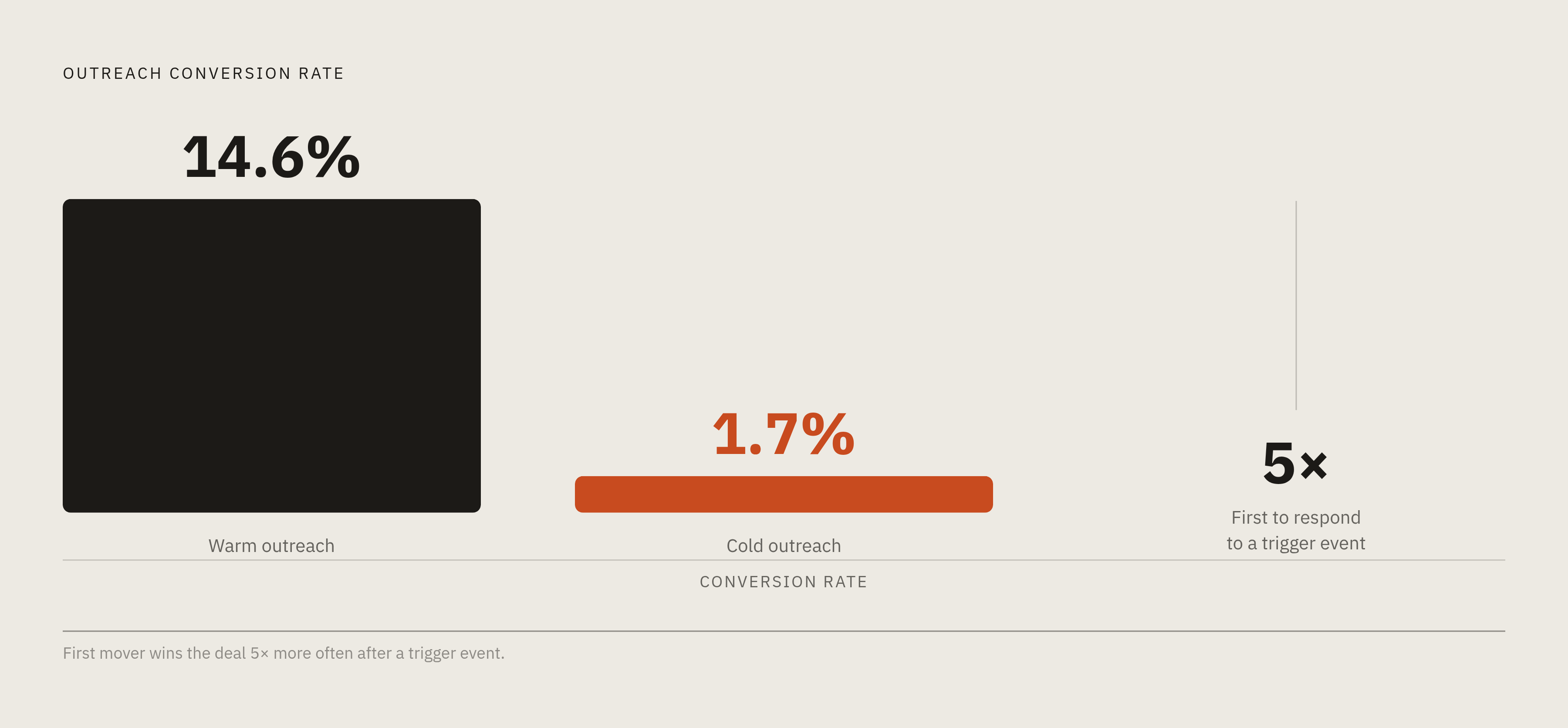
Put the two numbers side by side and the gap is stark. Warm outreach converts at 14.6%, while cold sits at 1.7%. That's a canyon with a Wi-Fi router at the bottom nobody's climbing down for. Job-change leads specifically convert at meaningfully higher rates than standard cold outbound, reflecting the trust and timing advantage the signal carries.
Speed decides who gets to celebrate. The first seller to reach out after a trigger event is five times more likely to win the deal, and teams that move quickly after the signal fires see meaningfully higher response rates than those that wait. Miss that window and the story gets worse: a significant share of B2B sellers report losing or delaying deals because a stakeholder changed jobs and nobody had a sequence ready to catch it. The signal was right there, and nobody was holding the net.
Meanwhile, cold outreach keeps eroding under its own weight. Reply rates fell from 6.8% in 2023 to 5.8% in 2024 across a dataset of 16.5 million cold emails, a 15% year-over-year decline. Every point cold loses makes warm capacity worth more by comparison, which is why successful B2B teams tend to put 30 to 40% of outreach capacity into warm campaigns and the rest into cold prospecting. Job-change sequences should anchor that warm tier.
Picture cold outbound as fishing with a net in open ocean, and warm job-change outreach as fishing in a stocked pond where you already know every fish by name. One takes patience and luck. The other just takes showing up with bait they already like.
The 90-day window and how it splits into distinct buyer modes
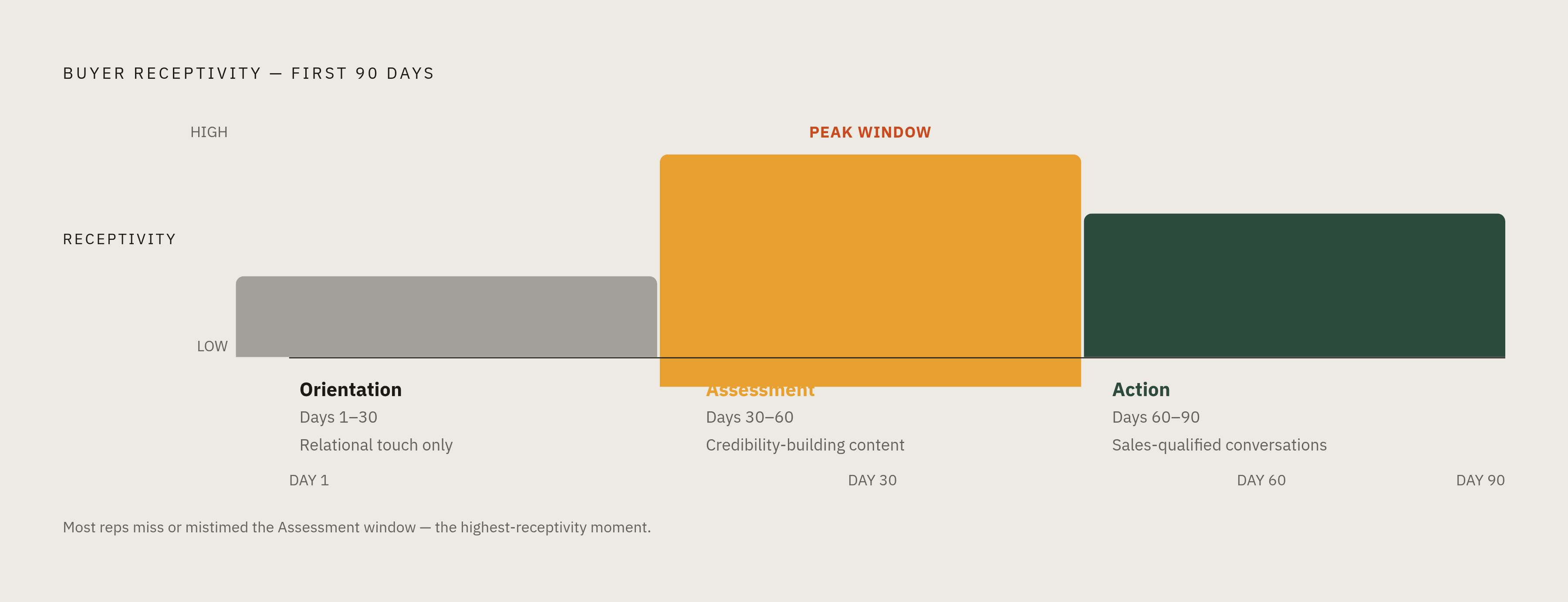
New executives are far more likely to evaluate new vendors in their first 90 days than at any point after. That window is real, and it closes the way all doors close: quietly, then completely.
Inside those 90 days sit three different people wearing the same executive's name badge. Days one through 30 is orientation mode: they're learning the org chart, inheriting whatever stack came with the office, and they are not deciding anything. Outreach here should feel relational, more "welcome to the neighborhood" than "here's our pricing tier."
Days 30 through 60 is assessment mode, and it's the good stuff. They're auditing what they inherited, spotting the gaps, forming early opinions about what needs to go. This is the highest-receptivity window for a credibility-building touch, the moment where being helpful actually lands. Then days 60 through 90 shifts into action mode: budget conversations start, first initiatives take shape, vendor decisions stop being theoretical. This is when a sales-qualified conversation stops being premature.
Worth noting: not every new executive arrives the same way. Someone hired from outside often carries an explicit mandate to shake up the existing tools, so their assessment phase starts earlier than the calendar suggests. Someone promoted from within already knows where the bodies are buried, but faces real pressure to show fast impact, which makes them unusually receptive to anything that helps them look decisive quickly.
Sequences that skip these phases fail predictably. Ask for a demo on day five and the message reads loud and clear: this sender cares about their pipeline, not your situation. That's the fastest way to burn a warm relationship before it ever gets used for what it's worth.
Q: What do you call a sales rep who pitches on day one of someone's new job? A: Unemployed by day two — of the deal, anyway.
Detecting the signal before competitors do
Job changes are visible, but they're also scattered across LinkedIn, CRM records, bounced emails, and a handful of third-party data feeds, which means teams relying on manual monitoring miss the 48-hour window almost every time. Somebody's scrolling LinkedIn on a Tuesday and finding out three weeks late. That's closer to archaeology than detection.
Layer the sources instead. First-party signals include CRM contact updates, a champion's old email address bouncing back hard, and LinkedIn connections announcing a new title. Third-party job-change data providers monitor LinkedIn and employment records at scale, catching what a human scrolling feed would miss. Contextual signals matter too: a LinkedIn post announcing the new role often comes with a wave of engagement, a public warm signal worth responding to publicly before ever sliding into a direct message.
Stack the signals and the opportunity gets sharper. A contact who just changed jobs is good. A contact who just changed jobs at a company that's also showing content engagement or review-site activity, someone reading comparison pages on G2, say, is a materially stronger opportunity than the job change alone.
None of this works if the CRM record never gets updated. That's the quiet killer: no updated record, no triggered sequence, no speed advantage, full stop. On the topic of signal quality generally, it's worth remembering that a job change sidesteps the noise plaguing most intent data. research from pipeline.zoominfo.com found 73% of B2B organizations increased content marketing budgets over the past year, yet a large share of those same organizations report the signals underneath are unreliable or inflated. A job change carries none of that ambiguity: it's either true or it isn't. Recommended cadence: weekly automated sweeps across the customer and prospect base, with alerts routed straight to the rep who owns the relationship, not dumped into a generic SDR queue where it'll die of loneliness.
Sequence architecture: how to stage touchpoints across the 90-day window
One rule governs the whole architecture: give something, don't ask for something, until the buyer's mode shifts to action. Everything else is staging.
Stage 1, days 1–7, is the congratulatory touch. Use LinkedIn or a short personal email, whichever channel the relationship actually lived on. Zero pitch, no link, no ask, just a reference to something specific about the new company or role. This tells the recipient the sender was paying attention, not running a mail merge.
Stage 2, days 14–21, is the value touch. Share something genuinely useful for their new context, original research, a benchmark, a case study from a comparable situation. Content that makes them look smart in front of their new boss is the single highest-value gift available at this stage.
Stage 3, days 30–45, is the light relevance touch. A short, specific question about what they're inheriting or what priorities are forming. This is the first message that openly acknowledges shared professional history, and it should surface whether they've entered assessment mode yet.
Stage 4, days 45–60, is the insight or proof touch. Connect what's known about their new company's situation to a specific, concrete result achieved for a similar company. One paragraph with a real outcome beats a brochure link every single time; nobody's ever forwarded a PDF to their boss out of excitement.
Stage 5, days 60–75, is the soft ask. By now the relationship has been maintained for two months without a single pitch, so the ask is earned. Frame it around their situation: something like offering to share what's worked for teams rebuilding a similar stack after a leadership change, twenty minutes, no obligation.
Stage 6, days 75–90, is the follow-through. One last touch, brief and warm, zero frustration baked into the tone. Offer a specific asset or an invite to something relevant, then leave the door open. If there's still silence, move the contact to a nurture track rather than a cold sequence. The relationship doesn't expire just because the timing didn't work out.
Match the channel to where the relationship actually lived. Opening on email after a purely LinkedIn history feels cold and out of nowhere, while opening on LinkedIn after a purely email history can feel a little like surveillance, which is not the vibe anyone's going for in a warm sequence.
Tone and messaging: how warm outreach goes wrong even with the right timing
Here's the trap: a rep gets the timing exactly right and then torches it with templated copy. The contact is warm, the sequence is staged perfectly, and the message still reads like a vendor alert because nobody bothered to write like a human being.
A few things kill warm tone on contact. Opening with a product or company name before acknowledging the person's actual change. Using shared history as a Trojan horse for a discount pitch ("As a former customer…" followed immediately by an offer). Attaching a deck to the very first touch. Writing about "our capabilities" in the third person, like a press release wearing a name tag.
A founder once opened a warm email with "I hope this finds you well" and then, three lines later, wrote "as you settle into your new role, I wanted to loop you in on our Q3 roadmap."" The recipient hadn't settled into anything. He'd been in the job four days, and he forwarded it to a friend with one line: "found."
Warm tone needs specificity: their new company, their new title, something they said publicly, anything that proves a real person read past the name field. It needs the buyer's situation acknowledged first and the solution left out entirely in the early touches. It needs brevity, because a warm email running longer than four sentences reads like a cold pitch no matter how warm the relationship actually is. And it needs a conversational register, the way someone writes to a former colleague, not the way someone writes a pitch deck's cover email.
There's a difference between personalization and personalization theater. Mentioning the company name and industry is theater. Connecting the message to a specific challenge that company or role is actually facing is the real thing. When content enters the picture, original research or a practitioner-written insight beats a product landing page every time, because it signals the goal is to be useful, not to convert. Big difference. One's a gift, one's a trap with a bow on it.
Using the job change to re-enter stalled or lost deals
A deal lost to a competitor. A deal stuck in procurement purgatory for six months. A relationship that went dark for no dramatic reason at all. A job change in a key role hands the sender a legitimate, relationship-appropriate excuse to knock again, and that excuse is worth more than it sounds.
Three situations, three different plays. A former champion landing at a new prospect account already knows the product cold, so the sequence can skip stages one and two entirely and open at stage three with a direct reference to shared history. A new executive arriving at an account where a deal previously stalled inherits zero loyalty to the status quo, so the re-engagement should frame around what that new leader is trying to build, not what got discussed with their predecessor eighteen months ago. And an incoming leader replacing a departed champion at an existing customer account calls for retention framing rather than a sales sequence, though the structure still mirrors stages one through three closely.
Speed matters just as much here as it does on new-logo outreach. The same urgency logic that applies to new-logo outreach holds here: acting on a job-change signal quickly is consistently associated with better retention outcomes. The same urgency logic applies on the sales side the moment a key contact leaves a prospect account behind.
One thing to avoid entirely: relitigating the old deal before finding out what the new executive actually cares about. Opening with "I know we talked to your predecessor about X" before establishing any new context is a fast, reliable way to earn a hard no. Compress the timeline for a former champion, since trust is already built, but stretch it out for a new executive walking into a cold account with no prior context, because that relationship starts from exactly nothing.
A stalled deal is a little like a sourdough starter left in the fridge too long — it's not dead, it's dormant, and the right feeding at the right moment brings it right back to life.
Tracking whether job-change sequences are actually working
Most teams fold job-change outreach into general outbound metrics, which is a little like measuring a marathon and a nap under the same stopwatch. The numbers blur together and nobody can tell what's actually working.
Job-change sequences need their own scoreboard. Response rate by stage shows which touch breaks the silence and how often. Time-to-first-meeting from signal detection measures speed and sequence quality in the same breath. Meeting-to-opportunity conversion answers the harder question: are these conversations turning into real pipeline, or just polite replies that go nowhere? And win rate plus deal velocity against the cold outbound baseline tells the real story; warm campaigns should be aiming for 10 to 30% response rates with noticeably faster cycles than anything cold.
There's a broader benchmark worth measuring against too. Content-attributed pipeline, deals where the buyer consumed at least one content asset before entering the sales process, averages 27% of pipeline for B2B companies overall, with top performers clearing 50% or more. Job-change sequences leaning on well-chosen content assets should be tracked against that same number. Companies that measure content-attributed pipeline specifically, rather than just counting traffic, report 2.3 times higher executive confidence in content budgets, and the same logic holds for warm outreach: proving the line from signal to revenue is what gets a program protected the next time budget season rolls around.
Review sequence performance by stage on a quarterly cadence. Low response at stage three usually means the tone showed up too early, while low meeting acceptance at stage five usually means the ask hasn't earned enough credibility yet. Treat the sequence as something that gets rebuilt slightly every quarter, not something bolted together once and left alone. Done well, it compounds: former champions start accumulating across accounts, and the warm list gets a little deeper every time somebody changes jobs, which, per that 3.9-year tenure number, is happening more than it ever used to.