Champion-Led Growth as a B2B Expansion Strategy
Expansion revenue costs three times less than acquisition—if you build the system to find it.

Most B2B revenue doesn't come from new logos. It comes from customers who already signed: 73% of B2B revenue traces back to existing accounts, according to Forrester's 2025 Marketing Survey. Marketing budgets still pour into acquisition anyway, like nobody read the memo. Champion-led growth is the fix, and it only works as a system you build on purpose, not a happy accident that happens when your product doesn't stink.
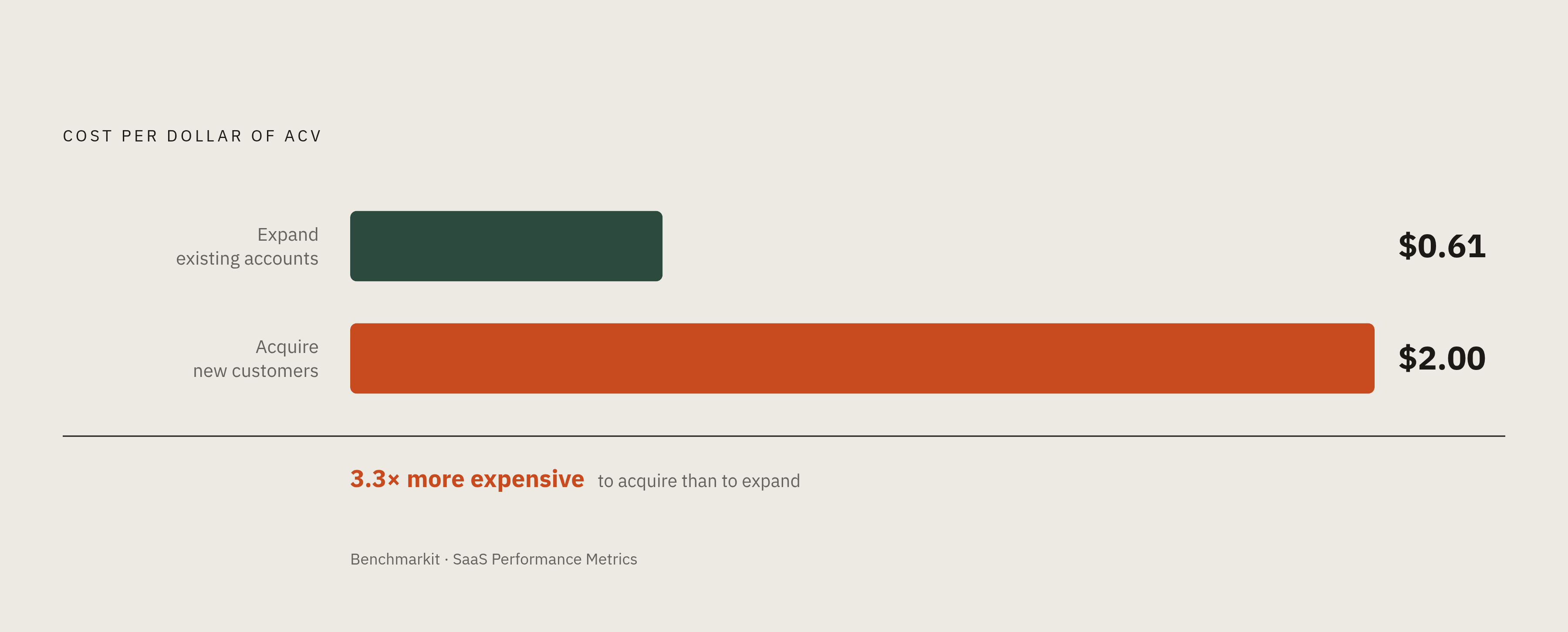
Here's the number that should bother any CFO. Benchmarkit's SaaS Performance Metrics report puts expansion revenue at roughly $0.61 per dollar of ACV. New customer ARR costs about $2.00 per dollar. That's paying more than three times as much for the harder version of the same outcome, and most teams still treat expansion as something that happens to them during a renewal call instead of something they build on purpose.
The gap between that math and actual behavior comes down to one missing piece: nobody built the machine. Sales waits for the upsell conversation to surface on its own. Customer success waits for the renewal to remind everyone the account exists. Nobody's running a system that finds the person inside a customer account who already believes in the product and turns that belief into a channel. Champion-led growth is that system, and it only works if "champion" means something specific, not whoever answered the phone last.
What a champion actually is and why the role is distinct from buyer, sponsor, or influencer
A champion is the person inside a customer's company who pushes your product upward and sideways without being asked to. Not the economic buyer, who signs the check and might not even log in. Not the technical evaluator, who runs the bake-off and moves on once the decision's made. The champion is the one still talking about your product in a team messaging channel three months after the deal closed, because they actually have something riding on it.
That personal stake is the whole thing. A champion isn't executing a task someone assigned them. They believe the tool makes their team look good, makes their own job easier, or gets them noticed by someone two levels up. That belief is what makes the advocacy self-sustaining instead of something a vendor has to keep refueling.
Three things separate a champion from everyone else in the room. They burn their own political capital to move a deal forward, calling in favors and reading the room in ways a vendor never can from outside. They translate the pitch deck into language their coworkers actually respond to (nobody internally cares about a "value prop," they care about not getting yelled at in the Monday standup). And they catch objections before those objections ever reach the vendor, killing the "but what about security" question in a hallway conversation nobody on the sales team will ever hear about.
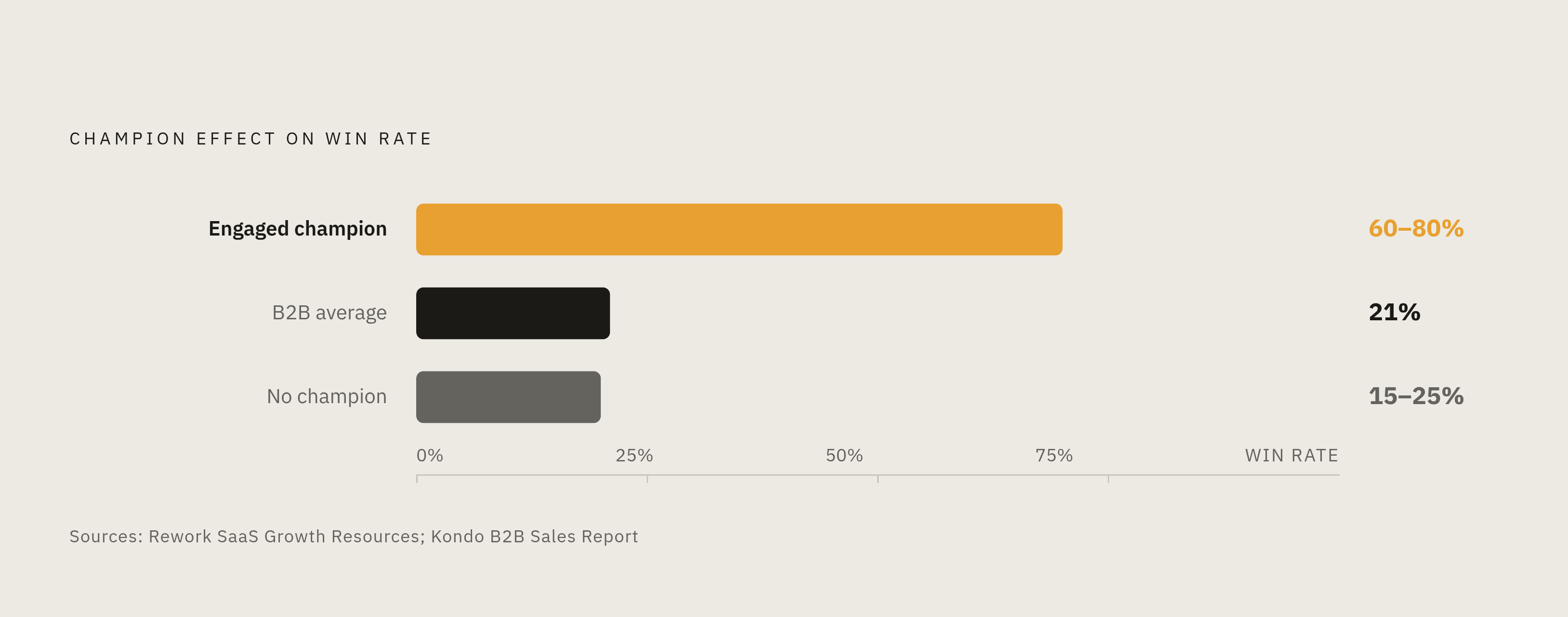
A sponsor is not a champion, and mixing the two up is where deals quietly die. A sponsor opens doors and won't lift a finger once you're inside. A friendly user isn't a champion either. They'll give five-star feedback but have zero pull with whoever approves budget. Mistake either one for the real thing and the pipeline forecast is fiction. Deals with an engaged champion close at 60 to 80%, while deals without one close at 15 to 25%, per Rework SaaS Growth Resources, against an average B2B win rate of around 21%, according to the Kondo B2B Sales Report. That gap is far larger than a rounding error. It's the difference between a forecast and a guess.
Champion-based selling and champion-led growth sound like the same idea, and conflating them is where most programs stall before they start. Champion-based selling is a rep noticing a good advocate in one deal and working that one relationship. Champion-led growth is a system: finding, developing, and activating champions across the whole customer base, not just the handful of open opportunities sitting in this quarter's forecast.
How to identify potential champions before they self-select
Waiting for someone to volunteer isn't a strategy, it's patience wearing a strategy's clothes. It gets exactly one loud advocate per account and misses every quieter influencer who's just as valuable and twice as reliable, because they don't need applause to keep advocating.
Inside an existing account, the signals are behavioral, and none of them require a psychic. Someone using features well past the basic workflow, going deeper than their peers. Someone forwarding vendor emails internally, or name-dropping the product in a cross-functional meeting nobody from the vendor was invited to. Someone asking "how would this work for our ops team?" (translation: they're already selling it in their head, out loud, to themselves). Someone who says yes instantly when asked for a reference call or a case study quote.
Net-new deals need a different lens, because there's no behavior to read yet, just a committee. Research puts the average B2B buying committee at around 6.8 stakeholders, a figure that has since grown to 11.2 in more recent data. Mapping that many people takes more than finding whoever's friendliest on the first call. It means finding whoever inside that group wants, personally, to own the outcome.
Referrals are the shortcut worth trusting over almost anything else. 84% of B2B buyers start their purchase process with a referral, and an account that shows up because someone vouched for the product almost always has a latent champion already sitting inside it. That person did the vouching. Go find them instead of starting the search from scratch.
The profile that actually holds up has three parts, and all three need to show up together or the champion folds the second someone pushes back. Enough seniority to get heard by the economic buyer. Enough hands-on proximity to the problem to be credible with the technical evaluator. And genuine belief that the product solves something real. Influence without belief just produces a champion who hedges in the room when it counts.
What champions need from vendors to sell effectively inside their organisations
Champions want to help. Wanting to help and knowing how are two different things, and treating them as the same thing is where well-intentioned champions get steamrolled in their own hallway. Most of them have never built an internal business case, never priced out an ROI argument for a CFO, and have no idea what to say when procurement starts asking about data residency.
Good enablement fills that gap, and it looks less like marketing collateral and more like a toolkit built for somebody else's job. A business case template written in the customer's own financial language, so the champion isn't starting from a blank page at 11pm before a budget meeting. One-pagers built for specific audiences (IT security gets one version, finance gets another, the C-suite gets a third, because nobody in security cares about the finance team's spreadsheet). A short list of the five objections that come up every single time, with real language to answer them, handed over before the vendor's even in the room. And proof: case studies, review-site ratings, side-by-side comparisons the champion can drop into a team chat when a skeptical coworker starts pushing back. Gartner found deals with customer references close at 2 to 3 times the rate of deals without.
The complexity isn't shrinking either. Recent data puts the average enterprise buying committee at 11.2 stakeholders. That's more people, more competing priorities, more places for the whole thing to stall in a hallway somewhere, and enablement built for a two-person approval chain doesn't hold up against 11 people with 11 different agendas.
Content is infrastructure here, not decoration. The vendor builds it, the champion deploys it, and the deal keeps moving without the vendor needing to be cc'd on every internal email. Skip that step and deals stall at the exact approval stage the champion can't navigate alone. Their credibility takes the hit when they can't answer a question, and the vendor ends up blamed for a process it never actually supported.
Champion mobility: when your best customers change jobs and become your best pipeline
Champions quit their jobs. That's not a loss, it's a tip sitting on the table that most companies never pick up. When a champion leaves one company and lands somewhere inside your ideal customer profile, the trust that took six months to build doesn't reset. It travels with them. They've already run the evaluation, already fought for the product internally, and now they're in a new building with a fresh budget and zero interest in relitigating a decision they already made once.
The window to act is short, and it closes fast. Re-engaging within 14 to 30 days of a detected job change produces conversion rates 3 to 5 times the cold baseline, per Boomerang AI, mostly because that's the window before the new employer is already deep into a competitive RFP with three other vendors circling.
The scale here is bigger than most teams assume. A 200-employee B2B company running 500 active customer relationships will see somewhere around 750 to 1,500 job changes across that base in a given year, per Boomerang AI's analysis. If even 30% of those moves land inside the ICP, that's 225 to 450 warm leads a year, sitting there, mostly ignored.
Armis put a real number on what happens when someone actually builds the system. In its first year running a champion mobility program through Boomerang AI, the team activated 26,000 warm-intro paths and reported a 10x return. The program turned champion job changes into a repeatable source of new pipeline.
The same signal cuts two ways, and that part is easy to miss. A departing champion is new pipeline at the company they just joined. But the account they left behind often goes quiet right after they walk out the door, and that silence is an early churn signal worth catching before it turns into a lost renewal.
Almost nobody tracks this properly, and that's the actual failure mode worth naming: most CRMs record who the champion was at a given moment, not whether they've since moved. The signal sits in LinkedIn activity and employment data the entire time. Most teams simply don't have anything watching for it.
The tools built specifically to operationalise champion tracking and mobility
Checking LinkedIn manually for 750 to 1,500 job changes a year, spread across hundreds of accounts, is a losing bet. It's a part-time job nobody wants and nobody's doing well, and that gap between signal and action is exactly why a small category of tools now exists to close it.
Boomerang AI runs champion mobility detection and drafts warm intros through an agent it calls Rudy, then plugs into Salesloft to fire off a re-engagement sequence the moment it flags a job change.
Champion (championhq.com) raised $3.3 million in seed funding in September 2024, led by Flyover Capital, with High Alpha, Bread & Butter Ventures, and Stage 2 Capital also in the round. It expanded its Gainsight partnership in 2026, adding new capabilities that connect champion identification and activation directly to revenue outcomes. It also launched on the Salesforce AppExchange in 2026, bringing its Match AI Reference engine straight into Salesforce.
UserGems focuses specifically on job-change tracking, including what it calls "forgotten champions": past contacts who've moved into ICP-fit accounts and never got a follow-up call.
What connects all three matters more than what separates them: each one turns a static contact list into something that watches for movement, drafts the outreach, and routes it to the right rep before the 14-to-30-day window closes. Passive referral programs, the kind with no real activation behind them, cap out contributing 5 to 10% of pipeline. Programs with real incentives, recognition, and networking behind them reach 25 to 35%, per Boomerang AI. Picking between the tools mostly comes down to where the data already lives: teams running Gainsight get more out of Champion's integration, teams running Salesloft get more direct value from Boomerang AI's cadence automation.
Connecting champion signals to competitor intent for mid-cycle buyer interception
This is where most teams leave the biggest win sitting on the table, untouched. A former champion lands at a new company. That same company, at the same moment, starts showing signs of comparing vendors: pricing pages, review sites, competitor research. That's not a coincidence worth shrugging off. It's an active evaluation happening in real time, with someone already inside it who's already on your side.
Timing decides most B2B deals, and this is the one moment where a champion's trust and an active buying decision land at exactly the same time. The champion isn't walking in cold to pitch a maybe. They're walking into a room where the decision's already being made, carrying credibility they earned somewhere else, months ago.
The clock doesn't care who's involved. Per SPOTIO's sales statistics, 35 to 50% of B2B deals go to whichever vendor responds first to a buying signal. A champion doesn't guarantee the win, but it puts a name and a face on one side of that race that didn't exist a week earlier.
Stacking signals is what turns a maybe into a real trigger worth acting on. One data point alone, say a visit to a competitor's pricing page, isn't much on its own. Stack that pricing page visit with a job posting for a Revenue Operations role and a known champion who just joined that same account, and now there's urgency, budget, and an internal advocate lined up at once. Teams working multiple signals together see conversion rates 25 to 35% higher and sales cycles 30 to 40% shorter than teams relying on a single intent source, according to analysis from salesmotion.io.
Intent data tells you a company's shopping. It doesn't tell you who's in the room, and it can't get you a seat at the table. A champion does both. The materials that champion needs in this exact moment look nothing like a standard sales deck: competitive comparisons, real win-loss stories from similar deals, and specific answers to whichever competitor is currently getting searched inside that account.
How to structure a repeatable champion program rather than a set of one-off relationships
None of this holds up if it lives in one rep's head and a few scattered CRM notes. That rep leaves, the account gets reassigned, and the whole relationship disappears with them. A champion program built on individual memory is just a collection of individuals. It's a rumor with a spreadsheet attached.
Four things make it durable instead. A champion registry, an actual maintained list of who the champions are, tagged by account, seniority, advocacy history, and current job status, kept separate from the generic contact list nobody bothers to update. A job-change monitoring layer, tooling or process that catches a move inside that 14-to-30-day window and routes it straight to whoever owns the account with a clear next step attached. A tiered content library, organized by audience (executives, procurement, IT) and by deal stage, so a champion gets exactly what they need instead of a folder dump they'll never open. And a recognition structure, because champions who get thanked, credited publicly, or rewarded for referrals keep showing up, while the ones who don't quietly stop. Boomerang AI's benchmarks are blunt about this: incentive structure is the difference between a program contributing 25 to 35% of pipeline and one stuck at 5 to 10%.
None of it works if marketing and sales stay in separate lanes. Marketing has to build the content champions actually use, and sales has to surface which accounts have live champion signals worth acting on right now. Skip the coordination, and both sides quietly underinvest in exactly what the other one needs.
The payoff for getting that alignment right isn't small, and it isn't soft either. Per Marketo research cited in Martal's 2026 B2B SaaS marketing analysis, revenue teams that align well see close rates 67% higher than teams that don't. A champion program forces that alignment structurally. It's not a nice-to-have once it's actually running.
None of it means anything without measurement, and this is the step most programs skip. Champion-sourced pipeline needs its own attribution category, not a footnote in the CRM. Conversion rates need tracking separately for champion-assisted deals versus everything else. Net revenue retention needs a lens on accounts where a champion left versus accounts where one stuck around or got replaced. Skip that data, and the whole program is just a nice story people repeat in quarterly business reviews.
Why champion-led growth compounds over time in ways cold outbound cannot
Cold outbound resets to zero every quarter. New list, new sequence, new set of strangers who've never heard of the company and mostly don't want to. It works, sometimes, but it never gets cheaper and it never gets easier, because every email starts the trust-building process completely from scratch, again.
Champion-led growth doesn't reset. Every champion identified, every job change tracked, every enablement asset built stays in the system and keeps paying out. A champion who moves to a new company becomes a second data point, and that new company's account, if it converts, produces its own champions eventually. The registry gets deeper every quarter instead of emptier.
Outbound is a treadmill. Champion-led growth behaves more like compound interest: quiet for a while, then suddenly doing most of the work by itself. Companies treating it as a real program, not a lucky side effect of happy customers, notice that gap first, and by the time competitors catch on, there won't be much runway left to catch up.