Tracking Champion Job Changes as a Pipeline Signal
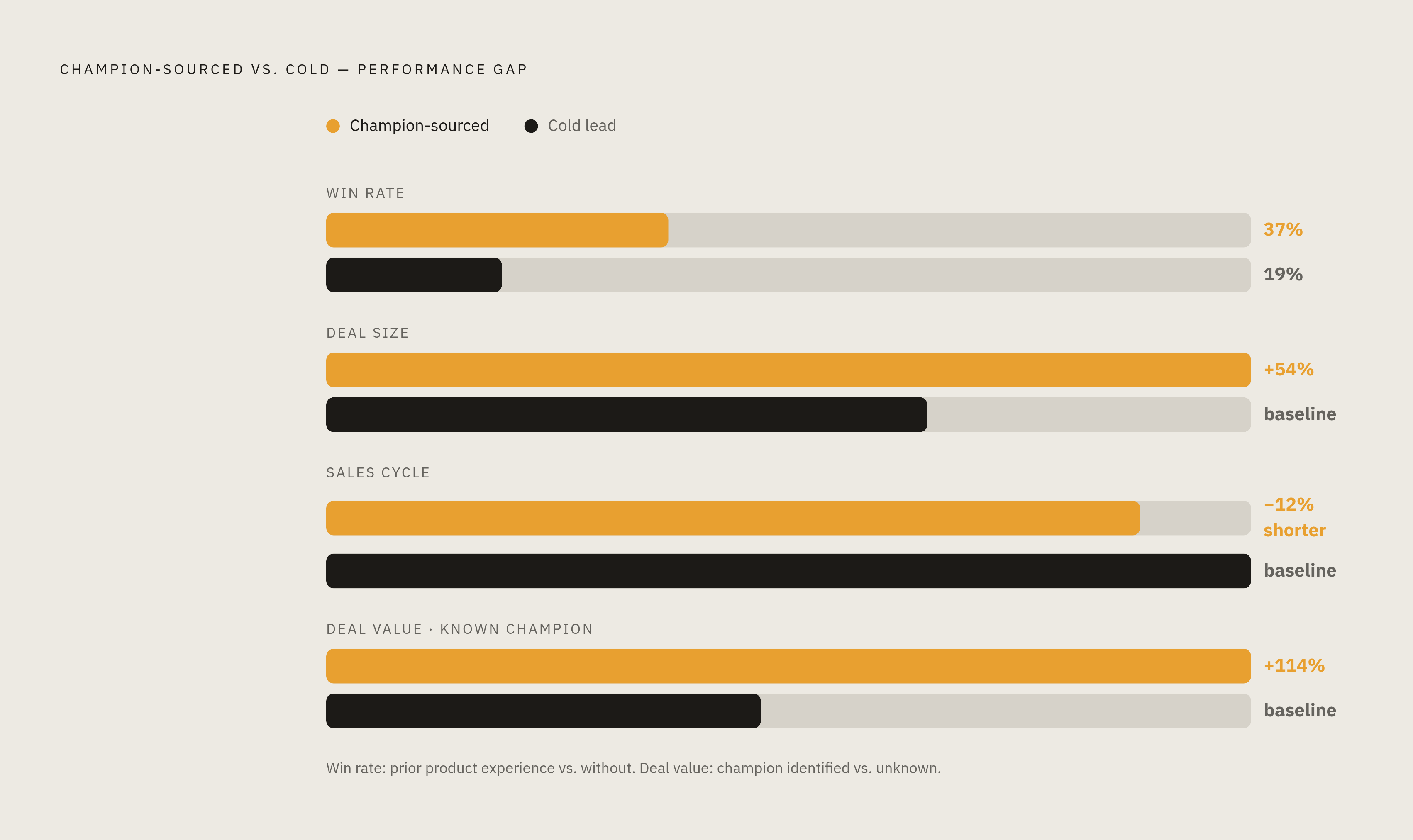
Former champions at new companies close deals twice as fast and 54% larger.

A champion who moves to a new company is one of the best sales opportunities in B2B, full stop. Trust already exists, product knowledge already exists, and the awkward first-date phase of a sales cycle just gets skipped entirely.
Here's why. New leaders show up to a job with a mandate: fix things, buy things, cut things. Reviewing the tool stack sits near the top of that list in the first hundred days, because that's usually where the easiest wins live. The champion who used to work with your sales rep doesn't need a slide deck explaining the problem. They already built that business case once, at their last company, probably in a Google Doc that's still sitting in some shared drive.
Compare that to a cold lead. No shared history, no baseline trust, and the rep carries the full weight of qualifying the deal from scratch, alone, every single time. The lesson underneath all of this: relationships travel with people, not with company logos. When the person changes seats, the relationship goes with them. Nobody signs a non-compete against liking their old vendor.
How big the conversion gap actually is between champion-sourced and cold opportunities
Champify's 2025 Impact Report put a number on it: opportunities where the buyer had prior product experience closed at 37%, versus 19% for opportunities without that history. That's basically double.
UserGems found something similar from a different angle: past buyers who changed jobs were three times more likely to buy again than an average lead. And the full picture goes further than just win rate. UserGems research also found deals influenced by a known champion closed up to 114% higher, ran sales cycles roughly 12% shorter, and landed deal sizes roughly 54% larger on average.
Stack those together and the combined effect is substantial. Faster close, bigger deal, higher odds of winning, all at the same time. That's the kind of triple stack that doesn't show up often in sales data, and when it does, it's worth paying attention to.
So if the signal is this strong, the real constraint is whether anyone on the team has a system built to catch it before it slips by. And that system is getting harder to run every year, because the people generating these signals keep changing jobs faster than anyone expects.
Why buying committees turn over faster than most sales teams realize
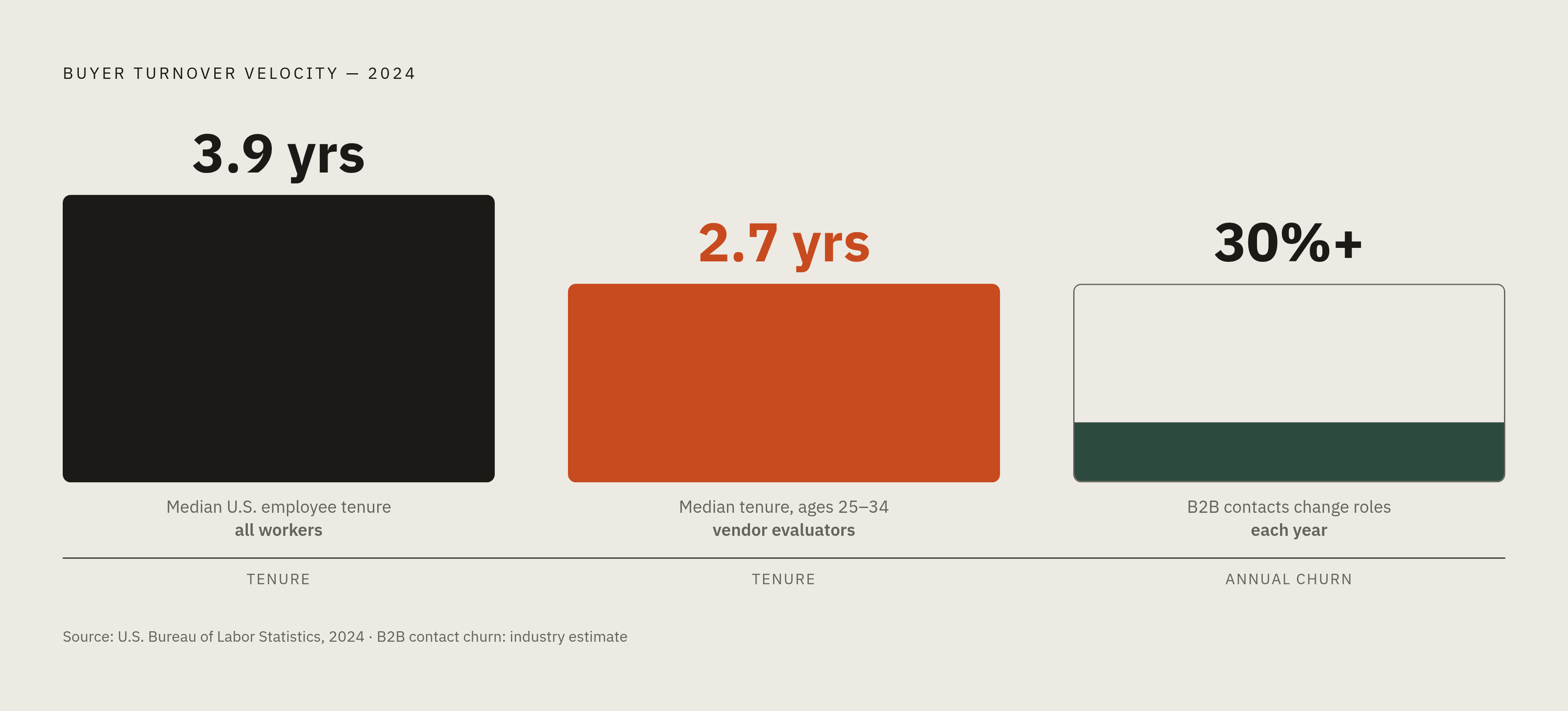
Median tenure for U.S. employees dropped to 3.9 years in 2024, the lowest mark since 2002, according to the Bureau of Labor Statistics. People just don't stay put the way they used to.
Break it down by age and the picture gets sharper. Workers 55 to 64 hold a median tenure of 9.6 years. Workers 25 to 34 hold just 2.7 years, per the same BLS data. That younger band fills most of the manager and director titles that actually run vendor evaluations day to day, which means the population doing the buying is also the population changing seats fastest, roughly every three years on average.
More than 30% of B2B contacts change roles annually, and most sales reps find out months after the fact, usually when an email bounces. Meanwhile the buying committees themselves have gotten bigger and messier. Forrester's 2025 Buyers' Journey Survey found the average B2B purchase now involves 13 internal stakeholders and 9 external participants. That's 22 people who all need to agree on something, and any one of them might be gone by next quarter.
LinkedIn's 2021 research found 85% of B2B sellers had lost or delayed a deal after a stakeholder changed jobs. Champion turnover is a constant condition, not a rare pothole in the road. Teams without a tracking system aren't occasionally caught off guard, they're driving blind the whole time.
The two-sided risk: why a champion departure also signals churn before anything else does
Here's the part most revenue teams miss: a champion leaving is both a sales opportunity somewhere new and the earliest warning sign of renewal risk back at the account they left.
It fires weeks before NPS scores dip, before usage data drops off, before support tickets start piling up. The champion's replacement at the old company has no relationship with the product and zero obligation to keep paying for it. That's just how contracts work when the person who fought for the tool internally is no longer there to defend it.
Sturdy's 2025 research found accounts where customer success acted on a departure signal within 48 hours were 33% more likely to renew. Most teams treat champion tracking as a sales-only motion, chasing the new opportunity and ignoring the renewal defense sitting right behind it. That's a mistake, because the defensive play is just as valuable and a lot less crowded; almost nobody's building for it yet.
Both plays, offensive and defensive, need the exact same raw material to work: a well-kept list of the contacts worth watching in the first place.
Building the contact list that makes champion tracking possible
Everything downstream depends on who's on this list. Get the list wrong and the best monitoring tool in the world just tells you the wrong story faster.
Four groups belong on it:
- Active champions at current customer accounts
- Former champions from closed-won deals, people who already said yes once
- Buying committee members at high-priority target accounts, even before any deal has started
- Decision-makers at closed-lost accounts, since they may be shopping again at a new company
The most common mistake: building the list only from active customers and stopping there. That misses the entire pool of former buyers who've since moved somewhere new and might be ready to buy again. And none of it works if the CRM data underneath is stale. Outdated titles, old emails, dead phone numbers, the monitoring layer can't match a job change to a record it can't recognize. Garbage in, garbage out, as the saying goes, and it applies here just as much as anywhere else.
Prioritize by deal size, how vocal the person was as an advocate during the original sales cycle, and how senior their title was. And treat the list as a living thing, not a spreadsheet built once and forgotten. Accounts churn, new deals close, new champions emerge. The list needs a regular review, or it decays quietly until it's useless.
Why job change signals are more reliable than most intent data
Intent data has a trust problem. DemandScience's 2025 research found 91% of B2B marketers use intent data, yet 87% say the signals it produces are unreliable. Only 26% of flagged intent activity turns into a qualified opportunity, per DemandScience. That's a lot of noise for not much signal.
A job change carries a different kind of weight, because it isn't an interpretation, it's a fact. A topic-spike in intent data means someone at a company researched a category, maybe, possibly, who knows. A job change means a named person moved from company A to company B on a specific date. There's no guessing involved.
Intent data tells a team an account might be in-market. A champion job change tells the team exactly who moved, where they landed, and when, with an existing relationship already sitting there ready to use. That's pipeline that exists today, pipeline that doesn't need three more discovery calls just to get qualified.
One caveat worth being honest about: this signal is sharp but narrow. It only fires when someone specific moves. Champion tracking works best as a complement sitting on top of a broader intent strategy, alongside the rest of the toolkit rather than in place of it.
How layering additional signals on top of a job change raises confidence and timing precision
One signal is just a data point. Three signals from the same account, clustered in a tight window, start looking like an actual pattern worth acting on.
Some combinations worth watching for:
- Champion job change plus active research on your category at the new company means that company is already evaluating
- Champion job change plus new job postings for roles that typically use your product means infrastructure spending is coming
- Champion job change plus a recent funding round means the new leader has both budget and a mandate to build something
- Champion job change plus website visits from the new company's domain means the champion is already looking at your product again
Timing matters here more than almost anything else. LinkedIn data shows new executives are 70% more likely to make a purchasing decision within their first hundred days on the job. Getting into the conversation before a shortlist even forms is the entire goal, because once the shortlist exists, the deal is already half decided.
Teams running a multi-signal approach have been shown to see meaningfully higher conversion rates and shorter sales cycles compared to teams relying on a single intent source. And the most underused signals sit in plain sight: job postings, earnings call transcripts, org-chart announcements. Every competitor buys the same third-party data feed. Almost nobody mines these public sources systematically, which means there's an edge sitting there for whoever bothers to build it.
Acting on the signal before competitors do
Speed decides more deals than most people want to admit. SPOTIO and Peak Sales Recruiting data found 35 to 50% of B2B deals go to whichever vendor responds first to a buying signal. First isn't always best, but it wins more often than it should.
The warm-channel math backs this up. Norwest Venture Partners' 2025 B2B Benchmark Report found 65% of B2B pipeline now flows through warm channels rather than cold ones. Commsor's research found warm introductions close in one to two touches, compared to three or more for cold outreach. Cold email, meanwhile, keeps getting worse: a signal everyone can access stops being an advantage the moment everyone acts on it, and cold reply rates have fallen sharply as every vendor chases the same triggers at once.
Champion-sourced outreach sidesteps that entire race. It draws on a real shared history, and it comes from someone the recipient already trusts. No competitor scrolling the same LinkedIn feed can copy that, because they weren't in the room the first time around.
Speed matters. So does what actually gets said once the message goes out, and which channel it goes out on.
What good activation outreach looks like when a champion moves
Lead with congratulations, not a pitch. The first message should acknowledge the move and reference the real history, nothing more. Nobody wants a sales pitch showing up in their inbox on day three of a new job; they want someone saying "hey, congrats, saw the news."
Timing: reach out early, while the champion is still in listening mode and before any vendor shortlist has formed. That's the window when the champion is still in listening mode, before any vendor shortlist has quietly formed around them.
Channel order matters too. LinkedIn first, since it's low-friction and feels natural during a career transition. A personalized email follows, referencing the specific prior project ("when we worked together on the rollout at your last company"). A call comes only after a warm reply, because a cold call into someone's new job feels transactional and burns the exact relationship capital the whole approach depends on.
Frame it as checking in on the new challenge, not reintroducing the product. The champion already knows the product cold. What they need is a conversation about whether it still fits the new context they're walking into. Bring shared history from the old deal, a case study relevant to their new industry or company stage, and a specific guess about what problem they're likely facing now.
One exception: if the champion landed at a direct competitor's customer, slow down. That's a longer nurture play, timed around their new employer's contract renewal window rather than their own start date. The goal of the first touch, in every case, is reopening the relationship. Booking a demo comes later.
The internal workflow: who owns the signal and what happens when it fires
Most teams have no defined owner for these alerts. The signal shows up in a tool somewhere, sits there, and the window closes while everyone assumes someone else is handling it.
A clearer model looks like this: the account owner (AE or CSM) owns alerts tied to current customers, covering both the renewal defense and the new-company opportunity. A designated rep or SDR owns alerts for former champions from closed-won and closed-lost deals. RevOps sets the routing rules so a signal doesn't fall into the gap between two teams who both assume it's the other one's job.
Automation does the boring part: watching the data feed for a job-change event, matching it to the right CRM record, and pushing a task to whoever owns it. No rep should be manually re-checking two hundred contacts every quarter by hand; that's data entry, not selling.
Set a 48-hour response window from the moment the signal fires to the first touch. Sturdy's finding, that CS teams acting within 48 hours saw a 33% renewal lift, suggests the same urgency applies on the sales side too. The task itself should include the champion's new company and title, the prior deal history, a suggested first message, and a flag if other signals are clustering at the new account. And if there's no reply after two weeks, one more attempt, then a shift into low-frequency nurture. Chasing too hard just burns the relationship the whole play depends on.
How to choose between purpose-built champion tracking tools and broader GTM platforms
The account intelligence platform market hit $2.1 billion in 2024 and is projected to reach $4.8 billion by 2029, and champion tracking is one of the main things pushing that growth.
Three types of tools exist in this space right now. Purpose-built point solutions, like UserGems and Champify, offer strong data quality and solid CRM automation, though the execution layer is thinner, meaning separate tools are usually still needed for outreach and enrichment. UserGems carries a G2 rating of 4.7, with a Core plan priced at $2,750 a month, built for teams that want deep CRM integration as part of their stack. Champify is a purpose-built option in this space, a better fit for teams earlier in building out this motion.
Database providers that include contact-change monitoring as part of a broader data offering, offer much broader data coverage, but champion tracking there is one feature bolted onto a much bigger platform rather than the core design principle behind it.
Before picking any of them, ask a few direct questions. Does the alert land inside the workflow reps already use, or does it demand a separate login nobody remembers to check? How fresh is the job-change data, since daily updates versus weekly batch processing changes the whole speed equation. And can the tool stack other signals, intent data, website visits, hiring activity, on top of the job change, or does it stop cold at just detecting the event itself?