Cold Email Deliverability and Signal-Based Targeting Interaction
Targeting the right prospects fixes deliverability and reply rates at once.

17% of cold emails never make it to the inbox. Plenty of senders do worse than that baseline. And here's the part that should bother you more: the fix most teams reach for (better authentication, cleaner warm-up, tighter domain settings) is necessary, but it's nowhere close to the whole story. Who you're emailing shapes whether your emails land as much as how you're sending them does. Reply rates have been sliding for years even though email is still the channel buyers say they prefer over LinkedIn or a phone call. That gap between what buyers want and what senders are getting back is the thing worth actually solving.
How inbox placement actually works — what email providers are measuring
Sender reputation isn't a badge you earn once and keep. It's scored on a rolling basis, recalculated with every batch you send, and it moves based on four things providers watch closely.
Bounce rate is the first. A high bounce rate tells Gmail or Outlook your list is dirty, unverified, or both. Spam complaint rate is second, and it doesn't take much: even a small number of complaints relative to your total volume can flip a filter against you. Third is engagement (opens, replies, moves from spam to inbox) which tells the provider real humans want this mail sitting in their inbox. Fourth is unsubscribe behavior; a sudden spike says the people you're mailing don't match who signed up to hear from you.
Authentication is a baseline requirement. SPF, DKIM, DMARC alignment, and sending from a named person instead of a generic "sales@" inbox are non-negotiable before volume even enters the conversation. North America runs ahead on inbox placement, largely because Gmail and Microsoft 365 pushed authentication standards hard and early; Europe lags a bit behind, partly a byproduct of stricter privacy rules raising the bar on what counts as "engaged." The best email service providers keep inbox placement near 90%; the weaker shared-IP networks sit closer to 75-80%.
There's a well-documented case of a sender moving from 65% inbox placement to 92% in about a month. How? Fixed authentication, cut daily send volume, and pruned every stale contact off the list. That last piece, list hygiene, is the step almost everyone skips because it's boring and unglamorous. Turns out boring and unglamorous is often the whole fix.
Why sending to the wrong people is a deliverability problem, not just a conversion problem
Broad lists built off demographics alone share one structural flaw: they're full of people who have no reason to think about your category today, tomorrow, or possibly ever. Someone with no active problem does one of three things with your email: deletes it, marks it spam, or ignores it into oblivion. All three feed straight into the negative side of your reputation score.
The volume-first instinct (blast tens of thousands of contacts, hope something sticks) feels like reach but behaves like a slow leak. The bounces, the complaints, the dead air from non-engagement all suppress inbox placement on your next campaign, including the one aimed at contacts who would have replied if you'd reached them cleanly. Reputation damage doesn't stay contained to the campaign that caused it; it follows the domain into everything that comes after, warm leads included.
Flip it around: a list of people actively researching a solution opens the email, and often replies, and that behavior is exactly the signal that protects and rebuilds sender reputation. Targeting precision works as a behavioral signal generator as much as a conversion lever, and mailbox providers are reading those signals closely. Worth noting too: reply rate has quietly become the metric that matters most, since Apple's Mail Privacy Protection made open-rate data unreliable. Which means targeting that drives replies is doing double duty, boosting pipeline and propping up deliverability at the same time.
What signal-based targeting is and how it changes who gets an email
Signal-based targeting sends outreach based on real, current evidence that someone's in a buying mindset right now, rather than because their job title or company size checks a box on a spreadsheet. Gartner has put the genuinely in-market share of any total addressable market at around 5% at any given moment. Signal-based targeting exists to find that 5% instead of carpet-bombing the other 95%.
Signals sort into three tiers by how close someone is to buying. Awareness-stage signals look like someone reading about broad category topics, "customer onboarding best practices" and the like; relevant, but early and low urgency. Consideration-stage signals show up as comparing vendors, downloading guides, browsing a competitor's site. Decision-stage signals are the ones with a ticking clock attached: pricing page visits, RFP downloads, demo requests.
Where do these signals come from? First-party data (website visits, content downloads, repeat visits to a specific page), third-party intent platforms that flag account-level topic surges, and event-based triggers like a new CRO starting, a funding round closing, or a company suddenly hiring in bulk. That last category deserves a second look: new revenue leaders typically rip out and replace 60-70% of their vendor stack in their first 90 days on the job. Catch that window and you become the incumbent's replacement before anyone else even knows the seat opened up. Growth List research cited in 2025 found that 75% of B2B sales engagements that year traced back to a signal-based trigger like this one.
The practical shift: instead of targeting "director-level at SaaS companies with 50-500 employees," the list becomes "director-level at SaaS companies with 50-500 employees who've shown category-relevant behavior in the past 30 days." Smaller list. Sharper list. Worth a lot more per contact.
The reply rate gap between generic outreach and signal-based outreach
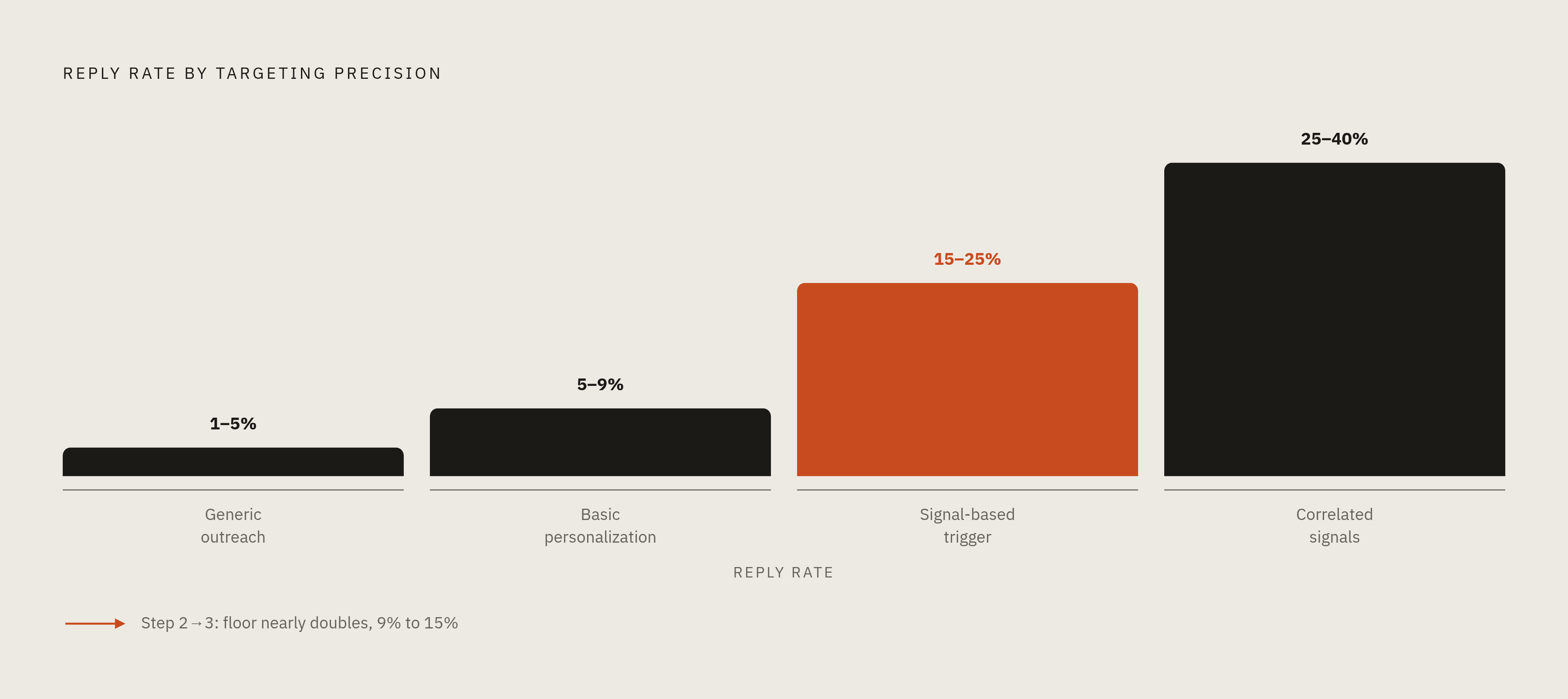
Line up the data and it forms a staircase. Generic cold outreach nets somewhere between 1% and 5% replies, with the industry average sitting near 3.43%. Add basic personalization, name, company, title, and that climbs to 5-9%. Move to signal-based personalization, where the message references a real trigger event tied to a relevant value prop, and replies jump to 15-25%. Stack two or three correlated signals with a real behavioral profile, and the range runs 25-40%.
That top range, 20% and up, is what sales teams report when targeting is dialed in and the message actually fits the moment, not a fantasy number pulled from a vendor deck. And the staircase isn't only about pipeline. A 25-40% reply rate is domain-protective. A 1-5% reply rate is domain-corrosive. Same channel, opposite effect on your sender score.
Speed matters as much as precision. Teams that act on an intent signal within 24 hours see a meaningful lift in opportunities created compared to teams that wait. For leadership-change signals specifically, vendors who reach out within 48 hours convert at roughly four times the rate of those who wait longer. Signals decay fast; treat one like a coupon with an expiration date, not a permanent fact about the account.
Run the math on volume and the case closes itself: 200 signal-qualified contacts generating 20%+ replies will outperform a 10,000-name spray on every metric that matters, deliverability, pipeline, and return, all at once.
Competitor intent signals — the highest-urgency targeting layer
Competitive intent data tracks something more specific than category curiosity: it tracks active comparison shopping. That's visiting comparison pages on review sites, engaging with a competitor's LinkedIn content, or mentioning a competitor's brand somewhere trackable. Platforms like G2 surface this directly through their own review and comparison traffic; a company showing up there is in the middle of evaluating vendors, not casually browsing.
This is the safest targeting layer for deliverability, and the reason is straightforward. These recipients already have a defined problem, an active evaluation underway, and a real timeline. They're the group most likely to open an email and reply to it, which happens to be exactly what mailbox providers reward. Forrester's Q1 2025 data found companies that prioritize intent-based triggers see a 31% higher lead-to-opportunity conversion rate than those that don't.
There's a term for this style of outreach: midbound. It sits between reactive inbound, waiting for a form fill, and cold outbound, starting from zero. It's stepping into a conversation the buyer already started, mid-cycle.
One catch on messaging: the signal should shape the angle, not become the subject line. Nobody wants to open an email that says "saw you checking out our competitor on G2 last Tuesday." That reads as surveillance, not insight. The better move is to use the signal to infer the actual problem and write to that person like you already know what they're dealing with, without ever naming how you know it. Among revenue teams consistently hitting quota, SpurIQ data puts the outreach split at roughly 70% signal-based and 30% cold, and competitive intent sits at the top of that 70%.
The signal quality problem — why more intent data does not automatically mean better targeting
Nearly every B2B revenue team has bought into intent data as a category; spend on it keeps climbing year over year. The problem is quality hasn't kept pace with adoption. One benchmark found the large majority of organizations, well over three-quarters, report signals that turn out unreliable or inflated. That means most of what teams are buying is noise. Acted on indiscriminately, that noise recreates the exact broad-spray problem signal-based targeting was supposed to fix.
Layer on the "dark funnel" and the picture gets murkier still. Buyers now complete the majority of their research, well over half the journey, before a seller even knows they exist. A growing chunk of that early research happens inside AI chat tools and AI-generated search summaries, completely invisible to traditional intent tracking. Buying groups are increasingly walking in with a shortlist already ranked before the first sales call ever happens. Even a good signal, in other words, is often catching the buyer later in the process than the seller assumes.
Four things separate a signal worth acting on from one worth ignoring. Recency: a signal older than a few weeks has mostly lost its predictive value. Specificity: a page-level or comparison-level visit tells you far more than a vague topic surge. Stacking: layer a job change with a competitor page visit and a pricing page hit, and confidence in that account goes up sharply. ICP fit: a screaming-loud signal from a company that's never going to buy from you is still a distraction dressed up as an opportunity.
The edge here comes from the filtering logic applied to the data already sitting in the system, and how fast someone acts once a real signal shows up, more than from buying additional data.
What the buying journey compression means for when to send
B2B buying cycles have shortened in recent years; buyers move faster than they used to, full stop. At the same time, the point where a buyer first contacts a seller has crept earlier in that shortened journey, which quietly widens the window for a seller to intercept a deal before a competitor even knows it exists.
The numbers here are stark. The first vendor a buyer contacts wins roughly 80% of the deals that follow, and in the large majority of those cases, that vendor was already on the buyer's shortlist on day one. Detecting a buying signal even a few weeks ahead of a competitor is a structural edge, not a marginal one.
Timing changes the deliverability math too. An email that lands mid-evaluation gets opened and gets a reply; that's domain-protective behavior, full stop. The identical email sent two months after that evaluation closed gets deleted without a second look. Same message, same domain, completely different outcome, because timing is doing all the work.
Follow-ups, not first-touch emails, drive most of the replies in any sequence, which means signal-based targeting needs a timed cadence built around it, not a single email fired off and forgotten. And even a perfectly signal-qualified list will tank its own deliverability if it's blasted out at reckless volume. Pacing still matters, no matter how good the list is.
Putting targeting quality and technical hygiene together into a working system
Technical hygiene and targeting quality aren't competing priorities; they're stacked on top of each other. Hygiene sets the floor for whether an email lands at all. Targeting sets the ceiling for what happens once it does.
Building this as one system rather than two separate projects looks something like this. Start by defining the ICP and the signal layer: decide which signals, at what level of specificity, actually qualify an account for outreach, before a single contact goes on a list. Next comes the infrastructure baseline: SPF, DKIM, DMARC, named human senders, a proper domain warm-up period. That's the entry fee, not a source of competitive advantage.
From there, list assembly should follow the signal threshold, not a headcount target set in a spreadsheet ahead of time. If only 150 accounts clear the bar this week, the list is 150 accounts. Messaging comes next, informed by the signal but never announcing it; the goal is writing to the problem the signal implies, not the surveillance trail that led there. And underneath all of it: pacing, sequencing, and follow-up timing tuned to how fast buying signals decay.
Do all of that, and deliverability becomes the natural byproduct of emailing the right 200 people instead of the wrong 10,000, rather than a separate technical checklist bolted onto a sales motion.