all-in-one signal-based outbound platforms for small B2B sales teams without RevOps
Signal-based outbound only works when data, sequencing, and CRM live in one place.

Small B2B sales teams keep buying the same three tools and getting the same result: a data provider, a sequencer, a CRM, and a rep who spends Tuesday afternoon exporting CSVs instead of calling anyone. This piece is about the fix. Signal-based outbound, where you reach out because something actually happened (a company hired a VP, a buyer visited a pricing page) instead of because a list got imported, works better. But it only works if the signal, the sequencer, and the contact record all live in one place, which is exactly what most small teams don't have.
What "signal-based" actually means and which signal types matter for outbound
Signals come in three flavors, and knowing the difference matters more than most vendors let on.
First-party signals are yours: site visits, content downloads, product usage if you sell a freemium tool. These are the most useful because you own them and you know exactly what happened. Second-party signals come from review sites like G2 or TrustRadius, someone looking at a comparison page or reading reviews of a competitor. These are late-funnel and sharp; if someone's reading reviews, they're close to a decision. Third-party signals come from research co-ops that watch activity across thousands of publisher sites and tell you a topic is trending in a given account. Useful, but fuzzy. It tells you a company is thinking about a category. It doesn't tell you who they're about to buy from.
For cold outbound specifically, four trigger types actually move the needle: firmographic (funding round, headcount jumped fast, new VP hired), technographic (they just dropped a tool that opens a switching window), behavioral (a job posting that basically describes the pain your product solves), and research (topic surge, or someone camped out on a G2 comparison page).
Here's the part people skip: the source of the signal changes what you should say. A topic-surge signal means "this company is thinking about the category." A G2 comparison signal means "this company is comparing you to a named competitor, right now." Sending the same templated email to both is a waste of a good signal.
And signals rot fast. The action window is days, not weeks. If your platform surfaces a signal but a human has to notice it, decide what to do, and manually build a sequence, you've already burned half the shelf life. Most B2B research happens before a buyer ever talks to a vendor, quietly, anonymously, in what people call the dark funnel. Miss the signal and you're not even on the list by the time they're ready to buy.
The minimum stack a lean team needs — and where all-in-one platforms close the gaps
Every outbound motion needs five things, no matter how big the team is: a contact and company database, a signal or intent layer, a way to send messages across channels, a system that decides what triggers what, and a CRM that stays synced without anyone touching an export button.
Without a RevOps person, here's where it all comes apart. Enrichment that doesn't automatically drop someone into a sequence means a human has to make that call every single time, and that human is your rep, who is now doing data entry instead of selling. Meanwhile CRM records rot: research on data quality has found that a large majority of CRM records are incomplete or wrong at any given time, which means signals start firing on the wrong person, or a contact who left the company eight months ago. And if your sequencer and your CRM don't share a data model, you can't even tell which message got the reply. You're flying blind with extra steps.
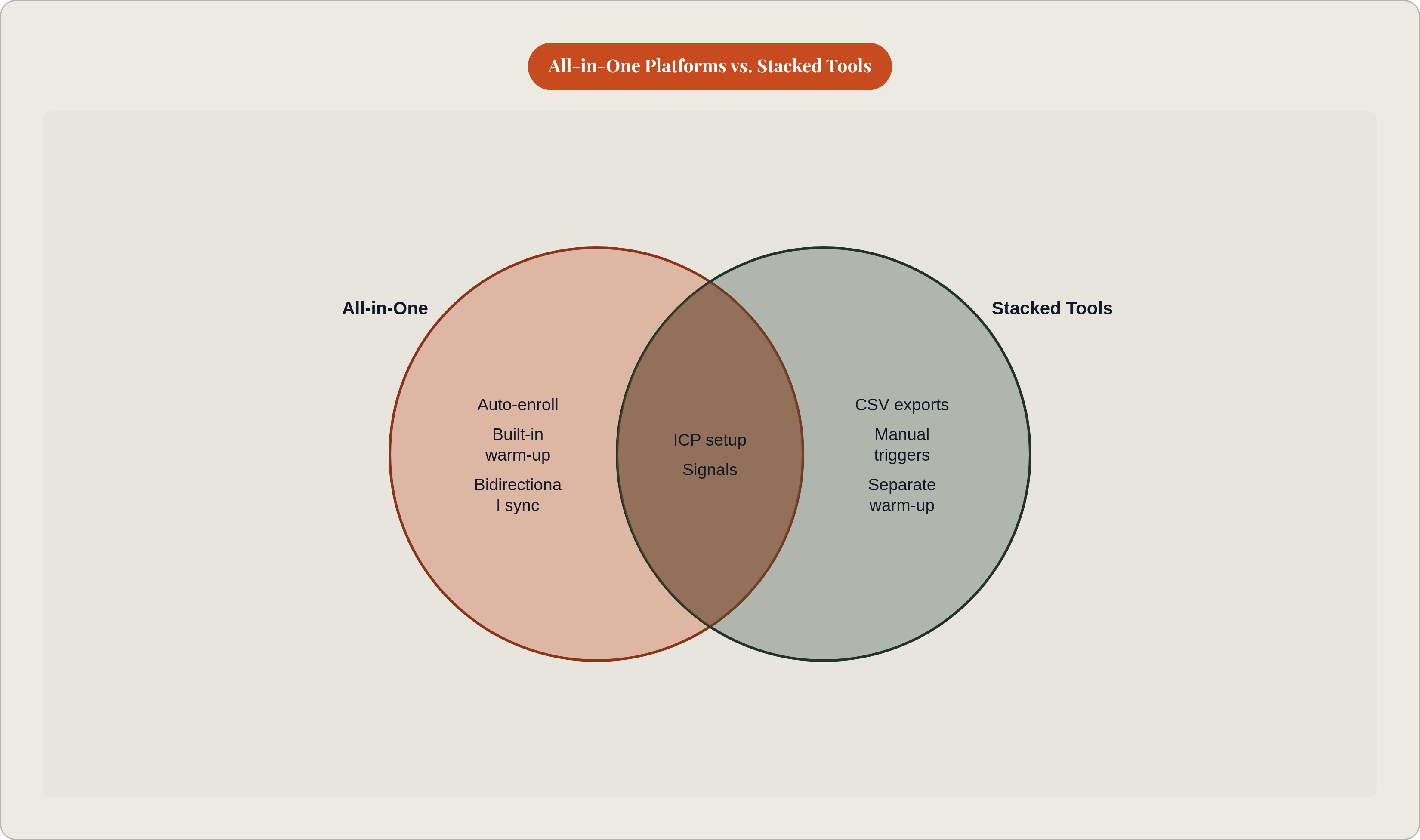
"All-in-one" should mean this, in plain terms: a signal fires, the contact gets enriched, the sequence starts, the CRM gets updated, and no human touches any of it in the middle. No platform is fully hands-off, to be fair. Someone still has to define the ICP, warm up the sending domain, and map a few CRM fields at setup. The real question is how much setup, and whether a rep who isn't technical can do it alone on a Tuesday afternoon.
Apollo.io: the strongest budget-first option with broad contact coverage
Apollo's database runs past 230 million verified contacts with over 65 search filters, which is the broadest reach of anything in this tier. The company claims 97% email accuracy on verified contacts; worth checking against your specific vertical before you bet your deliverability on it, since accuracy claims tend to look best in the industries a vendor optimized for first.
Apollo's AI Research Agent, per the company's own numbers, drives 46% more meetings booked among adopters, and AI-written messaging shows a 35% lift in bookings over manual outreach. Those are vendor-reported figures, so treat them as directional rather than gospel.
Where Apollo is strongest: firmographic and technographic filters, job-change tracking, decent intent data. Where it's thinner: real-time third-party signals and vendor-comparison behavior, the kind of thing that tells you a buyer is actively choosing between you and someone else. Apollo also has a free tier, which makes it the easiest on-ramp for a team that's never tried signal-based outbound and wants to kick the tires before spending real money. Sequencing and basic workflow automation come standard; the gap shows up in multi-step, conditional logic tied to live signals without a human clicking "go."
Amplemarket: multichannel automation with a native signal-to-sequence workflow layer
Amplemarket's structural advantage is a workflow layer that fires automatically off native events — a meeting gets booked, an email gets a reply, a LinkedIn connection gets accepted, a call gets logged, among others — without a human having to notice and act.
It covers multiple engagement channels, including email, phone, and LinkedIn, which matters if your buyers don't respond well to cold email alone (and increasingly, they don't). Buying-signal intelligence is baked in, with triggers that can launch a sequence the moment a signal lands, which is about as close as this category gets to the "signal to sequence, no human in the middle" ideal.
This fits teams where the reps are also running demos and closing deals, so the outbound motion needs to run mostly on autopilot, doing the configuration work a RevOps person would normally handle. The trade-off: the native contact database is narrower than Apollo's or ZoomInfo's, so a team chasing a very large total addressable market might find the pool a bit tight. On the plus side, deliverability infrastructure is built in rather than bolted on, which saves a team without a deliverability specialist from having to become one.
Unify GTM: intent-to-personalization automation for teams prioritizing signal quality over database scale
Unify's whole pitch is closing the gap between "a buyer signal just happened" and "a personalized email is sitting in their inbox," in one automated motion. The company built the workflow to make that gap as small as it can.
This is most useful for teams where reps are burning hours writing one-off personalized emails by hand instead of working a real volume of accounts. Automating the personalization step is the actual unlock here, not the signal detection itself.
Two caveats worth knowing before you sign anything. The integration library outside its core CRM and enrichment stack is smaller than the bigger players, so a team running an unusual tech stack should check compatibility first. And per-seat pricing runs higher than Apollo's entry tiers, so a team under five reps needs a clear read on their signal volume to know the math actually pays off. Unify fits best once a team has already nailed down its ICP and the bottleneck is speed of response, not finding new names to call.
ZoomInfo: the enterprise-grade option and when it makes sense for smaller teams
ZoomInfo's database is the largest of the group: over 321 million professional contacts and more than 104 million company profiles. Its intent signal tracking covers online research activity, site visits, hiring trends, and technology changes, and Forrester named it a Leader in its Wave for Intent Data Providers B2B, Q1 2025, with the highest scores across all eight evaluation criteria.
The Copilot workflows take signal detection straight into orchestrated outreach as a built-in feature, not a bolted-on add-on. So the capability is real and it's genuinely best in the category.
Here's the honest catch: ZoomInfo is priced and built for an organization with someone whose job is to configure and maintain it. Without that person, a small team risks paying enterprise rates for capability it can't fully use. It makes sense anyway when the total addressable market is large enough that the signal-to-pipeline math clears the bar, or when someone on the founding team has run enterprise sales ops before and can set it up solo. It doesn't make sense for a five-person team running a narrow ICP; a lighter platform will cover the signal types that team actually acts on, and the ROI math rarely closes at that size.
How to read signal coverage honestly across platforms before you sign
Ask every vendor, point blank, which signals they surface natively and which ones require a third-party bolt-on. "Intent data" on a pricing page can mean anything from broad topic-surge research to a bare-bones job-change alert. The words are doing a lot of hiding.
Vertical fit matters more than raw coverage numbers. Review-site intent tends to work best for B2B SaaS buyers doing active mid-market comparisons. IT and infrastructure sellers usually get sharper signal from dedicated research networks built for that audience. Developer-led or product-led growth companies get more out of community-layer signals, the kind that track engagement in forums and developer communities rather than search behavior. And if you sell into industrial, public sector, or healthcare buyers, none of whom show up much on review sites, broad topic-surge data is often the least-bad option, so the real question becomes which platform packages that data most usefully.
Update frequency matters too. Some signal feeds refresh in real time; others update once a day or once a week. For a fast sales cycle, the gap between real-time and a 48-hour delay shows up directly in reply rates.
And here's the gap almost nobody advertises clearly: most all-in-one platforms will tell you a company is researching "sales automation" as a category, but very few will tell you they're specifically comparing you against a named competitor. That level of detail usually requires licensed review-site intent data. If intercepting a deal mid-comparison is part of your motion, ask about this directly, because the pricing page won't volunteer it.
For a demo checklist: make the vendor show you signal-to-sequence enrollment start to finish with zero human steps. Ask exactly which CRM fields get written back automatically. And ask what a non-technical rep needs to configure before the very first signal fires.
Deliverability and sending infrastructure: the part most teams underweight
Deliverability isn't an afterthought you hand to whoever's free. It's a platform decision. Inbox placement rates differ meaningfully across tools, and a platform with excellent signal coverage but weak sending infrastructure will land your replies in spam, which makes the whole signal engine pointless.
Some platforms build deliverability in (Amplemarket does this natively). Others leave it to the team to configure sending domains, warm-up schedules, and IP rotation by hand, which is a lot to ask of a team with no dedicated ops person.
New domains are the classic trap. Send cold email at volume from a brand-new domain with no warm-up period, and your sender reputation tanks fast, sometimes within days. Platforms that automate warm-up remove one of the most common ways a new outbound program dies quietly in its first month. If a chosen platform's sending tools feel thin, dedicated specialists like Instantly and Smartlead lead specifically on sending infrastructure and warm-up automation, though bolting one onto your main platform adds another integration to babysit.
Before signing anything, ask: is sending infrastructure dedicated or shared across a pool of other customers? Does warm-up happen automatically? Does the platform watch bounce rates and pause a sequence on its own before reputation damage piles up?
CRM sync and data quality: the unglamorous requirement that determines whether signals stay actionable
Intent signals are only as good as the record they fire against. If the CRM data is stale, a signal routes to someone who left the company, or fires on an account that already churned, and the rep wastes a call finding that out.
Research on CRM data quality consistently finds that a large share of records are incomplete or inaccurate at any given point, with real revenue consequences for teams that rely on them. A platform that doesn't auto-enrich and refresh those records just hands the cleanup job back to the rep, which defeats the entire purpose of buying a signal-based tool in the first place.
Bidirectional sync is the non-negotiable here. The platform needs to write sequence status, reply events, and signal triggers back into the CRM, not just pull contacts out of it. One-way sync creates two versions of the truth, and they drift apart fast. Auto-enrichment helps keep the trigger logic current too, updating funding data, headcount, and tech stack changes without anyone manually refreshing a list.
None of this works without a defined ICP sitting underneath it. Teams without one consistently see lower win rates, because a platform's filtering and signal logic is only as sharp as the criteria you feed it. Before picking any platform, sit down and map exactly which CRM fields your team actually uses to qualify an account, then check that the platform writes to those specific fields automatically. If it doesn't, you've just bought yourself a very expensive spreadsheet.
Matching platform to team profile: a decision framework for the three most common small-team scenarios
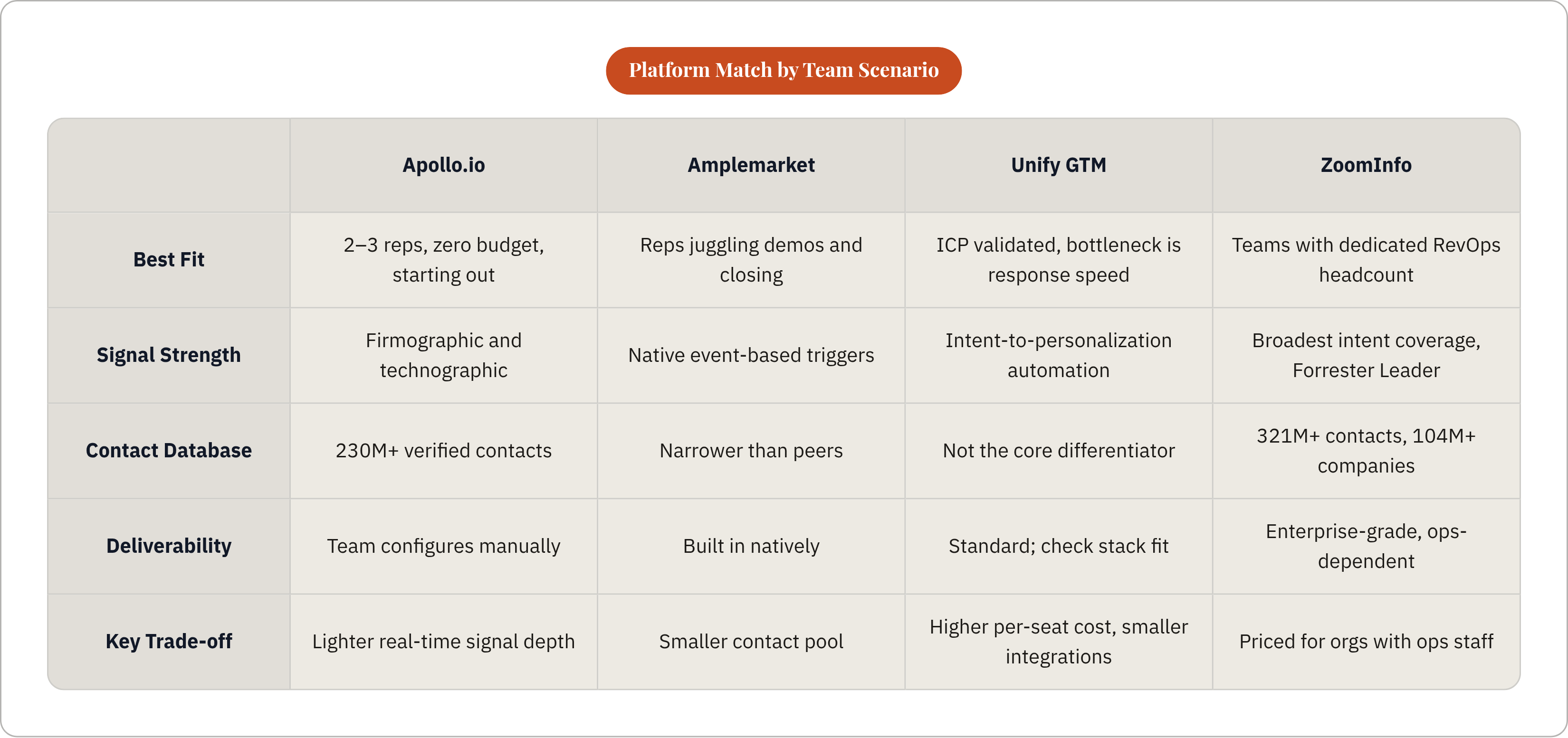
Scenario A: two to three reps, tight budget, starting from zero. Apollo is the sensible first move here. The free tier lets a team test signal-based outbound without a purchase order, the database is enormous, and the setup lift is low enough that a rep can configure it alone. The trade-off is living with lighter signal depth until the team proves out the motion and can justify spending more.
Scenario B: reps who are also doing demos and closing, with no time to babysit sequences. Amplemarket fits best, because the trigger-based workflow layer does the orchestration work a RevOps hire would normally own. Multichannel coverage matters here too, since a rep juggling calls, demos, and outbound doesn't have the bandwidth to manually run parallel campaigns across email, phone, and LinkedIn.
Scenario C: ICP already validated, and the real bottleneck is speed of response to signals, not finding new names. Unify makes the most sense here, since its whole design is compressing the time between a signal firing and a personalized message landing. It costs more per seat, so this only pays off once you already know exactly who you're chasing and you're confident in the volume of signal you'll see.
ZoomInfo sits outside all three scenarios for most small teams, not because the product is weak, it's the opposite, but because it's built for a market with dedicated ops headcount. A five-person team without RevOps buying ZoomInfo is a bit like buying a Formula 1 car to run grocery errands: technically capable of getting the job done, but you're paying for a pit crew you don't have.