Trigger-Based Prospecting Sequences for B2B Reps
Align multiple signals on the same account to hit prospects when they're actually buying.

Trigger-based prospecting works because it stacks two things that usually cancel each other out: good timing and good messaging. Most reps get one or the other. The reps who get both, on the same account, at the same moment, close more deals. This piece walks through what that looks like in practice.
What a buying trigger actually is — and what it is not
Let's clear the fog first. A trigger isn't a piece of firmographic data sitting in your CRM, a prospect opening a cold email (that just proves your subject line worked), or a company showing up in a news feed because someone on their comms team had a slow Tuesday.
A trigger is a specific, observable event that changes the odds a particular buyer is entering a decision window. That's the whole definition. "Specific" is doing a lot of work in that sentence, because it's the difference between a sequence that earns its timing claim and one that just assumes it and hopes nobody checks.
Triggers show up in three flavors: internal company events, external market events, and behavioral signals. We'll get into each below, but here's the part that trips people up. A single trigger opens a window; it doesn't guarantee anyone walks through it. A cluster of aligned signals on the same account is a different animal, and it points to an active evaluation with real weight behind it.
Write this on a sticky note near your monitor if you have to: one signal alone rarely justifies dropping everything for high-priority outreach. The stacking of aligned signals on the same account is what reliably points to buying intent. One data point is a rumor. Three pointing the same direction is a pattern.
The main trigger types and what each tells a rep about urgency
Internal triggers happen inside the prospect's own walls, and they tend to carry the most weight because they sit closest to the actual decision-maker.
Leadership changes top the list. A new VP or C-suite hire walks in with zero loyalty to whatever's already installed, usually carrying a rough 90-day mandate to size up the stack and decide what stays. They're hunting for proof points, which means they'll listen if you show up with the right one. Funding rounds work the same way, just with money attached instead of a mandate: fresh capital opens a budget window and creates pressure to show results fast, because investors ask questions. New tool adoption matters too, since a freshly bought piece of software often exposes a gap right next to it that the new tool doesn't touch. And a cluster of job postings in one function usually means that team is scaling, and scaling teams need new things to run their operation.
External triggers move slower but carry more context once they land. Regulation changes force decisions that used to sit on the back burner indefinitely. Competitor moves (an acquisition, a pricing shakeup, a product getting sunset) all create displacement pressure on whoever relied on that vendor. And a big market shift can flip priorities overnight, turning last quarter's non-issue into the thing keeping someone up at night.
Then there's behavioral and intent data, the most actionable of the bunch because it shows what the buyer is doing right now. First-party signals are the prospect's own footprints on your site: visits, downloads, time on your pricing page. Second-party signals live on review sites like G2 or TrustRadius, things like profile views or someone checking a competitor's pricing. Third-party signals come from research activity tracked across networks of B2B media sites, matched to a company and scored against how much research that company normally does.
Gartner projected 80% of B2B sales interactions would happen in digital channels by 2025. Buyers leave a paper trail of research long before they ever call a rep, and that trail sits there for anyone paying attention. Lantern's 2025 research backs this up from the other side: three out of four B2B sales engagements in 2025 are expected to start from signal-based triggers like leadership changes or funding news. This is turning into the default motion.
How signal stacking and intent scoring determine which accounts to sequence first
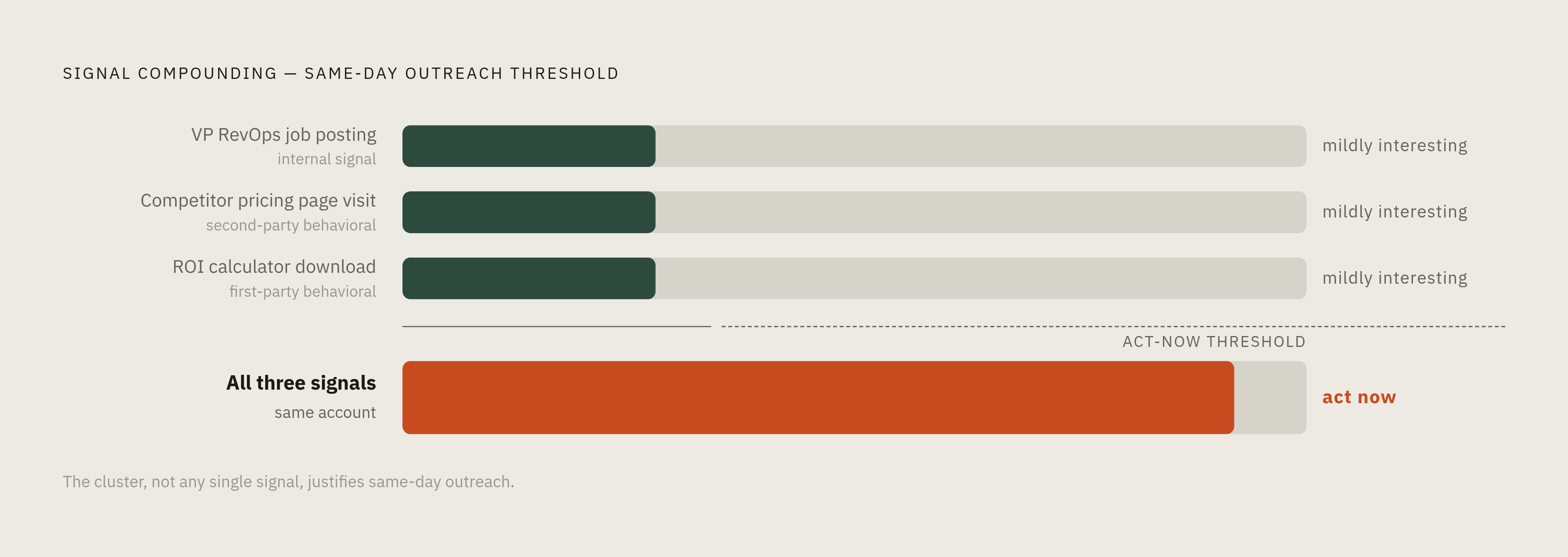
Here's the problem signal stacking solves. Any one trigger, alone, might just be noise. A job posting could mean nothing. A pricing page visit could just be a competitor snooping on you. But when several aligned signals land on the same account around the same time, the odds of an active buying window go up fast.
Say a company posts a VP of Revenue Operations job (internal signal), someone from that company visits a competitor's pricing page (second-party behavioral), and a different contact downloads your ROI calculator (first-party behavioral). Any one alone is mildly interesting. All three, on the same account, in the same window, is urgency.
Accounts worked with multi-signal approaches convert noticeably better and close faster than accounts worked off single-source intent data. That gap is why intent scoring exists in the first place.
The mechanics are simple. Assign point values to each signal type based on how strongly it tends to correlate with real buying intent, then add those points into one account-level score. Set thresholds: above 60 means outreach today, no excuses. Between 30 and 60 means active nurture, keep watching. Below 30 gets treated like standard cold outreach, because right now, that's what it is.
Pair the score with response-time rules. Tier 1 accounts, showing profile views plus a competitor comparison plus a pricing page visit, get same-day outreach. Tier 2 (category research surges, job postings, competitor site visits, repeat visits from a new account) gets prioritized within 48 hours. Tier 3, single content downloads or conference attendance, goes into a weekly nurture review instead of the fire drill pile.
The payoff shows up directly in close rates. Intent-prioritized accounts have converted to closed opportunities at roughly two and a half times the rate of accounts worked without any intent prioritization at all, according to the B2B Buying Study from The Starr Conspiracy. That's not a marginal edge.
A rep working a signal-prioritized list is working a fundamentally different list than everyone else.
The structural anatomy of a trigger-based sequence
Rule one, non-negotiable: the trigger has to show up in the actual outreach, not just live quietly in the rep's head as the reason they felt good about hitting send. A trigger-based sequence that never mentions the trigger is just a cold cadence wearing a disguise.
A sound framework for the opening move is to lead with a specific insight, name the trigger event directly, or ask a sharp question tied to the prospect's role. Touch one isn't there to close. It's there to earn touch two. Something like, "I noticed [Company] just expanded into [Region]. Are you seeing challenges with [specific pain point] as you scale?" Every word in that opener is pulling weight, tying the trigger to a business consequence the prospect actually feels.
A sequence tends to run something like this. Day 1: a personalized email that names the trigger. Day 2: a LinkedIn connection request with a short note referencing that same trigger, since personalized notes push accept rates from around 5.4% up to 9.4%, per Expandi's 2025 LinkedIn data. Day 4: genuine engagement with the prospect's LinkedIn content, no pitch, just real attention. Day 6: a follow-up email with new value, a case study or benchmark tied back to the trigger. Day 9: switch mediums entirely with a short LinkedIn voice note or a video under 60 seconds, because changing the format itself breaks the pattern of "just another email." Day 11: a phone call with a voicemail referencing the earlier touches, so it lands like a continuation instead of a cold reset.
Worth knowing that a 2025 Focus Digital study puts the average B2B deal at close to 29 interactions before it closes, and deals over a certain size closer to 47 touches. One perfectly timed email was never going to carry the whole sequence on its own. High-growth teams average 16 touches per prospect packed into a two-to-four-week window. Density matters as much as raw count.
What changes trigger to trigger is the opener, the proof you offer, and how much urgency you imply. The channel rhythm above stays roughly the same across trigger types; the message frame is what shifts.
Sequences calibrated to specific trigger types
Leadership change sequences need to meet the new exec where their head actually is: building credibility, auditing what they inherited, drafting a 90-day plan. They are not casually browsing vendors. Position yourself as a resource for that audit, and offer a benchmark or peer comparison instead of asking for a demo. Time it inside the first 30 days of the role change, before they've formed any loyalties to what's already in place.
Funding round sequences work off different psychology. Post-raise, budget suddenly exists, growth targets go public, and there's pressure to show that capital is being put to work. Tie your message to a specific growth target named in the funding announcement, using their language instead of a generic ROI pitch pulled from a template. Move within 7 to 14 days of the announcement, while it's still the thing people are talking about internally.
Event-adjacent sequences, tied to a conference, webinar, or product launch, live in a tight window: 1 to 2 weeks before, while the prospect is prepping, or within 7 days after, while it's still fresh. Before the event, offer something that makes their experience better, a framework, a peer intro, a research summary. After, reference a specific session or theme, which shows you were tuned into the same conversation they were, not just guessing.
Technology adoption sequences run off technographic data showing a new tool just landed in the prospect's stack. Congratulate the investment, then point at the gap that tool creates or leaves untouched. That's your bridge in.
All four share one thing: the message assumes the buyer's context instead of asking them to explain it. That assumption, when it's right, is exactly what earns the reply.
Competitor displacement sequences and mid-cycle interception
Mid-cycle interception plays by different rules entirely. The buyer already knows they have a problem and they're already comparing options. Your job is earning a seat at a table that's already set, not creating urgency from scratch.
Watch for displacement signals: negative reviews of a competitor on G2 or Capterra calling out specific pain points, Reddit threads full of frustration about a tool in the category, technographic data showing a competitor's tracking tag getting pulled off a prospect's site, or contract renewals coming up for known competitor customers. G2's Competitive Intent Signals, launched in August 2025, surface when prospects view a competitor's profile, pricing, or comparison pages, sometimes before they've looked at yours at all.
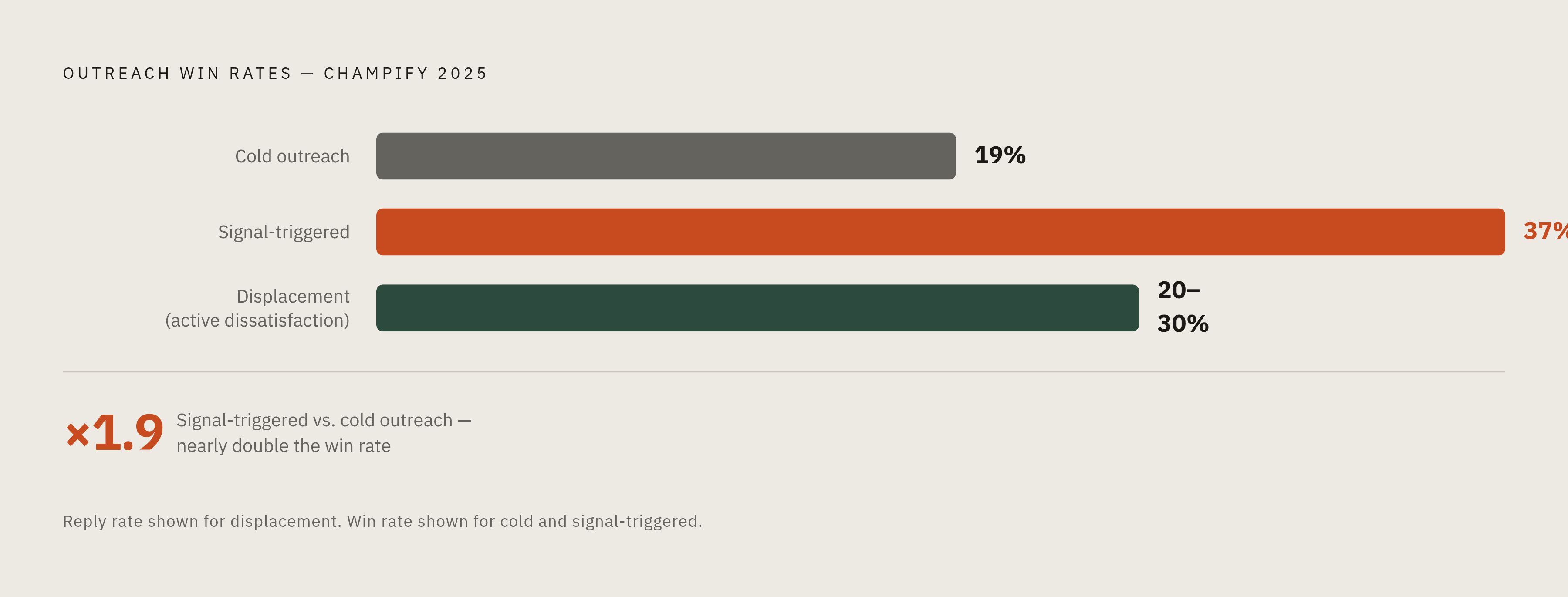
Reply rates on displacement outreach run 20 to 30% when the prospect has already shown active dissatisfaction, well above cold outreach baselines. Champify's 2025 data puts signal-triggered outreach at a 37% win rate against 19% for cold. That gap is the whole argument for doing this well.
Message discipline matters more here than anywhere else. Lead with empathy for the pain, not a jab at the competitor. Talk about the category problem, not "I heard you hate [Competitor]." The strongest proof point in this sequence is a customer story from someone who actually made the switch, told plainly enough that the prospect can picture themselves in it without you spelling it out. The prospect is a capable buyer weighing real options, not someone waiting to be saved.
There's a dark funnel piece worth flagging too. Review site activity, comparison queries, and topic shifts on third-party networks can surface accounts that quietly re-entered the market after going dark. That's your window to get back in front of them before the deal drifts to someone else.
On the infrastructure side, G2's Buyer Intent data draws on second-party, verified signals from software buyers, including direct Competitive and Compare activity. Third-party intent providers built on large co-ops of B2B media sites offer a broader lens on category research. Pricing across this category runs roughly $12,000 to well over $100,000 a year depending on scale and how deep the signal data goes.
What breaks trigger-based sequences in practice — and how to prevent it
Here's the uncomfortable part. The Sopro State of Prospecting found only 13% of B2B teams skip intent signals entirely. Sounds promising, until you look closer: just 43% actually adjust their messaging based on what those signals show, and 44% do almost nothing more than route the signal to a rep with no change to the message. The data's getting collected fine. The sequence design isn't keeping pace with it.
That's failure one: signal without message adaptation. Routing a hot trigger to a rep who then fires off the same generic template defeats the entire point of collecting the signal. The trigger has to change what gets said, not just who gets called.
Failure two is acting on stale signals. A funding round from six months back isn't a trigger anymore, it's old news. A hiring surge from last week still is. Teams need filters for recency, not just filters for signal type, or they'll keep working accounts whose window already shut.
Failure three is single-signal overconfidence. One compelling data point can still be noise wearing a disguise. Without stacking and scoring signals together, reps burn cycles chasing accounts that were never in a buying window at all, just accounts that looked interesting on a random Tuesday afternoon.