ICP Scoring Models That Incorporate Behavioral Signals
Behavioral signals reveal when accounts are actually buying, not just whether they fit your ICP.

Most B2B companies still don't have a clearly defined ICP, and the ones who do win more often. That gap alone should stop revenue leaders in their tracks. Here's what nobody mentions, though: even the teams with a sharp, documented ICP hit a wall right after. They build a scoring model on firmographic data alone, which tells you whether to sell to someone but never when. Reps end up chasing accounts that matched last quarter's profile while the accounts actually shopping right now slide past untouched.
A scoring model has two jobs. Qualify accounts for fit, and time outreach to the window when a buyer's actually ready to move. Treat those as one job and you get a score that looks sharp on a dashboard but sends reps chasing ghosts. The rest of this piece is about doing both, in order, without letting one eat the other.
The five layers a complete ICP actually covers before scoring begins
A real ICP has five layers. Skip any one of them and your model ends up scoring inputs it doesn't actually have.
Firmographic fit answers the basic question: should we even be selling to this kind of account? Industry, size, revenue band, geography. Technographic signals go a layer deeper: does their tech stack make them compatible, or even winnable, given what you sell? Behavioral signals answer the question everyone actually cares about, which is whether they're moving right now. Organizational readiness checks whether there's a real decision process in place and whether your buyer sits inside it. Negative indicators ask the one question most teams skip: does something disqualify this account despite a surface-level match that looks great on paper?
That last layer deserves more attention than it gets. Negative ICP criteria used to live entirely in the heads of your best AEs, the kind of thing you'd learn only after losing three deals the same way. Heavy customization asks at SMB price points. Regulated industries your product isn't built to serve yet. Buying committees shaped like a procurement-led bake-off where the lowest bid wins no matter what. None of that shows up in a firmographic filter, and all of it needs to be written down somewhere the whole team can see it.
Buying committee shape matters more than most ICP docs admit, too. Qualtrics ran research in 2024 and found buying committees running six to ten stakeholders in a typical B2B tech purchase, spanning procurement, security, finance, and the end users who'll actually live with the tool day to day. Each function can hold a veto. If your ICP definition doesn't account for who's sitting in that room, your model is scoring half the picture and calling it whole.
How to weight fit signals so behavioral data doesn't override a bad match
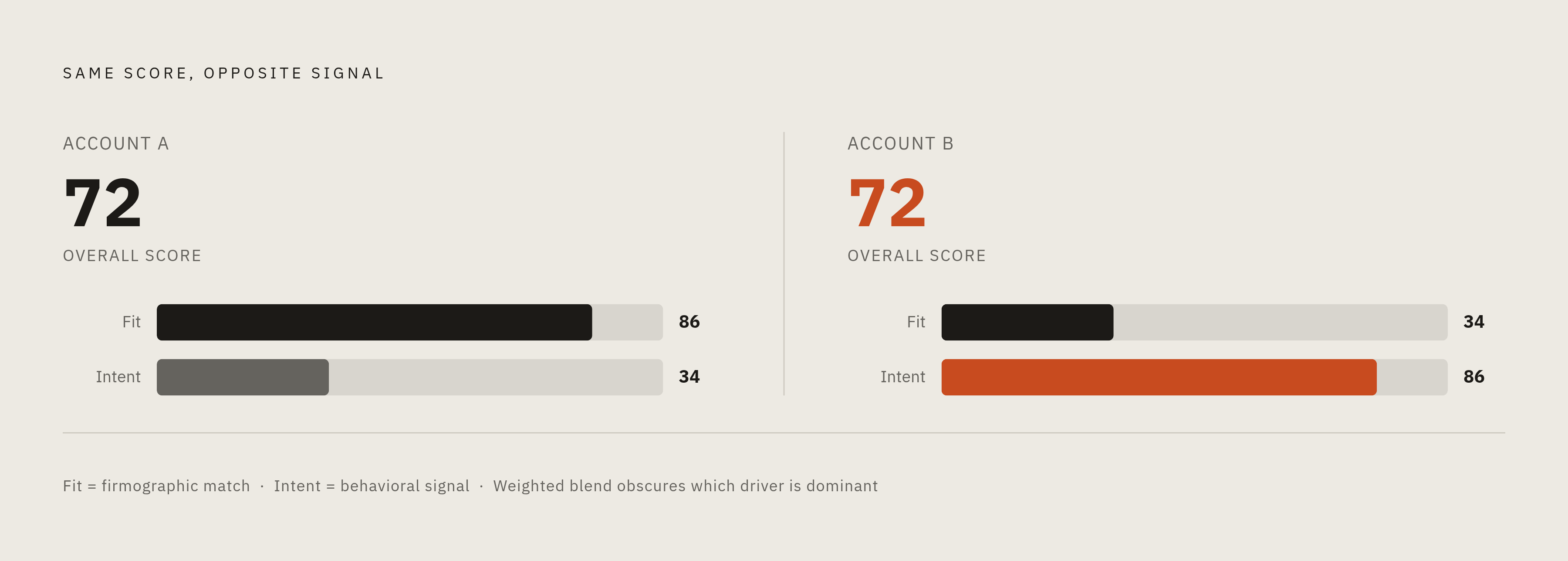
Fit comes first, and the weighting should say so out loud. A common structure gives firmographics 25 to 30% of the total score, with behavioral signals sitting lower, around 10 to 20%. The order matters as much as the math: score fit first, behavior last. A bad-fit account showing tons of intent is still a bad-fit account. High energy pointed the wrong direction is just noise in a nice outfit.
A strong behavioral trigger should still be able to bump an average-fit account up into high priority, though. That's the whole point of layering the two.
Reps also need two separate numbers, not one blended score. A 72 built from strong fit and weak intent means something completely different from a 72 built from weak fit and strong intent. Collapse those into one figure and you've hidden the exact thing a rep needs to know before they pick up the phone. Technographic and readiness signals sit in the middle of the range, doing quiet work, sharpening the fit picture without ever replacing it.
None of this survives contact with bad data, and that part isn't hypothetical. Validity ran a 2025 study and found 37% of CRM users said they'd lost revenue directly to poor data quality, and 76% said less than half their CRM data was accurate and complete. A nice weighting model built on garbage fields produces garbage output with better formatting.
Where behavioral signals actually live and why most CRMs miss them
The good stuff rarely makes it into the CRM. Behavioral and intent signals live in email threads, call recordings, web session logs, review sites, and content networks scattered across the internet, not in the tidy fields your reps fill out after a call.
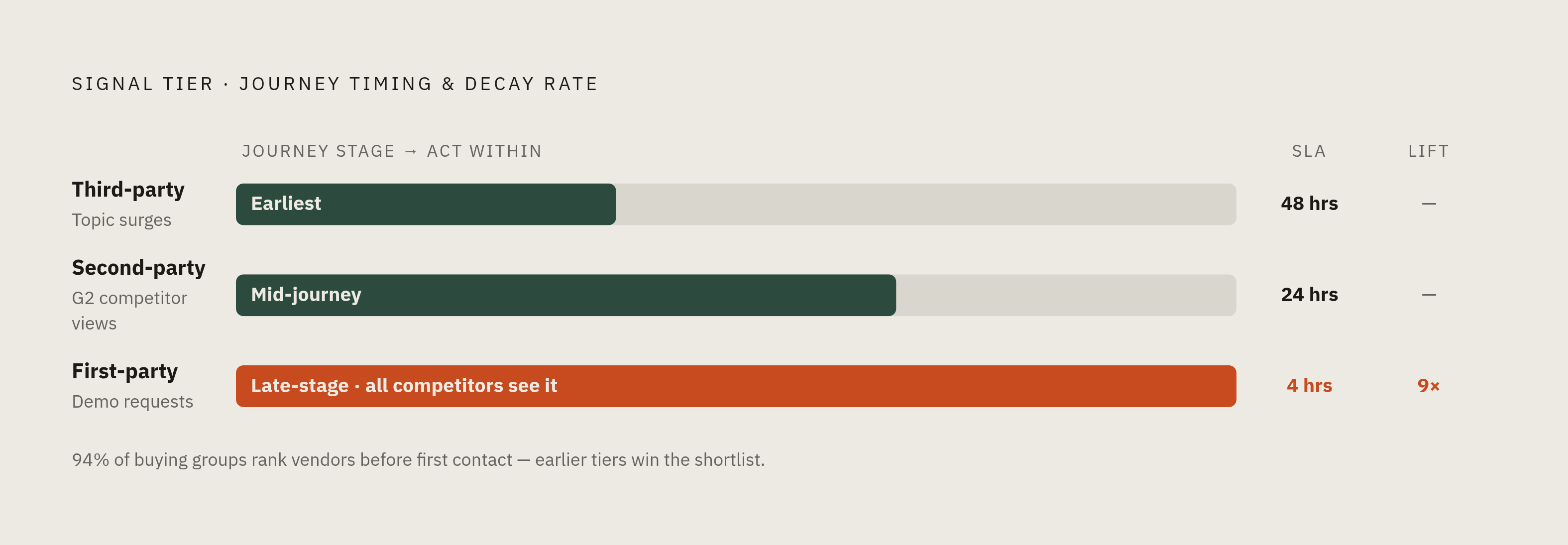
Signals come in three tiers, sorted by where they start. First-party signals are the ones you own: website visits, pricing-page views, demo requests, repeat sessions, content downloads. Highest confidence, but there's a catch: it only catches accounts that already found you. Second-party signals live on review sites, and they're underrated. A company reading competitor comparisons on G2 isn't idly browsing, that's active vendor evaluation, plain and simple. Third-party signals get captured across publisher networks and content sites, and they're the earliest of the three, often catching accounts before they've landed on your site at all.
G2 rolled out Competitive Intent Signals in August 2025, and it moved the timeline meaningfully. Buyers can now get flagged the moment they view a competitor's product profile or pricing page, before they've ever shown up on yours. Second-party data, arriving earlier than it used to.
The gap this creates is almost funny once you notice it. Most CRM cleanup efforts pour energy into fixing contact accuracy, correct titles, correct emails, right phone numbers, while the behavioral event logging that actually predicts a sale sits completely untouched. Teams spend weeks polishing fields nobody uses to make a decision.
Reading the signals correctly: what each type tells you about timing and urgency
Not all signals mean the same thing. Treat them like they do and that's where a lot of scoring models quietly fall apart.
A pricing-page visit or demo request is late-stage and high-intent, no question, but it's also the one signal every competitor sees at the exact same moment, so speed is the whole game there. A topic surge on a relevant category tells a different story: the account is earlier in its research, still figuring out what it needs, which means you've got more runway and less competition for their attention. Competitor review activity on G2 sits in the middle, and it might be the single best window there is, since the account is actively comparing vendors but no preference has hardened yet. Hiring signals, like a new VP of Revenue Operations getting posted, or "sales transformation" language showing up in a job description or earnings call, are operational triggers rather than research behavior, and they often show up before any digital buying activity starts at all. A technographic displacement, a rival tool sitting in the stack with a contract renewal approaching, is about as close to a calendar-driven opportunity as B2B sales gets.
The stakes of catching these early are bigger than they look. A 2025 Buyer Experience Report surveyed more than 4,000 buyers and found 94% of buying groups rank vendors before making first contact. 77% end up buying from whichever vendor was their early favorite. So the earlier you show up, the better your odds of making the short list at all. The research-to-engagement split has also shifted from roughly 70/30 to 60/40, meaning a bit more of the buying journey happens in live conversation now, but the majority of the decision still gets made before a rep ever says hello.
Signal decay is real, and it's brutal. It can turn good data cold in a matter of hours. Acting within minutes of a strong buying signal can make a lead up to 9 times more likely to convert. A signal behaves like a subway door: it closes whether or not you made it through, and there's no picking your mail back up off the platform after.
The operationalization gap between collecting signals and acting on them
Here's the uncomfortable number: only 24% of B2B teams report exceptional return on their intent data spend, according to a 2025 Demand Gen Report benchmark survey. Companies are spending heavily on signal data and getting a weak return on it, and the reason isn't the data. It's what happens after somebody sees it.
The gap is behavioral, not technical. Signals get dumped into a spreadsheet or fired into a Slack channel, and by the time anyone reads them, the moment's gone cold. Sopro ran a 2026 State of Prospecting survey, talked to 442 senior decision-makers, and found only 43% of teams actually adjust their messaging based on the interests a signal surfaces. Worse, 44% do little more than forward the raw signal straight to sales with zero interpretation attached. Reps can usually tell the difference within a sentence.
Picture a rep who gets a message that just says "Company X surged on 'sales enablement.'" No context, no suggested next move. Just a name tag stuck on a pile of noise.
Real activation needs three things working together. First, an interpretation layer that translates the signal into a stage and an implied need. Second, a playbook match, because the right outreach for a topic-surge account looks nothing like the right outreach for a company caught reading competitor reviews. Third, an SLA that actually gets enforced: website visitor signals need a follow-up inside 4 hours, topic surges get 24, funding signals get 48. Miss those windows and the signal's value drops fast, sometimes within the same afternoon.
The message itself needs to hold together too. Buyers report noticing real inconsistency between a company's website content and what shows up in its other marketing channels at a striking rate, 69%. If the outreach doesn't match what the account already read about you, the signal did its job and the follow-through didn't.
Intercepting competitor-evaluating accounts as the highest-leverage scoring use case
There's one moment where both halves of the scoring model peak together: an account matches your fit criteria and is actively comparing vendors right now. That's the exact scenario the whole setup exists to catch.
The window is narrow, and it closes fast. By the time the obvious signals show up (a demo request, a pricing-page visit), several competitors have already made contact, and the real opportunity sat earlier, in the quieter signals most teams don't even track.
Picture the signal stack on an account worth chasing hard. A G2 Competitive Intent Signal showing they've viewed a rival's pricing page. A topic surge on a relevant category, sitting well above their usual baseline. A hiring signal, maybe a job post naming a competitor's tool outright, or a role description that all but says "migration," something like a "RevOps Manager, systems consolidation" posting. A technographic flag showing the rival's tool sitting in their stack with a contract renewal on the horizon.
There's a concrete example worth sitting with here. Bynder used AI-powered intent data to find accounts actively in-market and sent them messages built around that context. The result: a 2.5x increase in outbound pipeline, with the investment paying for itself inside four months.
Outreach at this stage can be specific rather than generic. The rep knows the account is comparing options, knows which rival they're likely weighing, and can build a message around the exact concerns that come up in that specific comparison. That's precisely what the 43% of teams mentioned earlier are failing to do with the signal data sitting right in front of them. Content becomes the delivery vehicle here: a case study stacked against the rival's approach, a one-pager built around the objections that always surface in that matchup. The rep delivers it, but marketing builds it, and that handoff is the structural alignment the whole model depends on.
Tying scored accounts to pipeline so the model earns ongoing investment
A scoring model with no feedback loop rots quietly. Accounts get scored, outreach goes out, and nobody checks whether the high-scored accounts actually closed faster, or at better rates, than the low-scored ones. The model just keeps running on assumptions nobody's tested in months.
Fixing that means moving the measurement out of a marketing dashboard and into the CRM itself: tag content assets, log every signal-triggered outreach, track which scored accounts eventually show up in closed-won deals. A few numbers do most of the heavy lifting here. Pipeline velocity asks whether accounts with high behavioral scores actually close faster. Deal influence asks what share of won deals had a logged behavioral trigger before the first outreach ever happened. Win rate delta asks how much better signal-triggered accounts close compared to cold accounts prospected on fit alone. And cost-per-SQL by signal type tells you which signal source is actually worth paying for and which one you should probably drop.
The payoff for getting this right runs bigger than a tidier dashboard. Research consistently links aligning people, process, and technology across the demand engine to meaningful gains in both revenue growth and profitability. The scoring model is the piece that makes that alignment operational instead of aspirational.
Nearly every B2B marketer, 97% by one count, says they have a content strategy in place, yet proving its return stays one of the hardest problems in the building. Gartner's 2025 CMO Spend Survey found marketing budgets holding steady at 7.7% of revenue. Flat, not growing. A behavioral scoring model, built correctly, is what turns all that content and outreach activity into something you can point to and call revenue.
None of this is a one-time build, either. The model needs a regular check against closed-won and closed-lost data, because signal weights that made sense six months ago might be pointing the wrong direction today. Markets shift, products change, and ICPs age faster than anyone wants to admit. A model that never gets rechecked is a very confident guess wearing a spreadsheet.