Outbounding Strategies Triggered by Buying Signals
Rank nine buying signals to prioritize outbound outreach and compress sales cycles.

A buying signal is any observable event that suggests a person or company is more likely to buy right now, as distinct from simply fitting a demographic profile. The demographic says they belong on your list. The signal says they are moving.
There are three source tiers, and the differences between them matter more than most teams appreciate.
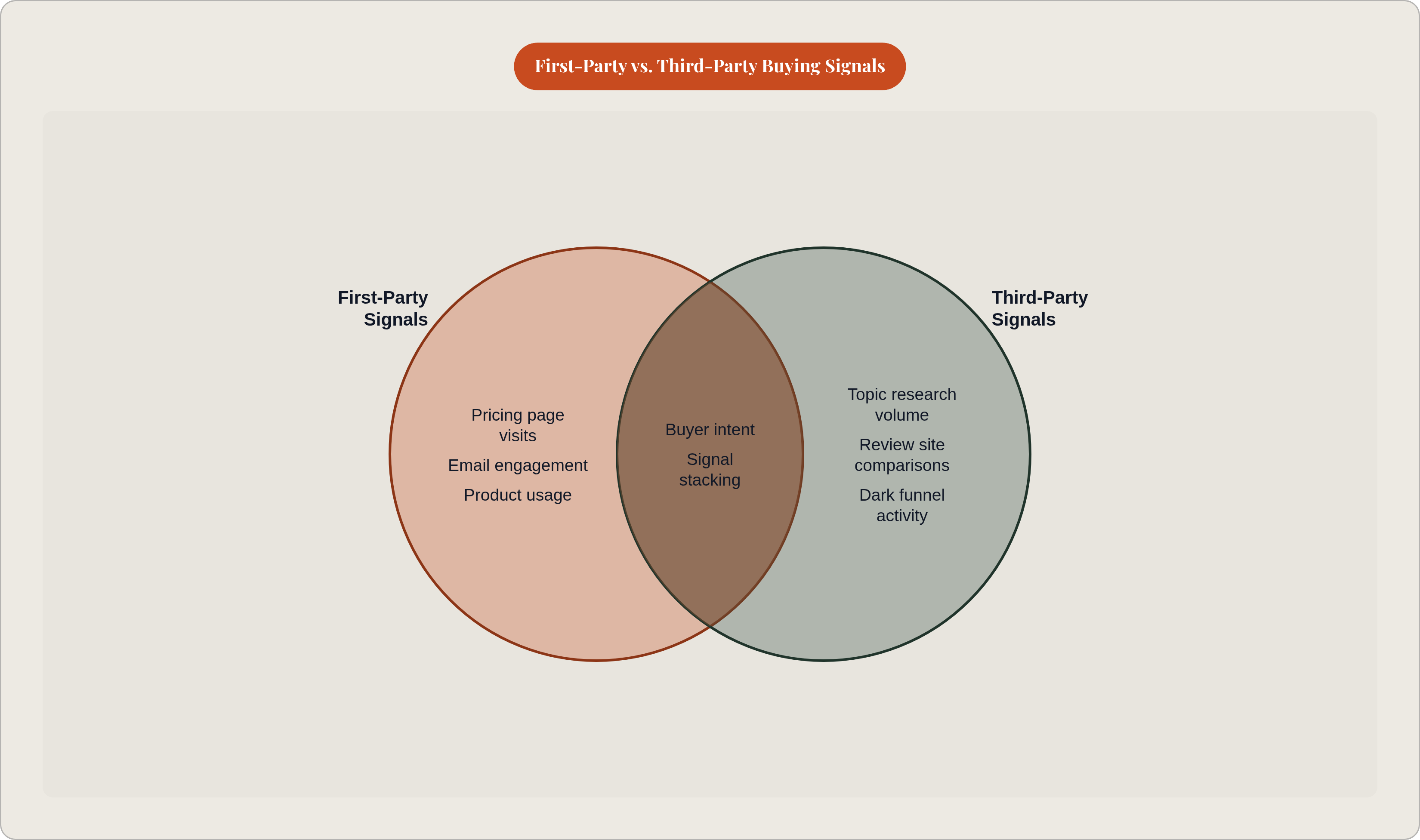
First-Party Signals
These are behaviors happening on your own properties. Website visits, pricing page views, content downloads, email engagement, product usage. They are exclusive to you, high fidelity, and they indicate something important: the buyer has already found you. They are raising their hand, even if they are not filling out a form.
Third-Party Intent Signals
These are aggregated behavioral signals from across the broader web. Topic research volume, visits to competitor pages, review site comparisons. You do not own this data. Providers in this space compile it by aggregating behavioral signals across the broader web. A "surge" means a company's consumption of content around a given topic has exceeded their own 52-week baseline by a statistically significant margin.
That is not someone casually clicking around. That is a pattern.
The real value here is reach. Third-party signals catch buyers before they ever land on your site. They illuminate what people call the dark funnel: the research, the comparisons, the Slack threads that never show up in your CRM.
Contextual and Firmographic Triggers
These are observable organizational events. Leadership hires, funding rounds, M&A activity, hiring spikes, tech stack changes. They are not behavioral in the digital sense, but they indicate structural readiness or pressure to buy. A CFO mentions "digital transformation investments" on an earnings call. A target company posts a VP of RevOps role. A competitor tool appears in their stack. Each of those is a signal, just a different kind.
Stage Mapping
Not all signals point to the same moment in the buying cycle.
- Awareness-stage: Researching broad category topics. They know they have a problem.
- Consideration-stage: Comparing solutions, reading competitor content, downloading evaluation guides. They are starting to shop.
- Decision-stage: Pricing page visits, RFP downloads, demo requests, G2 comparison activity. They are close.
The stage matters because it should change your outreach entirely. Sending a "book a demo" ask to someone in awareness mode is like proposing on a first date. Technically possible. Rarely advisable.
Signal Stacking as the Operating Principle
A single signal is a data point. A cluster is a conviction.
Say a target company posts a VP of RevOps role. Then one of their people visits a competitor's pricing page. Then someone from that same account downloads your ROI calculator. Each of those alone is interesting. Together, they paint a picture of an account in active evaluation with real urgency. You are not guessing anymore. You are reading a story that is already in progress.
Teams using multi-signal stacking consistently report higher conversion rates and shorter sales cycles versus single-source intent approaches. That gap is not surprising once you internalize what stacking actually does: it moves you from "this account is probably relevant" to "this account is moving right now and here is the evidence."
The Nine Signals Ranked by Conversion Leverage
These are not created equal. The ranking reflects decay speed, observed conversion patterns, and how hard each signal is to manufacture or fake.
1. Former Champion Changes Jobs
This is the highest-converting signal in outbound, full stop. There is no cold start. You already have a relationship. They already believe in the category. New buyers are far more likely to make a category-defining purchase in their first 90 days at a new company, because that window is when they are actively building their stack and trying to prove they belong in the seat.
The mental shortlist at the new company forms fast. Your job is to reach out before it closes. Act within the first 30 days. If their new company is already showing other buying signals, compress that window further. Do not let this one sit in a queue.
2. New Executive or Leadership Hire
A new VP of Sales, CRO, or CMO opens a window when that leader is rebuilding their stack and trying to prove they know what they are doing. New leaders tend to rip out predecessor vendor stacks within six to nine months. The rebuild starts the day the appointment is announced.
Messaging angle matters here more than almost anywhere else on this list. Do not lead with your product. Lead with something like: "Here is how the last few leaders in your role structured their first 90 days and where tooling decisions landed." Advisory framing earns the meeting. Vendor framing gets deleted. The decay window is 30 to 90 days from announcement.
3. Funding Event
Capital arrives. Now they need to spend it. Speed is the differentiating variable here more than with any other signal type. The window is two to four weeks. If you are emailing about a funding round a month after it closed, you are already late, and frankly the prospect can feel it.
4. Hiring Spike in a Relevant Function
Five SDR postings in 30 days at a 50-person SaaS company signals a serious outbound investment. Three "Head of RevOps" postings in a quarter signals a structural GTM shift. The key is deviation from their baseline hiring velocity, not raw volume. What it tells you is simple: this company is building a motion your product supports. The case for outreach basically writes itself.
5. M&A Activity
Mergers almost always trigger tech consolidation reviews. Overlapping tools get cut. Smaller vendors lose contracts. Procurement renegotiates everything. The optimal outreach window is 60 to 120 days post-announcement, when the operational reality of the integration has hit and the pain is no longer hypothetical. Earlier is premature. Later and decisions have already been made without you.
6. Tech Stack Change
Tools like BuiltWith, Wappalyzer, and HG Insights detect when a target adds or removes a tool from their public-facing stack. The play is adjacent category positioning. A company that just added a new sales engagement platform is likely evaluating intent data, dialing tools, or lead scoring software next. Use this signal to identify category openings, not just direct replacement plays.
7. Third-Party Intent Topic Surge
This catches accounts early, often before they have visited your site or any review platform. The upside is early reach before the shortlist forms. The tradeoff is lower urgency compared to decision-stage signals. The decay window is seven to 14 days. Surges dissipate quickly as research moves to the next phase, so acting fast still matters, just not "drop everything" fast.
8. Competitor or Review Site Activity
When a prospect is reading reviews, visiting competitor pages, or running side-by-side comparisons in your category, that is bottom-of-funnel behavior. They are building a shortlist, not browsing. Act within days, not weeks. A decision cycle that started without you will close before you reach them if you treat this like a low-urgency signal.
9. Demo Request or Pricing Page Visit
The most obvious signal and the one teams most often fumble on execution. A demo request means you are on the shortlist. Research consistently shows that responding within five minutes makes you dramatically more likely to qualify the lead than waiting even 30 minutes. That number sounds insane until you remember that your competitor probably got the same signal.
Even a pricing page visit without a form fill warrants same-day outbound. Behavioral intent without a hand-raise is still intent.
Competitor Intent Signals and Why Mid-Cycle Interception Is a Separate Discipline
This one deserves its own section because the play is genuinely different from everything else on this list.
B2B buyers spend a surprisingly small share of their total buying time actually talking to suppliers. That time gets split across multiple competing vendors. Do the math and any single vendor ends up with a pretty thin slice of the entire buying process. The rest happens somewhere you cannot see: AI search tools, peer Slack communities, LinkedIn DMs inside Revenue Collective or similar groups, review sites where buyers compare vendors anonymously, competitor websites. None of it visible in your CRM.
What Competitor Intent Data Actually Captures
An account visiting G2 comparison pages or reading "X vs. Y" breakdowns is signaling active evaluation, not exploratory browsing. Beyond category interest, intent data can often reveal which specific competitors a prospect is researching. That is the intelligence that changes what you say, not just whether you reach out.
A prospect researching a competitor is not a lost prospect. They have not decided yet. You still have a shot. But only if you move and only if you show up saying something specific, not something generic.
The Interception Play
A single cold email in response to a competitor signal is just noise. An orchestrated response is an interception. The structure that actually works has three parts:
- Outbound touch with a message that addresses the evaluation criteria they are already using
- Tailored ad sequence retargeting the account across channels
- Executive alignment play if the deal size warrants it
The message angle is not "our product is great." It is "here is how we stack up against the specific comparison you are already making." Address the conversation happening in their head. Show up answering, not selling.
Behavioral Signals Also Surface Mid-Deal Hesitation
This is an underappreciated use case that I do not see talked about enough. Renewed research activity or competitor comparison queries from an account already in your pipeline is a deal risk signal, not just an outbound trigger. The play shifts from initial outreach to re-engagement and stakeholder reinforcement. When someone already in your pipeline starts researching alternatives, they are telling you something pretty clearly. Pay attention.
The Strategic Prize: Pre-Contact Influence
Catching a buyer during competitor research lets you shape their evaluation criteria before competitors even know the account is in-market. You are not just responding to the buying process. You are influencing how they run it. That is a fundamentally different position to be in.
Signal Decay and Why Timing Windows Determine Whether Outreach Converts or Gets Ignored
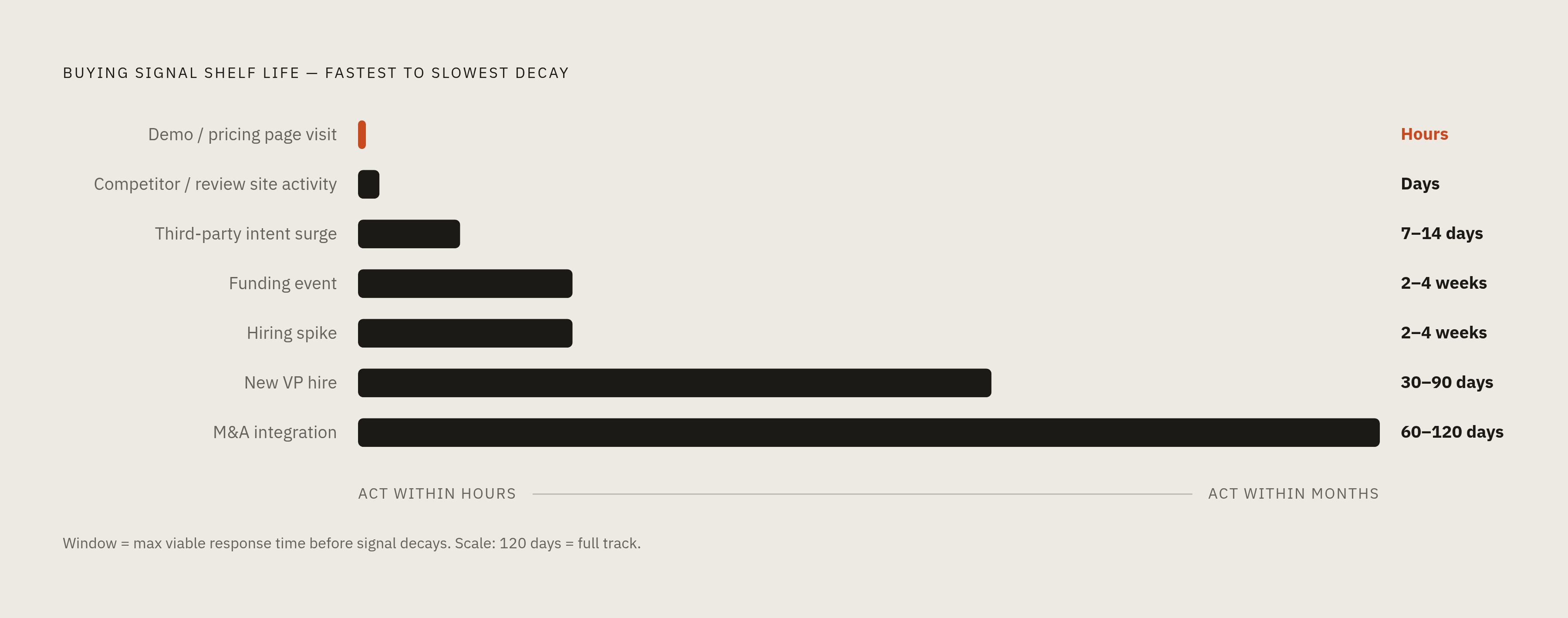
Every signal has a shelf life. Acting after the window closes is actually worse than not acting at all, because at that point you are just noise. You are irrelevant, you are late, and the prospect can feel it. I have seen teams put real effort into a well-researched, well-written sequence that still fell flat simply because they sent it three weeks too late. The signal had moved on. The buyer had moved on.
Here are the decay windows by signal type:
| Signal | Decay Window | |---|---| | Demo / pricing page visit | Hours | | Competitor / review site activity | Days | | Third-party intent surge | 7–14 days | | Funding event | 2–4 weeks | | New VP hire | 30–90 days | | M&A integration | 60–120 days | | Hiring spike | Ongoing, but act within 2–4 weeks of the pattern emerging |
First-mover advantage is real and it compounds with signal decay: the longer you wait, the more likely someone else already had the conversation.
The Operational Implication
Signal detection and outbound response cannot be two separate workflows with a meeting in between. High-decay signals like funding events, pricing page visits, and competitor intent need automated triggers into outbound sequences. Human review adds latency that destroys the window entirely.
Lower-decay signals like M&A integration or hiring spikes allow for more deliberate sequencing and personalization. The cadence can breathe. You have time to get the message right.
The point is that not all signals belong in the same queue. Teams that treat them as equivalent miss the whole benefit of signal-based outbound. Classify signals by decay rate in your playbook and route them accordingly. That is the operational piece most teams skip.
One more thing worth flagging: decay applies to message relevance too. A funding-event email sent three months post-close that references the round as "recent" does not just underperform. It actively damages credibility. It tells the prospect you are not paying attention. That is worse than silence.
Matching Signal Type to Outbound Motion, Channel, and Message
Different signals indicate different buyer states. Buyer state determines the appropriate channel, cadence, tone, and ask. Here is the practical playbook.
Champion Job Change → Warm Reactivation Play
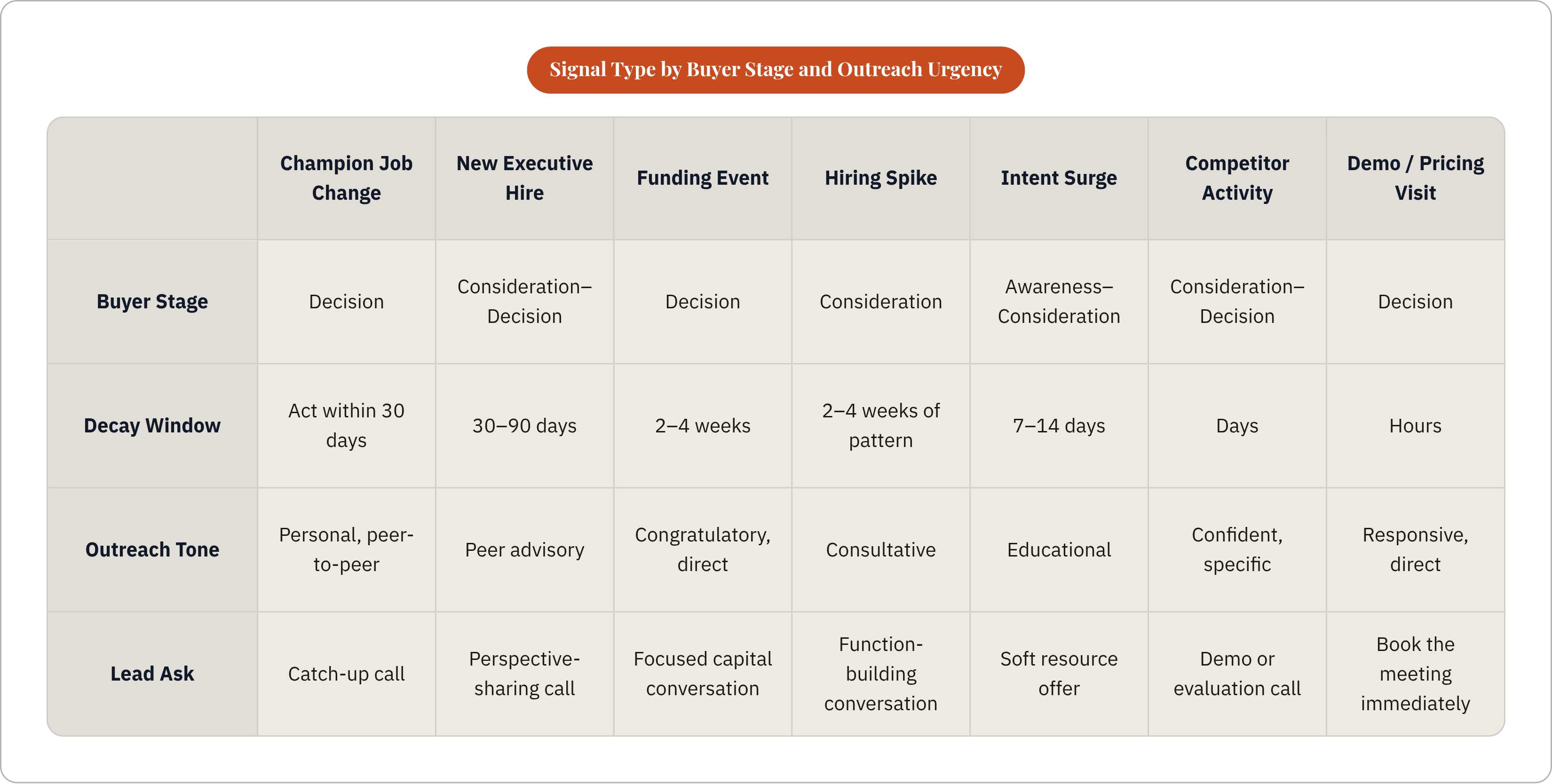
- Channel: Direct message on LinkedIn or email before any formal sequence
- Tone: Personal, peer-to-peer. Reference the shared history explicitly
- Ask: A call to catch up, not a demo. The relationship earns a softer entry
- Sequence length: Short. The relationship is the credibility, not the volume of touches
The mistake here is treating a warm contact like a cold prospect. Do not let your sequence tool make that decision for you.
New Executive Hire → Advisory Outreach Play
- Channel: LinkedIn connection request plus email. A brief congratulatory message before any pitch sequence goes a long way
- Tone: Peer advisory, not vendor. Frame around what leaders in their role typically prioritize in the first 90 days
- Asset to include: A relevant benchmark, a case study from a similar company, or a framework. Give before you ask
- Ask: A 20-minute perspective-sharing call, not a demo
New executives are drowning in vendor outreach. Everyone wants a piece of the new stack decision. The advisors get meetings. The vendors get deleted.
Funding Event → Speed Play
- Channel: Email first, LinkedIn as a follow-up layer
- Tone: Congratulatory but direct. Get to the point fast
- Ask: A focused conversation about where they are investing the capital and whether your category is on the roadmap
- Sequence length: Short and fast. Two to three touches in the first week
Do not overthink this one. The differentiation is just being first and being relevant.
Hiring Spike → Strategic Pain Play
- Channel: Email, with LinkedIn for account-level touches across multiple stakeholders
- Tone: Consultative. Show you understand what the hiring pattern signals about their direction
- Asset to include: Something that addresses the motion they are building. If they are hiring five SDRs, bring something about outbound infrastructure
- Ask: A conversation about how companies at their stage typically build the function they are clearly investing in
You are not selling to a hiring spike. You are showing up as someone who understands what the hiring spike means.
Intent Surge (Third-Party) → Early Education Play
- Channel: Email and targeted ads working together. This is not a single-touch signal
- Tone: Educational, not urgent. They are early in the process
- Asset to include: Category-level content. Comparison guides, ROI frameworks, "how to evaluate X" content
- Ask: Soft. A relevant resource, a short conversation about what they are exploring
The temptation is to go in hard because you caught them early. Resist that. Early-stage buyers need to feel educated, not cornered.
Competitor or Review Site Activity → Differentiation Play
- Channel: Multi-touch. Email, ads, and if the deal size justifies it, a direct executive reach-out
- Tone: Confident and specific. You know they are comparing. Acknowledge it
- Asset to include: A direct comparison, a "why customers switch from X to us" one-pager, or a case study from someone who evaluated both
- Ask: A demo or a focused evaluation conversation. They are ready for it
This is not the time for a soft ask. They are in evaluation mode. Meet them there.
Demo Request or Pricing Page Visit → Response Speed Play
- Channel: Phone first if you have the number. Email as immediate backup
- Tone: Responsive and direct. They took an action. Acknowledge it
- Ask: Get the meeting scheduled in the first message. They are already warm, so skip the warm-up
- One rule: Sub-five-minute response on demo requests. The competitor who got the same signal is not waiting around