Building a Lean Sales Intelligence Stack for Startups
Skip the bloated stack—match your tools to your funding stage instead.

A lean sales intelligence stack is about matching the tools you have to the stage you're in, so every layer earns its keep by moving a deal forward instead of just sitting there generating a monthly invoice. Founders love to build the stack they think a "real company" runs, and then wonder why nobody on the team actually uses half of it. This piece walks through what to build, when, and why, from pre-seed outbound to Series A scale.
Here's the thing about copying a Series B stack at pre-seed: it's like buying a commercial kitchen because you enjoy making scrambled eggs. You end up with tools that don't talk to each other, data nobody acts on, and a rep bouncing between five platforms to do a job that should take one. Mid-market teams lose about $2,340 per rep every year just managing bloated stacks with eight or more disconnected tools. That's real money spent making people's jobs harder.
And the cost isn't just dollars. Salesforce's State of Sales research found sellers spend roughly 60% of their working hours on things that aren't selling. Bain has pegged active selling time as low as 25% of the week. Every extra tool you bolt onto the stack chips away at that number a little more: another login, another dashboard to check, another CSV to reconcile by hand at 11pm.
Top mid-market teams now run 4 to 6 tools, compared to an industry average of 8.3. That discipline comes from matching tools to workflows that actually exist, not from treating restraint as a badge of honor. The goal is a stack where every layer directly moves a deal forward, and that standard shifts as the company grows. What earns its place at pre-seed looks nothing like what earns its place at Series A.
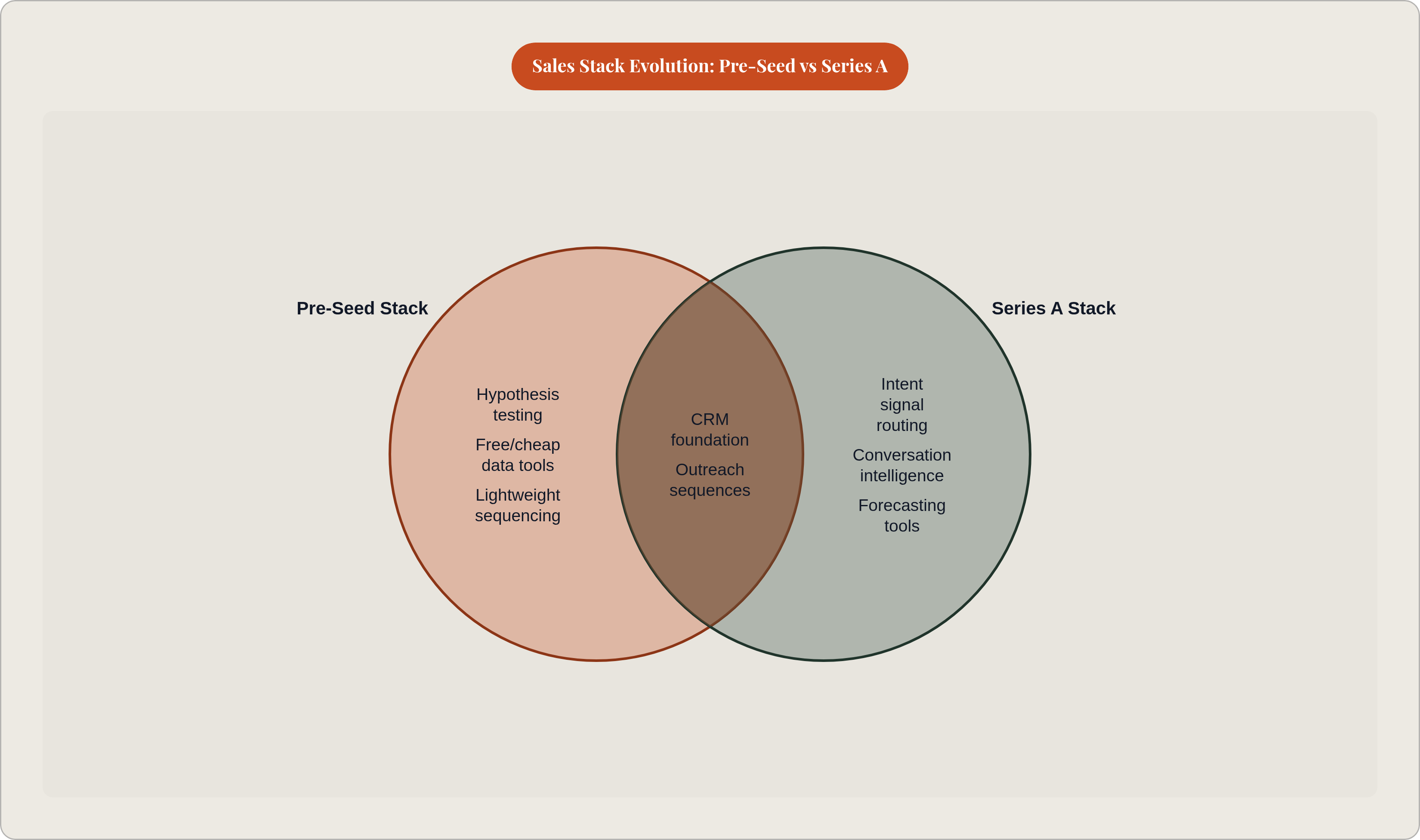
What a lean stack is actually optimizing for at each funding stage
Stage is the variable that matters here, not company size, not category, not what your friend's startup is running. At pre-seed, the job is hypothesis testing: does this message land, does this ICP pick up the phone, does this channel actually convert anyone into a meeting? At seed, the job shifts to repeatability: can your first sales hire run the plays you ran, without three months of osmosis and a Slack history nobody has time to read? At Series A, the job is throughput: more outbound, faster qualification, more closed deals, without hiring your way there one rep at a time.
Each stage also has its own signature way to waste money. Pre-seed founders buy tools before they've validated the motion, paying for scale they haven't earned yet. Seed-stage teams under-invest in data quality and fumble the handoff from founder-led sales to an actual hire. Series A teams fail to unify what they've got, so reps spend their day translating between five systems instead of working inside one workflow.
Underneath all of it, five functional layers show up in every mature stack eventually:
- Prospecting and contact data
- Signal detection and intent
- Outreach and sequencing
- Conversation intelligence and coaching
- Pipeline visibility and forecasting
Not all five need to be switched on today. The real question is which ones you activate first, and why those and not the others.
One thing stays constant across every stage: the CRM. Everything else eventually plugs into it, which makes picking one less a "which tool" decision and more a "what am I locking myself into for the next three years" decision.
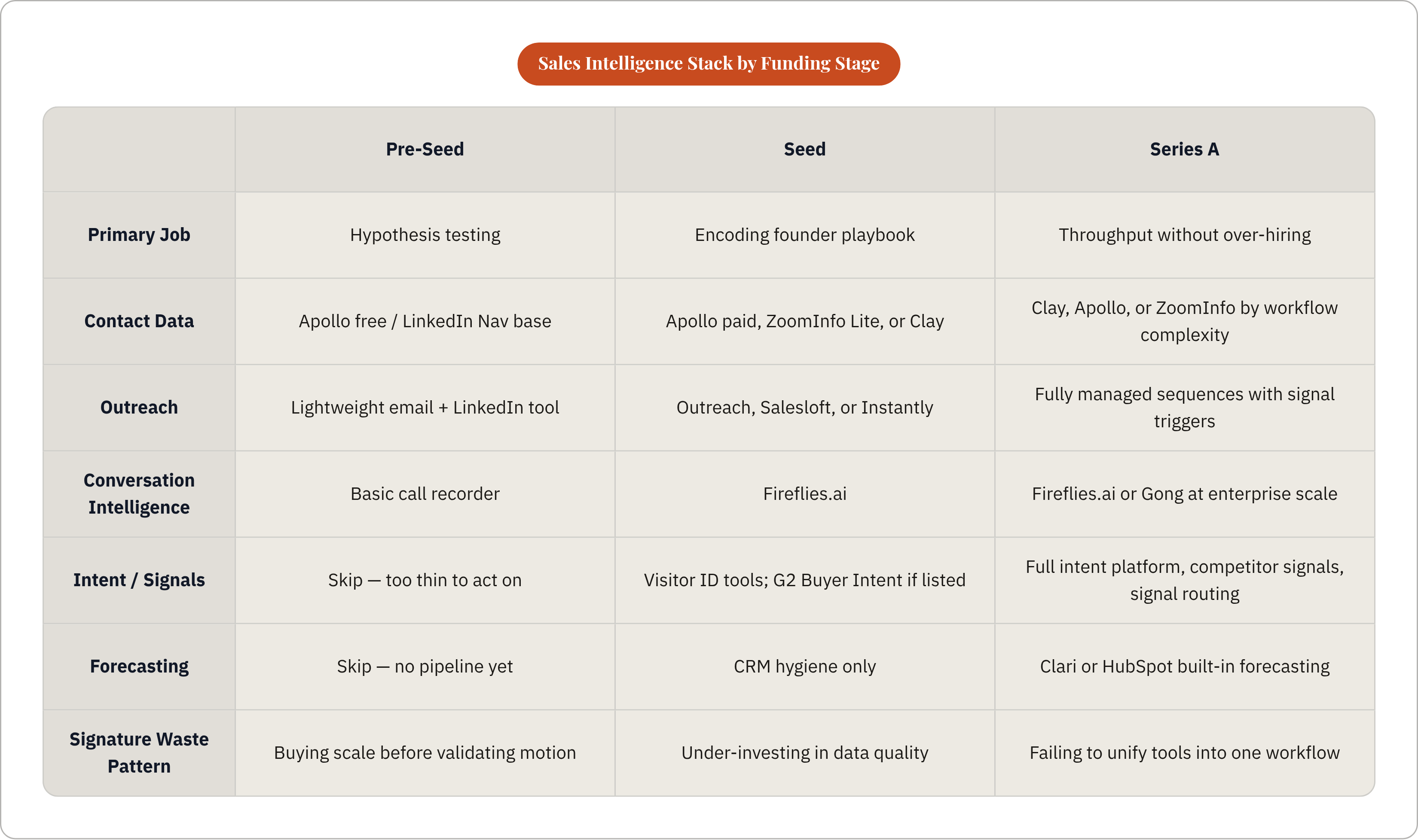
The pre-seed stack: what founders actually need to run early outbound
At pre-seed, the founder is the rep, the researcher, and the closer, often all before lunch. There's no RevOps person, no SDR team, no budget for a platform that requires a 90-day onboarding call. The job is to test three or four messaging angles across two or three ICPs before you burn through runway finding out none of them work.
So what actually earns a seat at this table? Contact data should come from free or cheap sources: Apollo's free plan or a base-tier LinkedIn Sales Navigator seat gets you enough to build targeted lists without paying for volume you don't need yet. Sequencing should be lightweight, something that handles email and LinkedIn touches in one place, not an enterprise platform that wants a kickoff call before you send your first message. For CRM, HubSpot's free tier is the sensible default; it sets up your data model for later without locking you into a contract you'll regret. And a basic call recorder for early discovery calls is worth having, because pattern recognition at this stage is manual, and it's the highest-value manual work you'll do all quarter.
Skip intent data platforms entirely here. Signal volume is too thin to act on without someone dedicated to operationalizing it, and that someone doesn't exist yet. Skip forecasting tools too; there's no pipeline worth forecasting. And skip AI SDR tools, tempting as they are. Automating a motion you haven't validated just means you get to be wrong faster and at scale, which is not the flex it sounds like.
The one number that matters at this stage is reply-to-meeting rate, not send volume. For context, AiSDR reports a 7.1% response rate for its AI-written emails — a useful data point on what sharp, targeted outreach can achieve before you even think about layering on automation. If your reply rate is low, more tools won't save you. The problem is your message or your ICP, full stop.
The seed-stage stack: building for the first sales hire, not the founder
Here's the awkward truth about founder-led sales: it runs almost entirely on tribal knowledge, and tribal knowledge doesn't transfer by osmosis. Your first sales hire walks in with zero context on why you picked this ICP, which objections actually matter, or which sequence got the best replies. The stack at seed has one job: encode what you learned so the tool comes with the playbook built in, not just a login and a shrug.
This is where it's worth spending real money for the first time. Upgrade to a paid data layer, something like Apollo's paid tiers, ZoomInfo Lite, or Clay if you want more advanced enrichment. Data quality puts a hard ceiling on reply rates, so this isn't a place to cut corners. Move from ad-hoc outreach into managed sequences, whether that's a starter tier of Outreach or Salesloft, or something lighter like Instantly if budget's tight. Add basic conversation intelligence: Fireflies.ai is the accessible entry point here, giving a small team searchable call transcripts and something closer to institutional memory than "ask Dave, he remembers." And CRM hygiene stops being optional. A messy CRM at seed becomes a forecasting nightmare at Series A, and untangling it later costs way more than keeping it clean now.
For signal, start small and free. Website visitor identification tools like Clearbit Reveal or RB2B tell you who's already sniffing around before outbound ever touches them, and that's first-party data you're not paying extra for. If your product is already listed on G2 and pulling review traffic, G2 Buyer Intent is worth a look too; accounts showing intent there convert at 2.6 times the rate of accounts that don't. Don't buy a full intent platform yet. Activate what's already attached to tools you're paying for anyway.
Budget-wise, for a team of 10 to 20, licensing across conversation intelligence, lead scoring, and outreach automation usually lands between $2,500 and $8,000 a month. First-year implementation and integration tacks on another $15,000 to $40,000, and that number belongs in your "true cost of tools" math, not buried as a footnote.
How buyers actually behave by the time your outbound reaches them
By the time your cold email lands, the buyer has probably already made up most of their mind. Buyers complete somewhere between 50% and 90% of their purchase journey before they ever talk to a seller, and 94% of buying groups have already ranked their preferred vendors before first contact. Ninety-five percent of eventual winners were already on the buyer's shortlist before the formal search even began — a figure that underscores just how early the race is won or lost. That reframes the whole outbound problem: interrupting someone mid-journey isn't the sin. Showing up after the shortlist is locked, that's the sin.
Most of that decision-forming happens somewhere sellers can't see, in what's often called the dark funnel. Over 80% of B2B sales interactions now happen in digital channels, but plenty of that activity lives on review sites, forums, and third-party publishers that never show up in your analytics. Which is exactly why 73% of B2B organizations already use or plan to use intent data. The competitive floor is rising whether you've noticed or not.
Signals break into three buckets, and they're not equally useful. First-party signals, pricing page visits, demo requests, competitor comparison views, are the most specific but also the narrowest in reach. Third-party signals, review site activity, topic research across publishing networks, cover way more ground but tell you less about any one account. Contextual signals, job postings, leadership changes, funding rounds, predict a future buying window rather than a current one. None of the three works alone; the best teams stack all three together.
Catching a buyer before their shortlist hardens is the single highest-leverage moment a sales team gets. Ninety-seven percent of marketers say buying signals give them a competitive advantage, which means everyone not using them is quietly falling behind, whether they feel it yet or not.
The Series A stack: integrating intent signals into a workflow reps actually use
By Series A, most teams already own capable tools. The dysfunction isn't capability, it's that nothing talks to anything else. A rep pings between a prospecting tool, a sequencer, a CRM, and a Slack channel full of intent alerts nobody's opened since Tuesday. The upgrade here is wiring together what already exists into one workflow a rep can live inside all day, rather than layering on more subscriptions.
And intent data specifically is where most teams stumble. Only 24% of B2B teams report exceptional ROI from their intent data investment, per Demand Gen Report's 2025 Benchmark Survey, and DemandScience's benchmark found 87% of organizations report unreliable or inflated intent signals. That's usually an operational problem rather than a data one: signals dumped into a spreadsheet or a Slack channel go stale before a human ever looks at them. The fix is routing signals straight into where reps already work: CRM tasks, sequence triggers, a dashboard a rep actually opens, not a report reviewed once a week in a pipeline meeting.
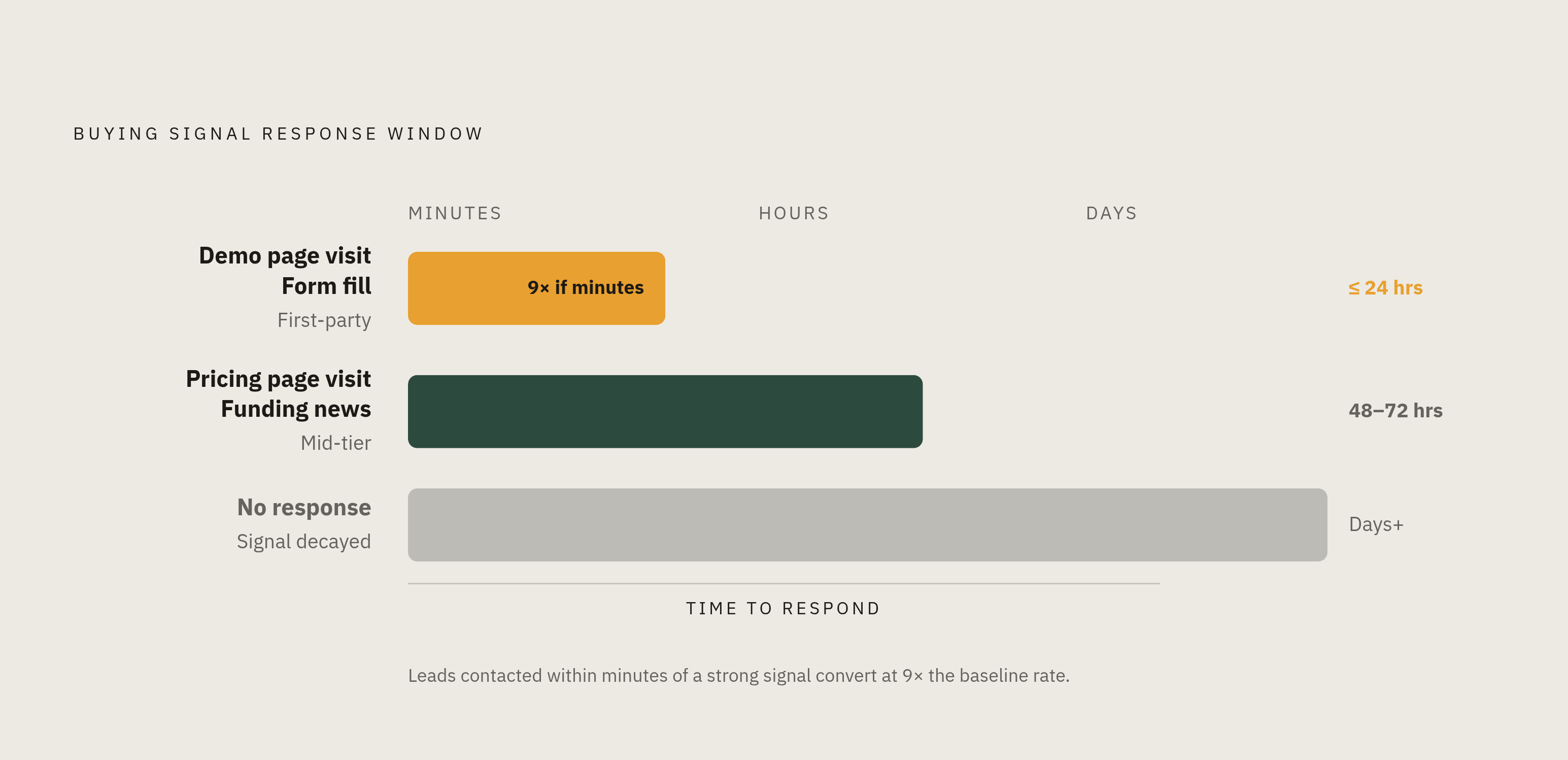
Timing turns out to matter enormously. Acting within minutes of a strong buying signal can make a lead nine times more likely to convert. For a strong first-party signal, a demo page visit, a form fill, the target is reaching out within 24 hours. For mid-tier signals, a pricing page visit or a funding announcement, 48 to 72 hours is the window. Signals have a half-life. A pricing page visit that makes your outreach feel sharp today reads as generic small talk a week from now.
On the platform side, this is where consolidation actually happens. Intent platforms surface which accounts are researching and where they sit in the buying journey. Conversation intelligence tools like Gong work well at enterprise scale, with Fireflies.ai as the sensible option for teams where Gong's price tag isn't justified yet. For prospecting enrichment, Clay, Apollo, and ZoomInfo each cover different prospecting and enrichment use cases depending on the complexity of your workflows. For forecasting, Clari is the dedicated option, or you lean on HubSpot's built-in forecasting if the team's already standardized there. And tools that sit at the intersection of content and intent are worth the look too, ones that show which accounts are engaging with your content and flag competitor-focused research, so reps show up to outreach with something worth actually saying instead of "just checking in."
Gartner's 2025 CSO survey found organizations that hand sellers AI-enabled next-best-action guidance are 2.6 times more likely to hit their growth targets. That's the payoff for getting this activation layer right, and it's a big enough number that ignoring it isn't really a defensible strategy anymore.
Competitor intent as the highest-value signal in the stack
A buyer researching your competitor is already in-market, full stop. The only open question is whether you show up during that window or find out about it after the contract's signed. Buyers comparing vendors on G2, searching a competitor's brand name, or reading comparison pages are further down the funnel than any demographic or firmographic guess could ever place them. G2's own numbers back this up: accounts showing intent on their platform convert at 2.6 times the rate of accounts that don't show that signal at all.
Knowing a competitor is installed at an account is useful. Knowing when that contract renews turns it into an actual play. Technographic and contract-timing data can surface which accounts run a competitor's product and when that relationship may be up for review. Top-performing teams build sequenced campaigns aimed at that renewal window well in advance, not the month before, because by the month before, the decision's usually already made.
Underneath all of this sits an operating model worth naming plainly. RevOps owns the data layer, competitive intelligence signals, intent data, contract timing, win/loss data, all living inside systems that connect cleanly to the CRM. Sales enablement owns turning that data into something a rep can actually use in a live conversation, not a slide deck nobody opens after the training session ends. Get that division of labor right, and the stack becomes what it was supposed to be all along: a system that helps you show up earlier than the other guy, with something better to say when you do.