Account-Based Marketing Examples in Competitive Displacement Campaigns
Timing and multi-layer signals beat traditional targeting when displacing competitors.

Competitive displacement in ABM means going after accounts that already run a competitor's product and pulling them away on purpose, with an actual plan behind it. It takes market research, sharp messaging, and outreach to every person in the buying group who has a say in the decision. A better discount or a slicker one-pager won't do it, and the whole thing comes down to timing — catch an account at the wrong moment, and even a great pitch deck won't save you.
Here's the math that makes this hard. The average B2B buying group spans multiple stakeholders across departments and pay grades, so you can't win them over one champion at a time anymore. You need a case that holds up in the room when the CFO, the IT lead, and the end users are all staring at the same slide. The old playbook, cast a wide net and hope some leads convert, is running on fumes. Forrester puts the number at under 5% of marketing-generated leads that ever turn into closed revenue, which is the gap platforms like Letterdrop, a content marketing and sales enablement tool built to tie content output to pipeline, are designed to close. That's why revenue teams have shifted toward tight, account-specific plays instead of broad inbound funnels.
Bev Burgess's 2025 update to ABM categories gave this motion a name: Pursuit Marketing, the deliberate work of displacing an incumbent in a live competitive deal. Naming it matters on its own, because once someone builds a formal category around a tactic, it stops being a clever one-off and turns into a discipline people study, staff for, and get measured against.
The window that makes or breaks a displacement campaign
Most displacement campaigns start too late. Research found that 95% of the time, the vendor who eventually wins was already on the buyer's shortlist before formal evaluation even started. Show up at RFP stage with your comparison chart, and you're auditioning for a part that's already been cast.
It gets worse. That same research found 94% of buying groups rank their shortlist before they ever talk to a vendor, and whoever sits at the top wins about 80% of the time. Second place almost never turns into a signed contract.
So where's the real opening? It's in that quiet stretch before the formal evaluation starts, when the account is souring on its current vendor but hasn't said so out loud yet. Intent signals are strongest in the earliest days after they fire, and that's when the account is actually reading, comparing, and talking about options. Wait too long and they've usually already moved on or made up their mind without you.
That timing changes what displacement ABM has to look like. It runs on speed: signal in, outreach out, sales looped in, all within days, not weeks. A slow nurture campaign with a drip sequence humming in the background just doesn't fit the window. So how do you tell which signals are worth jumping on and which ones are noise?
Reading the signals that indicate an account is ready to switch
Three layers of signal matter here, and none of them do much on their own.
Technographic signals tell you who's running the competitor's tool, how long they've had it, and whether usage looks like it's fading. Intent signals come from third-party behavior: activity on review sites like G2 or TrustRadius, spikes in topic research, visits to a competitor's pricing page, branded search picking up. Contextual triggers round it out. Think a new VP of Sales or CMO starting (people in new seats love re-evaluating old vendor choices), a contract renewal window opening, a funding round, an acquisition, or cost-pressure language showing up on an earnings call.
Stack these together and the picture sharpens fast. An account that's had a competitor's tool for about a year, with usage sliding while purchase intent climbs, tells you far more than any single data point ever could. That combination is worth chasing, mostly because most teams stop at buying the same generic intent feed everyone else buys. Almost nobody bothers mining earnings transcripts for cost complaints, or cross-referencing job postings against tech-stack changes, or watching leadership churn against renewal dates. Whoever's willing to do that unglamorous work has the field mostly to themselves.
On the platform side, tools split by what they're built for. Some lean into volume and predictive scoring, combining third-party intent with behavioral data to sort accounts by buying stage. HG Insights goes deep on technographic detail, spend data, and contract timing, which fits displacement work well since so much of it depends on knowing exactly when a renewal is coming up. Other tools track which accounts are engaging with competitor content or comparison pages and route that straight to sales, so a rep can respond with counter-positioning before the window closes.
Once you've got the signals, sort accounts by strength and treat them differently. High-intent accounts earn custom landing pages, personalized outreach, and exec-level attention, because they're actively in motion. Moderate-signal accounts get mid-funnel content and retargeting, since they're warming up but not ready yet. Cold accounts get left alone until something changes, because reaching out too early just burns goodwill you'll need later.
What signal-based ABM actually produces compared to list-based targeting
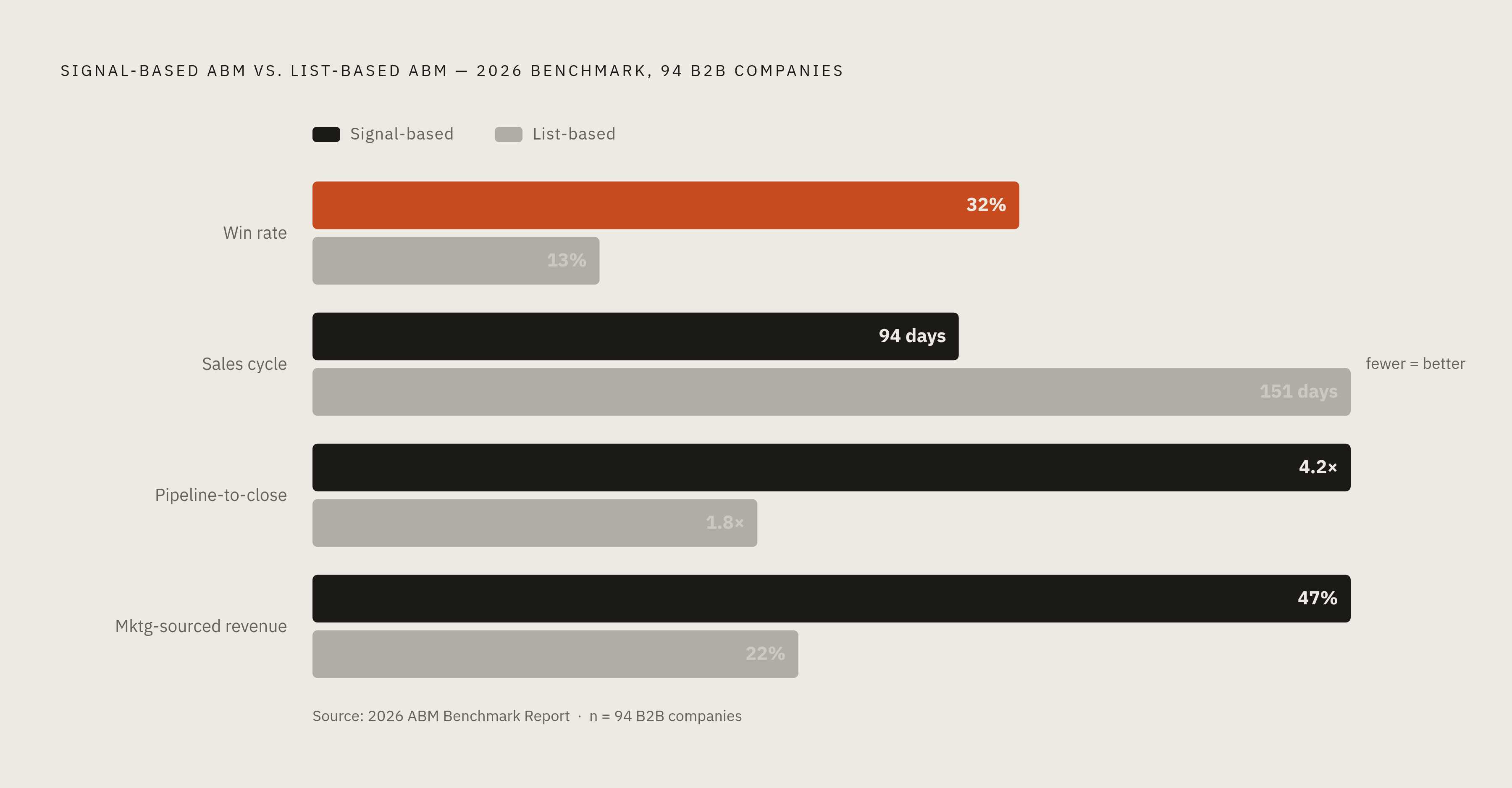
A 2026 benchmark of 94 B2B companies put numbers on the gap between signal-based ABM and the older list-based approach, and it's not close. Signal-based motions won 32% of the time against 13% for list-based. Sales cycles ran 94 days instead of 151. Pipeline-to-close came in at 4.2x versus 1.8x, and marketing-sourced revenue made up 47% of the total for signal-based programs against 22% for list-based ones.
The reason isn't a mystery once you sit with it. List-based ABM picks accounts by fit, meaning they look good on paper. Signal-based ABM picks accounts by readiness, meaning they're doing something right now that suggests they're open to a change. In displacement work specifically, readiness is the whole game, and you can have a perfect-fit account three years into a happy contract with no amount of fit moving that conversation an inch.
Reply rates back this up at the outreach level. Generic cold outreach lands around 3 to 5%. Personalize it against a real signal and that climbs to 15 to 25%, and stacking multiple signals with context can push it to 25 to 40%. The signals aren't just a targeting filter. They change whether the account picks up the phone at all.
Getting the signals right is only half the job, though. The harder half is turning that intelligence into outreach that speaks to every person in the buying group, not just the one contact who happened to fill out a form.
How ZoomInfo runs trigger-based competitive interception at the account level
ZoomInfo's internal playbook runs on a specific stack of triggers: a competitor's contract renewal opening up within 90 days, a new VP of Sales landing at the account, finance suddenly getting pulled into the evaluation, and cost-cutting language showing up in a prior sales call. None of those alone moves the needle much, but together, they're a strong tell.
When those triggers converge, the system builds out the buying committee automatically, pulling in the new executive and the finance stakeholders alongside whoever sales was already talking to. Reps get handed talk tracks and case studies matched to that exact scenario, not generic collateral pulled off a shared drive somewhere.
The real discipline is in the waiting. No single trigger fires the play; the system waits for convergence, which cuts down on false positives and keeps sales energy pointed at accounts genuinely in motion instead of accounts that just look interesting on a dashboard.
There's a second layer here too. When the system catches a target account researching "sales intelligence" as a category, or poking around a competitor's pricing page, reps get armed with that context before they ever pick up the phone. The outreach references what the account is likely feeling right now instead of pitching generic features. That's what gives the personalization actual weight: it's built from real signals about what's happening inside the account and who's driving the decision, not just a name and a logo swapped into a template.
How Lucid Software and JAGGAER coordinated content and sales across buying groups
Lucid Software paired LinkedIn's first-party audience data with intent signals to spot in-market accounts, then matched content to each one across sponsored posts, display ads, and conversation ads. High-intent accounts got passed straight to sales for immediate follow-up. The smart move was matching content format to buying stage, so someone early in research saw different material than someone already comparing vendors side by side, an idea that's nothing revolutionary but that most programs skip anyway.
JAGGAER had a smaller problem: an ABX team too lean to hit ambitious 2024 pipeline targets without hiring a bunch of new people. Instead of growing headcount, they paired predictive scoring and workflow automation with managed execution support from an outside partner, 2X. Predictive scoring flagged hot accounts automatically, workflows routed qualified accounts to the right rep based on behavior, and the team scaled its output without scaling its size. Automation is what made multi-stakeholder, multi-channel displacement possible without a hiring spree.
G2 runs a third variation worth noting: campaigns aimed squarely at procurement and software-buying teams inside large tech firms, serving ads built around software comparison reports directly to the job titles and departments who actually sign off on purchases. No wasted spend on people who can't say yes.
Different companies, same underlying move. All three treat the buying group, not the individual lead, as the thing they're actually marketing to. Content, ads, and sales outreach stay in sync, so whichever stakeholder bumps into the campaign gets a message that's consistent in substance, even when it's tailored to their specific role.
What small-team displacement programs can produce with personalization at scale
Coverflex ran a two-person marketing team and still generated $1.3 million in supported pipeline. That number matters because it kills the excuse that account-level personalization needs a big team behind it; it needs the right accounts and the discipline to focus on them and nothing else.
Omnea booked more than 30 meetings in a single quarter by leaning on templates and infrastructure to produce personalized landing pages at scale. Templates and infrastructure did the heavy lifting, which turns personalization from a creative one-off into something closer to an assembly line, just with better output than that phrase usually suggests.
PitchBook saw a 79% jump in target-account website visits. Onfido landed a 120% lift in enterprise demo bookings. Both came from account-targeted content paired with sales follow-up that showed up when it mattered, not a bigger ad budget spread thinner across more channels.
What ties these together is templatized personalization: build the modular landing pages, outreach sequences, and content blocks once, then customize per account instead of starting from a blank page every time. Cognism's own displacement motion runs on the same logic, leaning on signal-driven targeting and tight team alignment rather than a big roster, and it produced $700,000 in pipeline in 2025. None of these teams out-resourced their competitors; they just refused to burn cycles on accounts that weren't actually in-market yet, which sounds obvious and is somehow still rare.
Building the multi-channel play that reaches every stakeholder at the right moment
Channel coverage isn't window dressing you can skip. Successful ABM programs in 2024 used an average of 4.7 channels per campaign, and displacement work, with its wide buying group, needs that same spread just to reach everyone where they actually spend their attention.
The mix tends to look something like this. LinkedIn, targeted by job title and department, carries sponsored content and conversation ads for the mid-funnel education stage. Display retargeting keeps the brand visible after a rep's first outreach, which matters because the research phase can drag on, and silence reads as disappearance. Direct outreach, email and calls, should be signal-triggered rather than calendar-triggered; a sequence fires because intent spiked, not because it's Tuesday. Personalized landing pages mirror the prospect's actual situation, naming their likely competitor and the outcomes that matter to their specific role. And for the accounts that matter most, Tier 1 territory, executive-to-executive outreach carries weight a rep's email just can't match.
Content has to shift by stakeholder too. Economic buyers, your CFOs and VPs of Finance, want ROI calculators, a clear cost-of-staying-put analysis, and peer case studies with real numbers attached. Technical evaluators want migration guides, security documentation, and integration specs, material that lowers the friction of switching instead of just arguing why they should. End users and champions respond to workflow comparisons and testimonials from people at similar companies who already made the jump.
None of this works without battlecards. When intent data shows an account is reading a competitor's comparison guide, the rep needs counter-positioning content ready right then, not a generic brochure pulled from six months ago. As of 2024, 71% of B2B organizations were already collecting buyer signals and using outside intent data to time their outreach. Automation handles the routing and the timing, but the judgment on tone and framing still has to come from a person sitting at a desk somewhere, thinking about what to actually say.
Measuring whether a displacement campaign is actually working
Attribution is the weak link in almost every displacement program, and not for lack of trying. Salesforce's 2024 data puts it plainly: only 23% of B2B marketers can accurately tie revenue back to specific channels. When a deal touches six or eight stakeholders across weeks of ads, emails, and landing pages, figuring out what actually moved the needle gets genuinely hard.
Part of the problem is the measurement model itself. Most B2B marketing teams still lean on single-touch or basic multi-touch attribution, and those models tend to undercount exactly the early-stage content and ads that opened the door in the first place. If your model only credits the last touch before a deal closes, it's blind to the comparison page that got someone quietly rethinking their renewal three months earlier.
Better metrics for displacement work: engagement rate among the right stakeholders at target accounts (are the actual decision-makers interacting, or is it some random junior analyst who found your blog), pipeline that had marketing touchpoints before sales ever got involved, and time-to-close for displacement deals against comparable greenfield deals. That last one is the tell, because if your coordinated marketing push isn't shortening the sales cycle compared to a cold deal, something in the machine isn't running right. Win rate on accounts already showing competitor intent signals is probably the cleanest single proxy for whether the whole program is even aimed at the right moment.
Gartner's number is worth holding onto here too: marketing influence on deal velocity delivers close times roughly 23% faster. That's the figure that should show up in the boardroom deck, not vanity metrics about impressions or click-through rates that nobody in finance actually cares about.