Revenue Intelligence Tools vs Sales Intelligence Tools
Revenue intelligence is growing faster than sales intelligence, but both categories are converging.

These are not niche software categories anymore. That much has been clear for a while.
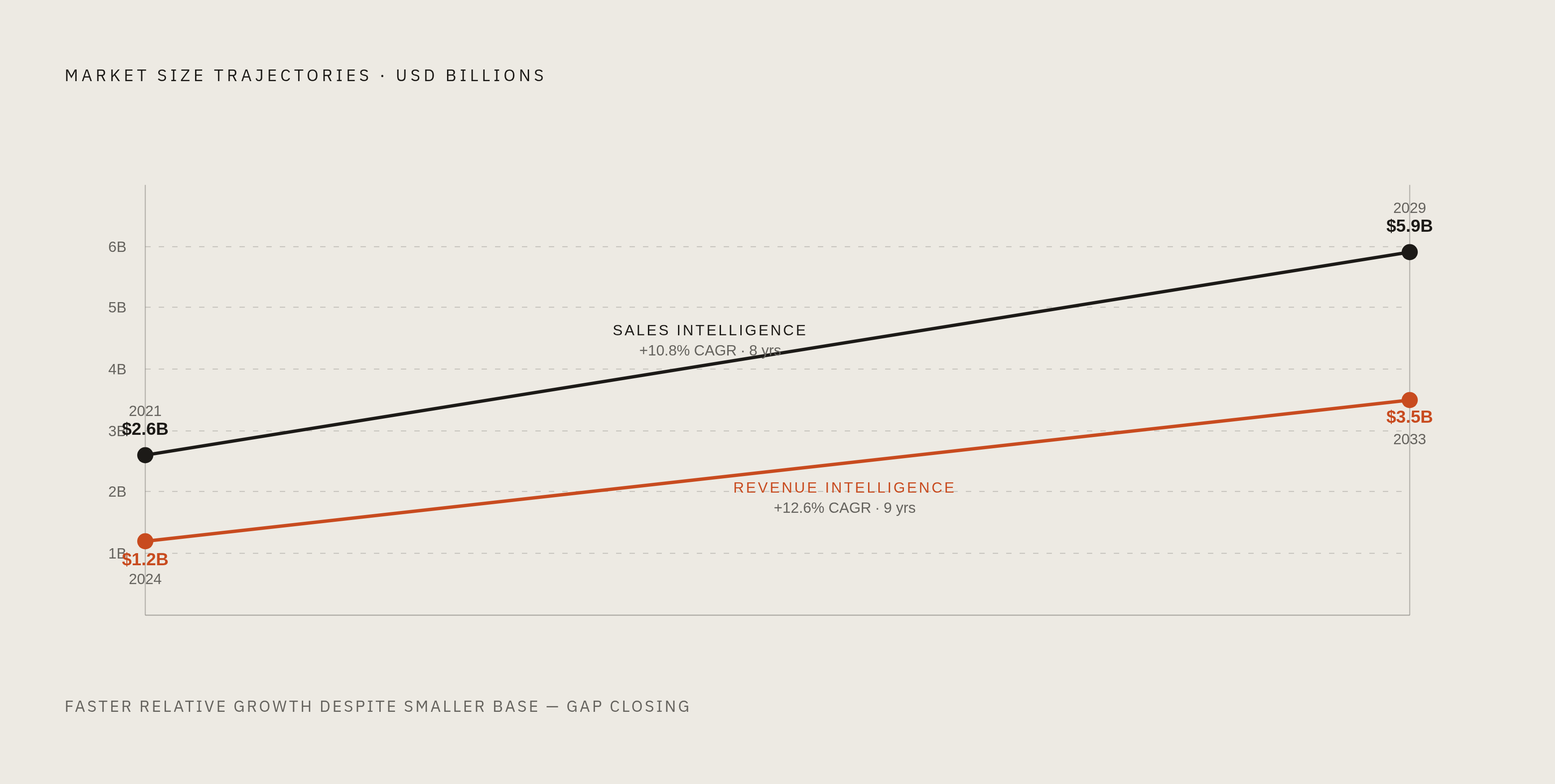
The sales intelligence market was valued at around $2.6 billion in 2021 and is projected to hit $5.9 billion by 2029. Depending on which analyst you read, the compound annual growth rate sits somewhere between 10 and 18 percent over that window. Revenue intelligence is smaller but moving faster. It came in at roughly $1.2 billion in 2024 and is projected to reach $3.5 billion by 2033. Three quarters of companies expect to increase investment in the category over the next year. More than three quarters of U.S. enterprises have already implemented or are piloting a revenue intelligence platform.
That is not early adoption. That is just Tuesday.
The growth gap tells you something simple: revenue intelligence is newer and catching up fast, like a rookie sprinter who just discovered caffeine, while sales intelligence is the seasoned marathoner who has been lapping the field for years. What the numbers do not tell you is whether your team actually needs both. And this is where it gets genuinely annoying, because market growth also means the categories are converging. Which makes the "what do I actually need" question harder, not easier. You would think more clarity would come with more money flowing in. It does not.
Why Buyers Are Harder to Reach Before Sales Intelligence Closes the Gap
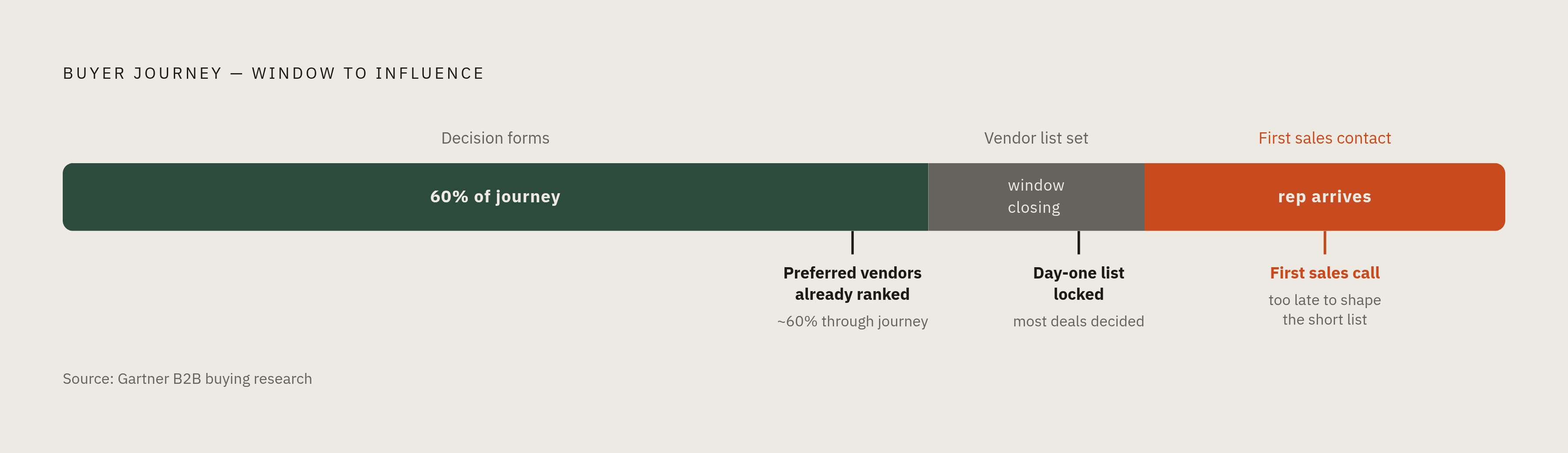
Here is a number that should bother anyone who carries a quota: buyers complete roughly 60 percent of their journey before they ever talk to a seller. Nearly all buying groups have already ranked their preferred vendors before the first sales call happens.
By the time an account shows up on a rep's outreach list through traditional prospecting, the shortlist is usually done. Most deals land with a vendor that was on the buying group's day-one list. You do not lose those deals because a competitor was better. You lose them because you were absent when the room was being set up.
Sales intelligence is trying to fix exactly that. Surface the accounts that are in-market before they raise their hand publicly. Get your team in front of the shortlist while it is still forming, not after it has hardened into something you cannot crack.
The buying group reality makes this messier. B2B buyers consume a lot of content through their journey, and almost all of it happens anonymously. They are comparing options before any vendor knows they exist. The window to influence the decision opens, and then it closes — knock knock. Who's there? The shortlist. The shortlist who? Exactly — you'll never know, because you weren't there when it formed. Sales intelligence is about catching that window while it is still open. Sounds obvious. Almost nobody does it consistently.
How Intent Signals Actually Work and Where They Fall Short
Intent signals are the mechanism that makes sales intelligence useful. But most teams use them wrong, and a lot of vendors make good money off that confusion.
There are three signal types that actually matter:
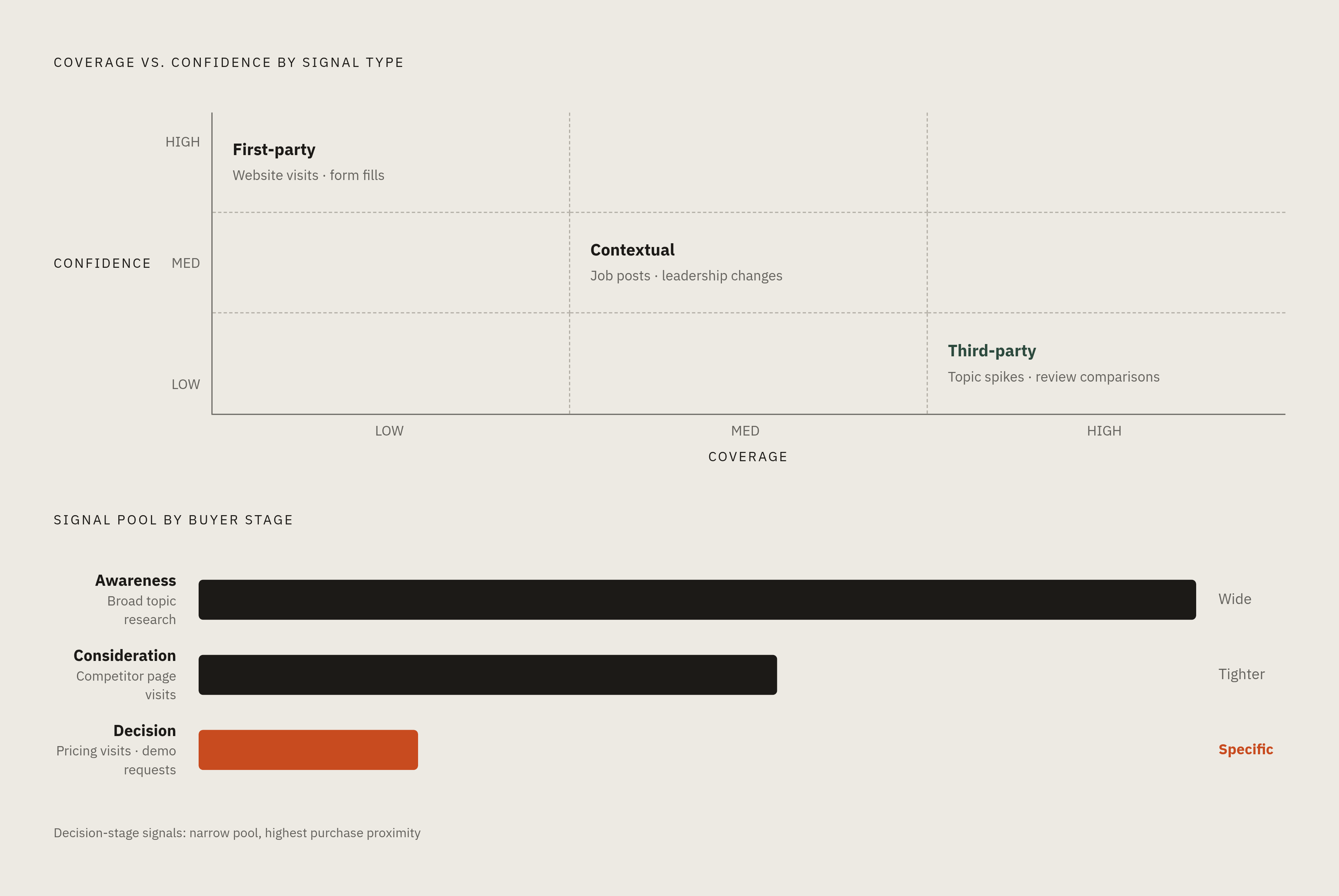
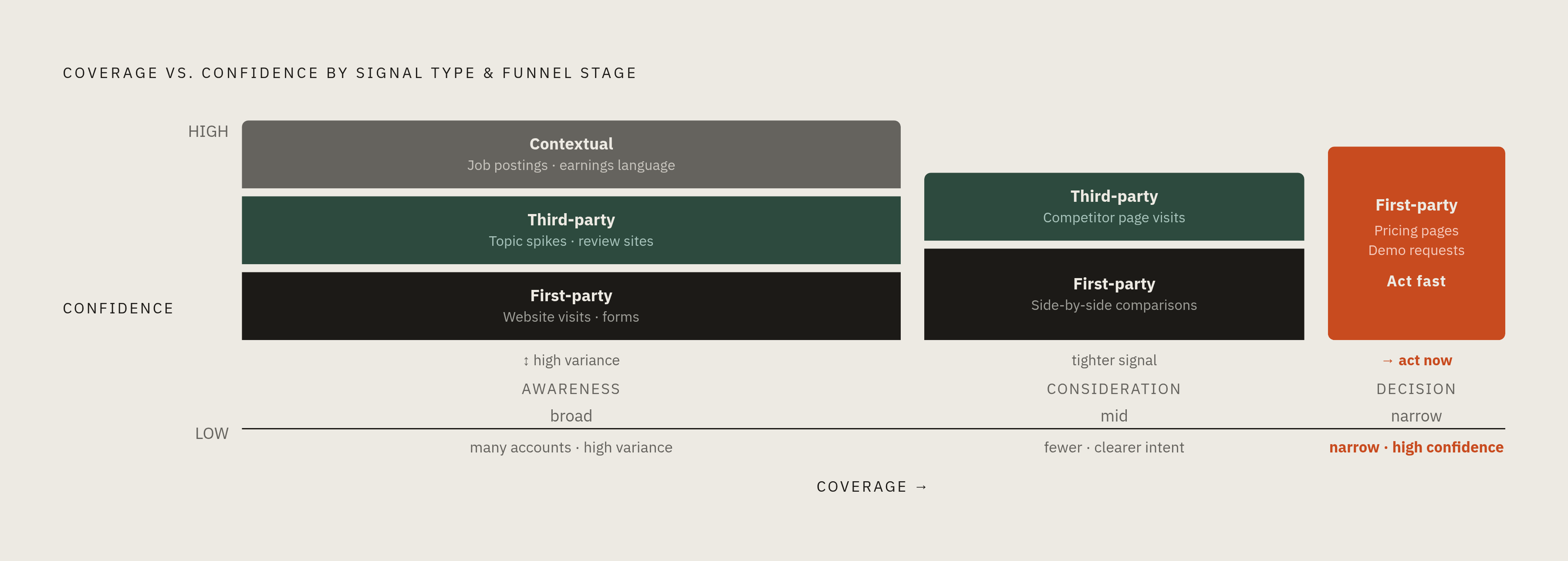
- First-party signals. Website visits, content downloads, form fills. High confidence because it is your data. Low coverage because it only captures people who already found you.
- Third-party signals. Topic research spikes tracked across large publisher networks, review site comparison behavior. Much broader reach. Lower confidence because you are inferring intent from activity on someone else's property.
- Contextual signals. Job postings, leadership changes, earnings call language. A company posting five new enterprise sales roles is probably building out a revenue function. That is signal, even if they have never searched your category once.
Signal quality also shifts depending on where a buyer sits in their journey. Broad topic research at the awareness stage flags a lot of companies with a lot of variance in how close they actually are to buying. Competitor page visits and side-by-side comparisons at the consideration stage are tighter. Pricing page visits and demo requests at the decision stage are a narrow pool with genuine purchase proximity. Review platforms with intent data consistently show that accounts in active comparison mode convert at much higher rates than accounts without those signals.
Here is where most teams fall down. Adoption of intent data has grown a lot. But adoption does not equal ROI. The gap most teams fall into is buying more data rather than getting better at filtering and acting on what they already have. That is not a data problem. That is a discipline problem.
The noise is real. A meaningful chunk of organizations report that their intent signals are inflated or just wrong. Only about a quarter of signals convert to qualified opportunities. And speed compounds everything. If a signal fires Monday and a rep sees it Thursday in a pipeline review, two competitors have already booked demos. The response window is hours, not days.
Good intent data in the hands of a slow team is not an advantage. You know exactly where to go. Your team just never gets there in time.
The Specific Case for Competitor Intent as the Highest-Value Signal
Knowing a competitor is installed at an account is useful. Knowing their contract is up in 90 days is actionable. The best teams track both and time outreach to the renewal window. That is not a sophisticated strategy. It is just math.
The signal trail is detectable. Buyers who are researching alternatives leave marks. Competitor brand searches. Category replacement keywords. Review site comparison clicks. When competitor install data, intent signals, and contract timing stack up together, that is one of the highest-leverage moments in the entire sales process.
When those signals line up, the play is to get there before the buyer formally opens an evaluation:
- Acknowledge the incumbent without tearing it apart
- Frame the renewal as a natural moment worth a second look
- Give them a specific reason to add another option to the mix
Timing is the whole thing. A displacement play eight months before renewal lands. The same play one month out usually arrives too late because the shortlist is already set. I have seen teams get this exactly right and I have seen teams get it exactly backwards, and the difference in outcomes is not small.
Letterdrop's competitor intent capability was built around this problem specifically. Catching a buyer mid-evaluation requires both the signal and the content ready to meet them where they are. Signal without a content motion is just a notification you feel good about. A content motion without the signal is noise you send into the void. The point is connecting both in one workflow rather than bouncing between two tools and losing time in between.
One thing that is easy to miss: intercepting a competitor evaluation is a pre-deal motion. Once that conversation turns into a created opportunity in your CRM, you have crossed from sales intelligence territory into revenue intelligence territory. Different problem, different tools.
What Revenue Intelligence Covers Once a Deal Is in Motion
Revenue intelligence does not help you find deals. It helps you protect the ones you already have. These are separate jobs, and treating them like they are the same is how good pipeline goes sideways.
The core problems it actually solves:
- Forecast accuracy. Traditional forecasting has ugly error rates. Revenue intelligence platforms cut those errors significantly. Gartner research shows only a small fraction of sales organizations hit high forecast accuracy without this kind of tooling. Most are guessing, just with more confident language and a straighter face.
- Deal visibility. Activity capture across email, calls, and calendar shows what is actually happening in an account, not what a rep remembered to log. Those are very different pictures, and the gap between them is where forecasts go wrong.
- Deal risk detection. Flags when engagement drops, a champion goes quiet, or velocity slows before the deal falls off the forecast entirely.
- Post-close expansion. Customer health scores and product usage signals let you get ahead of churn and upsell before the customer starts quietly shopping alternatives.
The key distinction from CRM is this: a CRM stores what happened. Revenue intelligence infers what is likely to happen next and tells you where to intervene. Same underlying data, fundamentally different kind of analysis running on top of it.
McKinsey research points to meaningfully higher sales efficiency and shorter cycles for companies using revenue intelligence tooling. The category now has well-defined players: conversation intelligence platforms, forecasting and pipeline inspection tools, CRM activity capture solutions, and broader revenue orchestration platforms. RevOps functions have grown substantially as a result, with close to half of companies now running dedicated RevOps teams. That is a structural change, not a trend.
How the Tool Market Is Consolidating and Why the Lines Are Blurring
The average revenue tech stack has shrunk over the past couple of years. Integration fatigue is real. Data fragmentation is expensive. Context-switching between eight tools that do not talk to each other burns time and, eventually, the patience of whoever manages the stack. Companies have been rationalizing aggressively, and the vendors have responded accordingly.
The most visible signal of consolidation is the Clari and Salesloft merger. Combined, the entity manages what it describes as roughly ten trillion dollars of revenue across thousands of organizations including Adobe, IBM, and Zoom. That is a direct bet that finding the deal and running the deal belong in one platform. You can disagree with the execution. The thesis is hard to argue with.
Gartner published its first Magic Quadrant for Revenue Action Orchestration in late 2025. The category name itself is telling. Analysts are treating the pre-deal and in-deal motions as one continuous workflow now, not two separate purchasing decisions.
Agentic AI is accelerating all of this. Most revenue leaders expect their teams to be running heavily on AI tools by 2026, and a lot of those applications will involve agents executing workflows rather than just helping someone think through them. The shift from AI-assisted to AI-executed is already underway. That will push consolidation further and faster.
The practical implication: consolidation does not erase the conceptual distinction between sales intelligence and revenue intelligence. A single platform can handle both. But if you are unclear on which job you are actually prioritizing, you cannot evaluate whether any given platform does it well. Buying a platform for one job and assuming it will handle the other is a real and recurring mistake. Consolidation is a supply-side story. The demand-side decision still requires you to know what problem you are actually trying to solve.
How to Decide Which Tool Your Team Actually Needs Right Now
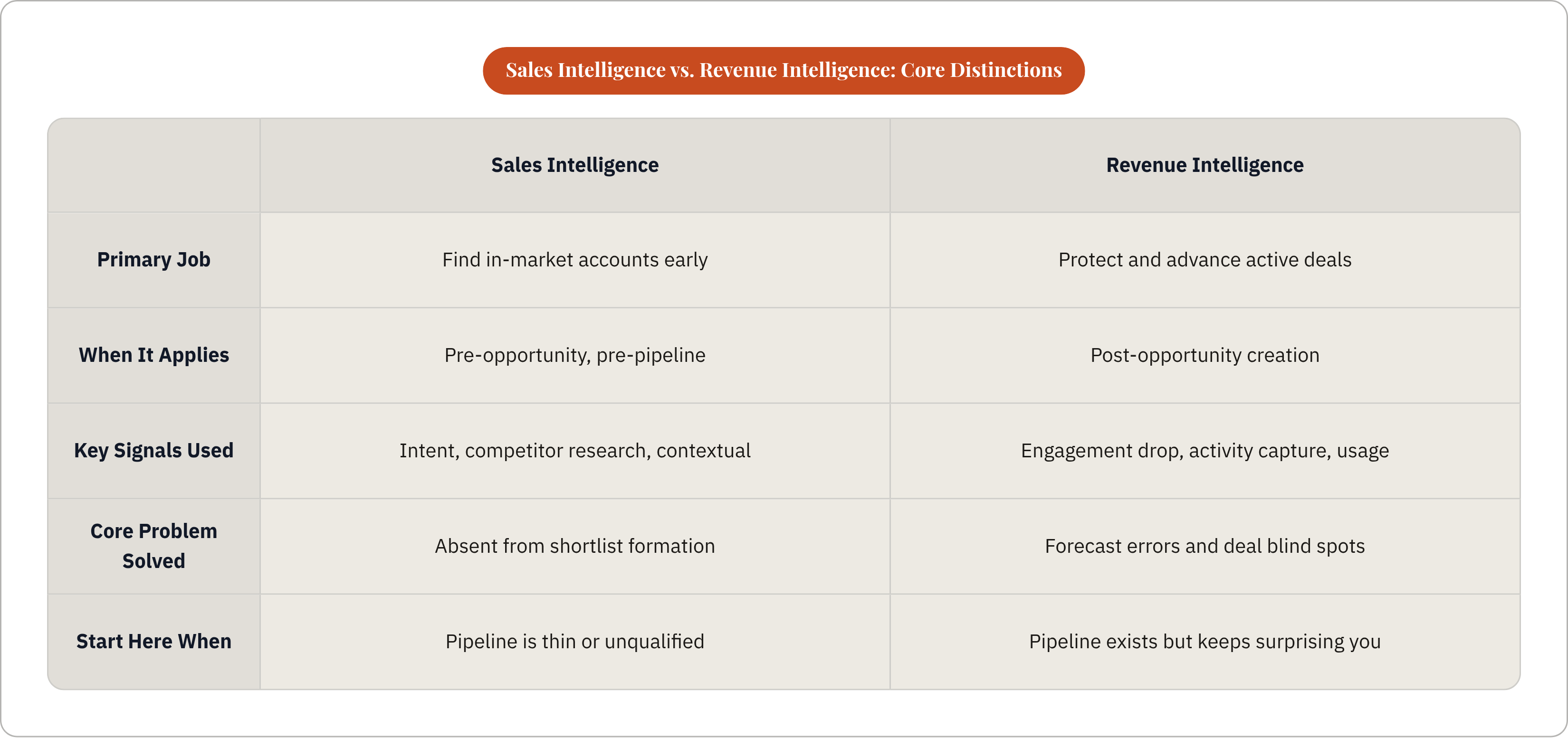
Pick the category that addresses your biggest revenue leak right now. That is it. That is the whole framework.
Start with sales intelligence when:
- Pipeline is thin and the team does not have enough qualified accounts in motion
- Reps are doing high-volume outreach without signal prioritization and genuinely cannot figure out why conversion is low
- Competitor wins are happening before your team even knew the account was evaluating
- You have an ICP but no system for deciding which accounts to actually work this week versus next quarter
Start with revenue intelligence when:
- Pipeline exists but forecast accuracy is a mess and quarter-end surprises keep happening
- Deal inspection depends on rep self-reporting, which is selective by nature and optimistic by design
- Deals go dark and the team finds out too late to do anything useful about it
- Post-close expansion is managed reactively, off lagging signals instead of leading ones
When you need both, sequence it.
Companies using the right combination of both categories report higher win rates and larger deal sizes. But trying to fix the front of the funnel and the middle of the funnel simultaneously, with one platform that does neither particularly well, is a common and expensive mistake. For most teams the right order is: get signal quality and coverage working first, then layer in deal execution and forecasting once there is enough pipeline to actually manage.
Some tools sit at the intersection of those two motions, surfacing competitor intent and in-market signals (the sales intelligence job) and connecting that to content-driven outreach that moves deals forward (the sales enablement layer that bridges into deal execution). The design assumption is that signal and action should live in one workflow, not two disconnected platforms with a gap in between where deals fall through.
The noisy signal problem is worth coming back to here because it is the thing most teams consistently underestimate. It is a workflow and prioritization problem, not a data problem. More data does not fix it. The platform that closes the loop between signal detection and rep action fastest is the one that wins. The category label on the box is secondary. The loop is what matters.