ZoomInfo vs Apollo for B2B Prospecting Teams
ZoomInfo dominates on data quality; Apollo wins on price and speed for tech teams.

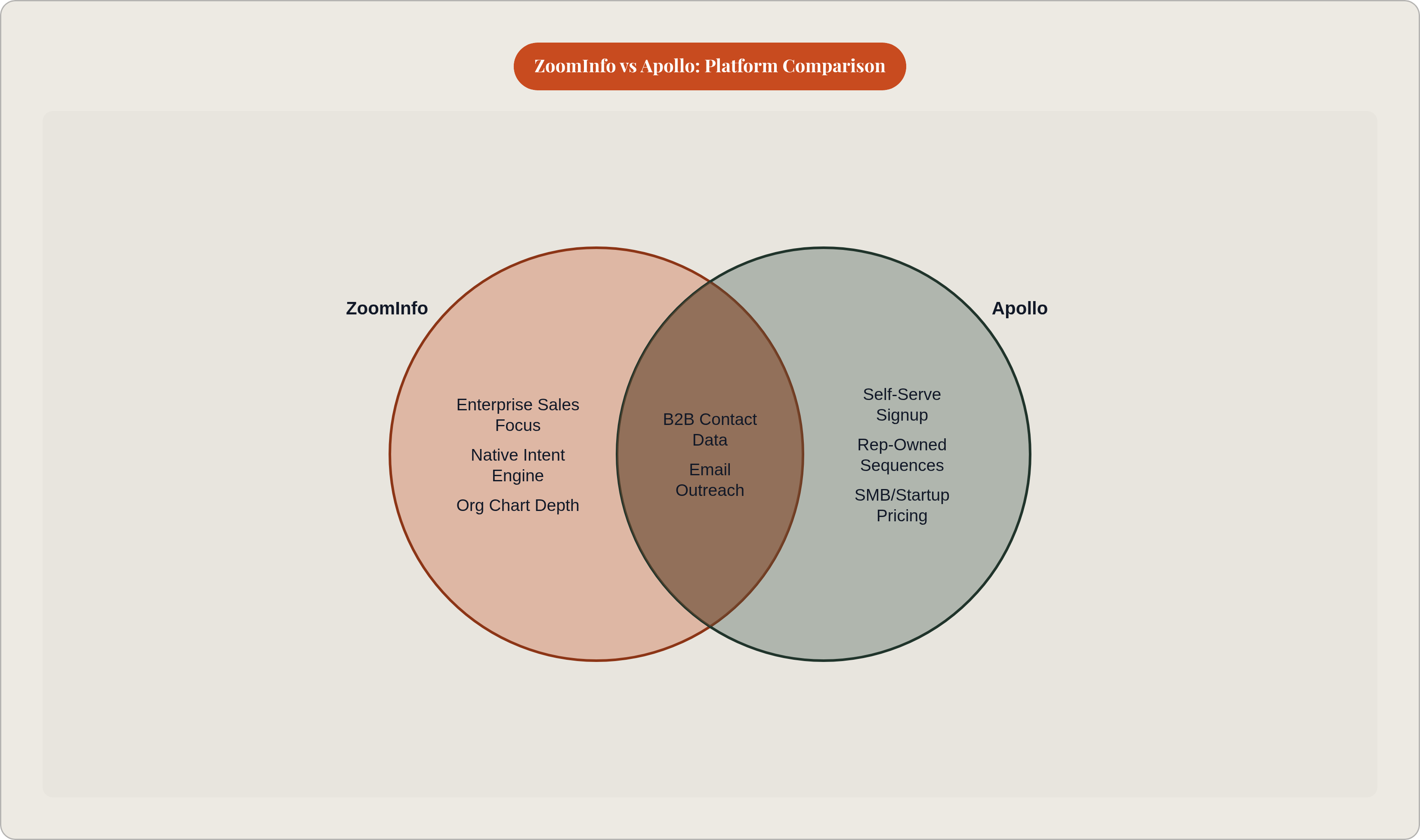
ZoomInfo and Apollo both get filed under "sales intelligence tools," which is a little like calling a Honda Civic and a delivery truck both "vehicles." Technically true, but the label hides more than it reveals. This piece looks at what each platform actually was built to do, tested it against real data quality benchmarks, and mapped both to the team profiles they genuinely fit, so you can stop scrolling feature comparison charts and start asking the one question that actually matters: who are you, and what are you trying to do?
What each company was built to be
ZoomInfo started in 2007 and went public on the Nasdaq under the ticker ZI. It now pulls in $1.25 billion a year and counts more than 35,000 customers, including Adobe, Snowflake, and JPMorgan. Here's the tell: over 85% of its 2024 revenue came through enterprise direct sales. That points to a company built around procurement cycles, legal review, and the kind of contract that needs a signature from someone with "VP" in their title.
Apollo showed up in 2015 with a different bet entirely: sell straight to the individual rep, skip the procurement committee. By May 2025, it had reached $150 million in annual recurring revenue, crossed a million users across more than 550,000 companies, and closed a Series D at a $1.6 billion valuation after growing revenue 9x in two years. It got there through self-serve signups, not enterprise sales teams knocking on doors, and that's a real signal about who the product was made for.
Neither approach is the "right" one. ZoomInfo bet that data completeness and admin control win the long game, while Apollo bet that speed and rep-level productivity matter more. Both bets paid off, just for different audiences.
How the databases actually compare when tested
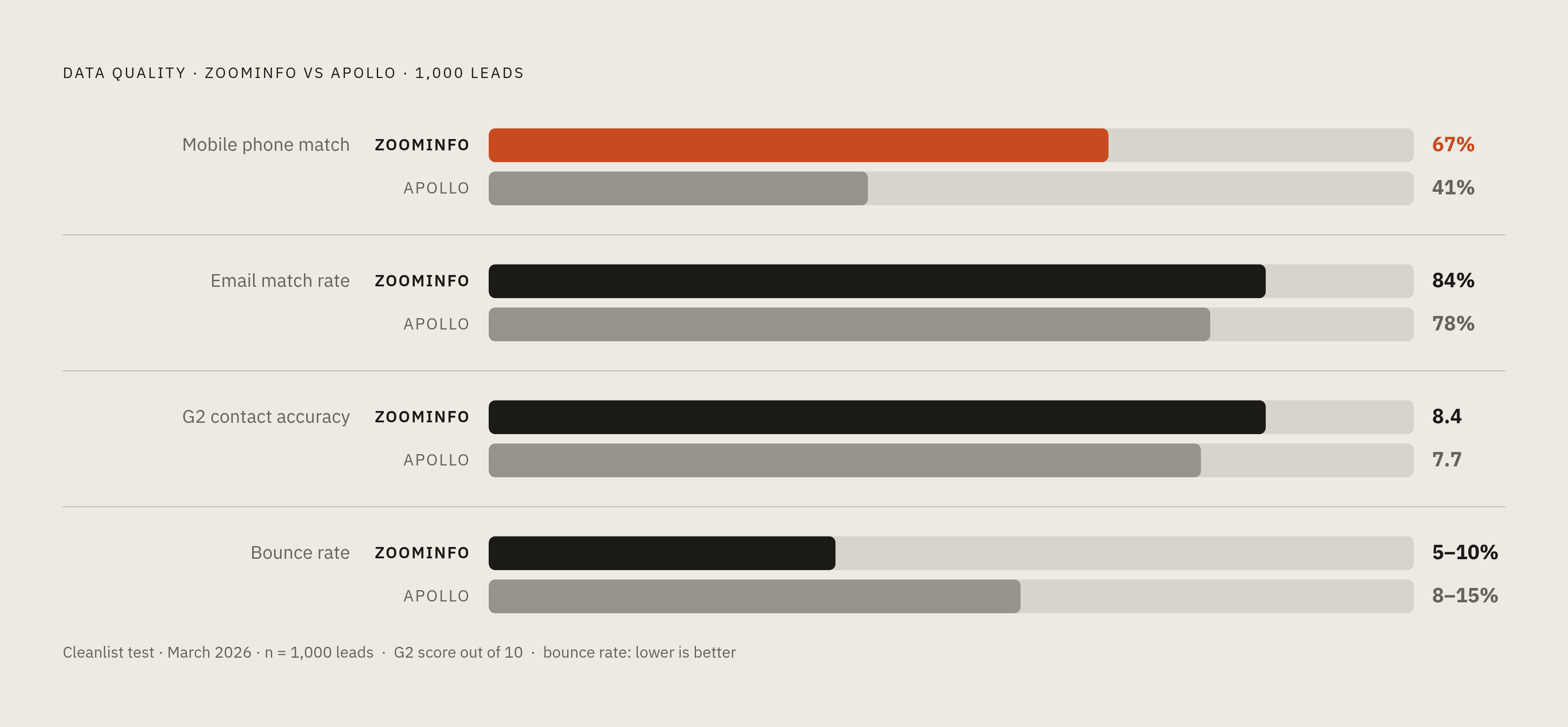
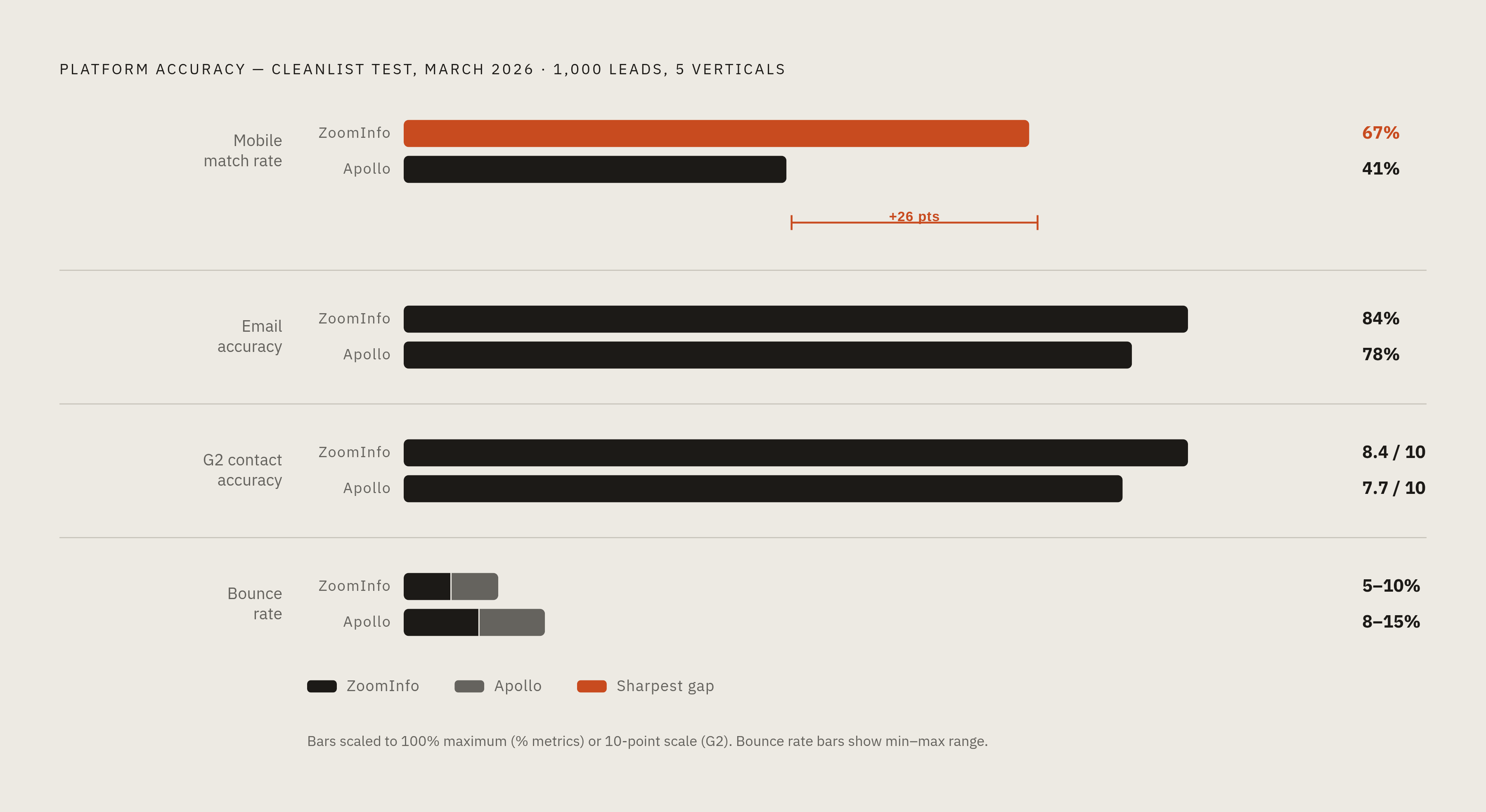
A March 2026 head-to-head test run by Cleanlist, using 1,000 leads across five verticals, gives us the cleanest look at how these platforms actually stack up outside of marketing copy.
ZoomInfo's database covers more than 321 million professional contacts and over 104 million company profiles, the broadest single-source coverage for US-based B2B prospecting. Apollo comes in at 230 million-plus people and 30 million-plus companies, backed by a claimed 97% email accuracy rate through its continuous validation system.
Where ZoomInfo pulls ahead clearly: phone numbers. It hit a 67% mobile match rate in the test, against Apollo's 41%, and G2's contact accuracy scores back this up too, with ZoomInfo at 8.4 versus Apollo's 7.7. Email is a closer race: 84% for ZoomInfo, 78% for Apollo, a modest gap compared to the one on phone data.
Bounce rates tell a similar story. ZoomInfo runs 5 to 10% on quality lists, while Apollo runs 8 to 15% on similar lists, a number that's improved a lot over the past couple years but still trails once you get into enterprise or regulated industries.
Now, the part that actually changes the math: Apollo starts at $59 a user per month, while ZoomInfo's minimum commitment runs around $15,000 a year. That gap in data quality is real, but so is the gap in what you're paying to close it.
Worth flagging too: for pure SaaS-to-SaaS prospecting, the coverage difference between the two shrinks quite a bit. Step outside that lane, into manufacturing, healthcare, government, or non-US SMB markets, and ZoomInfo's lead widens fast. And both platforms, worth noting, let SMB record freshness slide more than either would probably like to admit. Build a high-volume SMB list on either tool and check your data monthly, not annually.
Which verticals and ICPs each platform actually serves well
Apollo's home turf is US-based B2B tech. Coverage is deep, accuracy holds up, and it's fast enough for most outbound motions a tech company runs.
ZoomInfo's home turf is everywhere else: multi-vertical ICPs, non-tech companies, anything that crosses borders. In manufacturing and industrial sales, ZoomInfo's org chart depth gives reps a real edge navigating longer, more complicated buying committees. In financial services, the compliance documentation and enterprise-grade data give it an institutional trust factor that matters when you're selling into a bank's procurement team. Healthcare is the one place both platforms come up short; specialized healthcare-specific databases tend to beat either tool on that vertical alone.
The practical test is simple. Ideal customer concentrated in US tech? The ZoomInfo premium might not be worth paying. ICP spread across sectors, or includes non-tech companies? ZoomInfo is the safer bet. Global teams should weigh ZoomInfo's wider geographic reach against Apollo's lower cost per seat before deciding how far their budget needs to stretch.
Intent data — where the two platforms diverge most sharply
Contact accuracy gets you in the door, and intent data tells you when to knock. Buyers are typically 60 to 90% through their decision process before they ever talk to a vendor, which means by the time they reach out, the shortlist is usually already locked.
ZoomInfo built its intent infrastructure natively. It tracks signals off a network of 210 million IP-to-organization pairings and pulls in more than 6 trillion new keyword-to-device pairings every month. It scores intent across three dimensions: Date Range, which tracks repeated interest over time; Signal Score, which measures how far above baseline a company's content consumption on a topic runs; and Audience Strength, which captures how broad the research is across days and sites. Sitting on top of all that is a proprietary system called the GTM Context Graph, which processes over 1.5 billion data points a day, fusing intent with CRM activity, conversation intelligence, and behavioral data, functioning as a reasoning layer rather than a plain signal feed. Forrester named ZoomInfo a Leader in its Q1 2025 Wave for Intent Data Providers, with the highest possible marks across all eight evaluation criteria.
Apollo takes a partnership approach on intent, giving users access to over 15,000 intent topics with scores refreshed weekly, and it layers in a second source pulling signals from public web activity, social networks, event attendance, hiring patterns, and technology installs, updated weekly with a claimed 98% accuracy rate.
Here's the architectural difference that actually matters: both platforms draw from third-party intent data at the base layer, but ZoomInfo adds its own reasoning layer on top, and Apollo doesn't have an equivalent. For teams that want signal volume, either works; for teams that need signal prioritization, that's the gap. Snowflake, using ZoomInfo's scoring, saw a 90% jump in opportunity rates and doubled customer conversion on scored accounts, a result the company attributes to native signal precision rather than raw aggregation.
None of this works without discipline, though. A large share of B2B buyers actively tune out vendors who send irrelevant outreach, and industry benchmarking on intent data adoption shows a lot of practitioners are collecting signals without a real strategy for acting on them. Buying the intent data is the easy part; without someone on the team owning how it turns into action, it becomes an expensive spreadsheet nobody reads.
Intercepting buyers mid-cycle — what ZoomInfo Copilot and Apollo AI actually do
ZoomInfo Copilot is built to tell you which accounts deserve attention right now. It pulls intent spikes, executive hires, personnel changes, and even competitor research activity (including visits to G2 and TrustRadius pages) into a live feed on every company and contact profile. If a decision-maker goes quiet for 30 days, Copilot flags it as a stall risk before the deal quietly dies on your pipeline report. During its beta period, 45% of open opportunities sitting in customer CRMs matched a Copilot recommendation to engage, which says a lot about how tight the signal-to-outcome loop actually is. The competitor research alert is the sharpest edge here: when a prospect visits a rival's G2 profile, that shows up in Copilot, giving reps a shot at reaching out at the exact moment someone's shopping around.
Apollo AI plays a different position entirely. Its AI Research Agent drove a 46% jump in meetings booked in reported results, a rep productivity number through and through. It picked up the 2026 MarTech Breakthrough Award for Best AI-Powered Sales Solution, recognition earned on outbound automation quality. It's built for reps running high-volume sequences who need help personalizing at scale, a different job than helping a RevOps leader decide which of 200 accounts deserves a call this week.
Think of it this way: Apollo AI rides shotgun with the rep, while ZoomInfo Copilot sits with the revenue leader deciding where the whole team should be looking. Both jobs are real; they're just not the same job.
How each platform fits into a sales enablement motion
ZoomInfo's data depth changes what a cold call sounds like. A rep who knows the org chart, the recent executive hire, and the account's research activity before dialing sounds prepared and grounded. Seismic reported saving reps 11.5 hours a week using ZoomInfo, a 54% productivity gain, with 39% of pipeline traced back to ZoomInfo signals. Thomson Reuters saw a 40% increase in closed-won deals and hit 115% average monthly quota attainment. ZoomInfo's own 2025 Customer Impact Report found customers closing 46% of deals, up from 32%, a 14-point jump.
Apollo's enablement story runs on friction, or the lack of it. Reps move fast, build their own sequences, and tweak messaging without waiting on RevOps to design a workflow first, which fits teams where reps are self-sufficient and sales cycles are short enough that speed beats depth.
There's also an alignment question underneath all this. ZoomInfo's Copilot layer is built to connect marketing's intent signals directly to sales action, which matters for teams trying to run a real go-to-market motion across departments. Apollo's workflow stays largely rep-owned, with less infrastructure built for the marketing-to-sales handoff. Longer sales cycles with bigger buying committees make ZoomInfo's organizational depth worth more, while shorter, more transactional motions shrink that value considerably.
Where a dual-platform approach makes sense — and where it doesn't
Plenty of teams already run both, whether they've admitted it out loud or not. Apollo handles broad outbound prospecting and sequencing, while ZoomInfo gets reserved for the highest-value target accounts, where data precision and timing are worth paying up for. Apollo's pricing lets you scale wide; ZoomInfo's data quality justifies spending more where it counts most.
Dual-platform makes sense for teams with a tiered ICP, enterprise accounts on one end and a longer tail of SMB or mid-market targets on the other. It also fits RevOps teams that separate account prioritization from rep-level sequencing as two distinct jobs, and organizations with enough budget and operational maturity to run both tools toward different goals without tripping over each other.
It stops making sense the moment you don't have someone actually governing the mess. Two data sources without a dedicated admin means duplicate records, muddy attribution, and lists that overlap in ways nobody notices until a prospect gets the same cold email twice in one week. Early-stage teams and individual contributors are usually better off putting all their budget into one platform than spreading thin across two. The real cost of running both tools was never the second subscription; it's the hours somebody has to spend keeping the data clean.
The decision framework: matching platform to team profile
Apollo fits best when the team is small, self-serve, or led by individual contributors without a RevOps function standing by to manage two systems. It fits when the ICP sits mostly in US-based B2B tech, when speed matters more than data depth, and when the sales cycle is short and volume-driven rather than committee-based. It's also the right call when budget is genuinely tight and that $59-a-month entry point is the difference between having a tool and not having one, and it fits teams where reps want to own their sequences start to finish, without waiting on marketing or RevOps to hand them a workflow.
ZoomInfo fits best on the opposite end of nearly every one of those dimensions: larger teams with dedicated RevOps, ICPs that stretch across industries or geographies, longer sales cycles with multiple stakeholders, and organizations that need marketing and sales signals connected in one system rather than living in separate silos. It's the platform for teams where the cost of missing a signal is higher than the cost of the subscription.
The right choice depends entirely on where your team actually sits, not on which platform's marketing pages sound more convincing. Match the tool to your ICP, cycle length, and operational maturity, and the decision gets a lot less complicated than it first appears.