Sales Intelligence Platform Evaluation Criteria
Signal quality, not just coverage, determines which platform actually catches buying intent early.

Sales intelligence platforms all promise the same thing: the right data on the right account at the right moment. There are north of 385 vendors on G2 claiming to do exactly that, and if you line up their feature lists, they read like carbon copies. Contact data, firmographic enrichment, intent signals, AI scoring, CRM sync. Check, check, check. So buyers end up comparing price tags and database size instead, sign the contract, and six months later discover the intent signals they paid for tell them about as much as a weather report for last Tuesday.
The market's worth close to $5 billion now, growing around 13% a year. Every vendor with a scraper and a slide deck has shown up to the party. What follows is the stuff that actually separates the platforms worth your budget from the ones that just look good on a comparison chart, and signal quality is the thread running through all of it.
What a sales intelligence platform actually does and where signal quality enters the picture
Strip away the marketing copy and every platform in this category does one job: put useful information about the right account in front of a rep who can act on it, at the moment they can act on it. Everything else is plumbing.
Most pull from four data buckets. Contact and firmographic data tells you who the company is and who works there. Technographic data tells you what software they're running. Event signals catch a new job posting, a leadership change, a funding round. Intent signals try to catch someone actively shopping in your category right now, not someday.
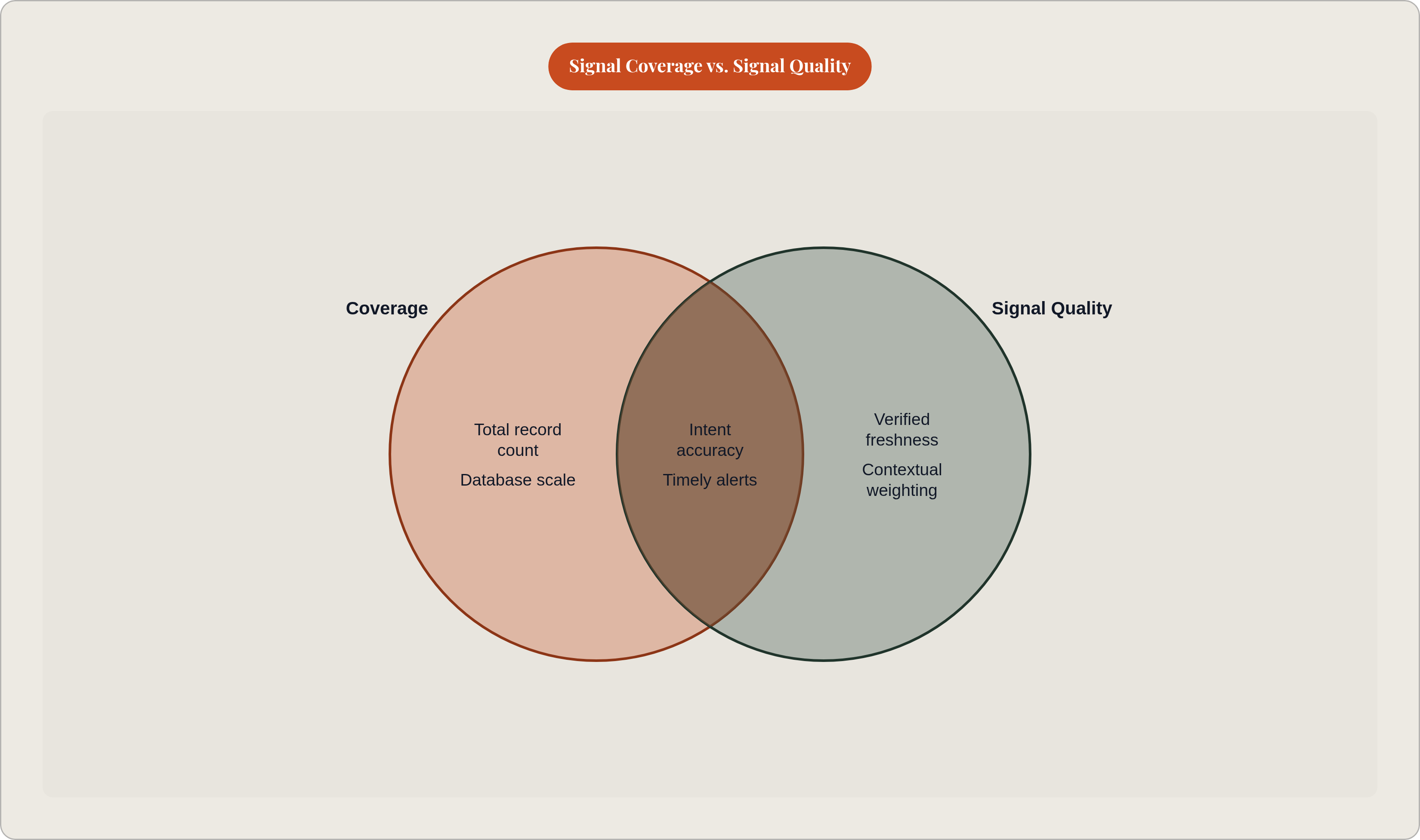
Buyers mix up two things that aren't the same. A platform can sit on millions of contact records and still hand your reps intent signals that are stale, inflated, or pointed at accounts that were never buying anything from anyone. Coverage is how much a platform has stored up. Quality is whether what it hands you is true and current, and those two things fail independently all the time.
This matters more now than five years ago, because buyers do most of their homework before a seller ever hears from them. Something like 60% of the buying journey happens before first contact, and by the time a buying group actually calls, they've usually already ranked their preferred vendors. Your window to shape that shortlist is narrow, and it opens and closes based on how early your platform catches the signal.
Which data type matters most depends on the job. Outbound prospecting runs on verified contacts and company triggers. ABM and demand gen live and die by intent and firmographic fit. RevOps cares about enrichment that feeds routing and scoring without breaking anything downstream. Teams running automated pipeline motions need all four working together, and freshness decides which vendor wins that fight.
Data accuracy and verification — the floor every other criterion rests on
Accuracy doesn't win the deal. It just gets you in the room. A platform that fails at basic accuracy disqualifies itself before you reach the interesting questions, and passing this test only means you're allowed to keep talking.
Ask the boring questions early, because the boring questions are the ones that matter. How often are contact records re-verified, and by a person or by an algorithm making assumptions? What's the real email deliverability rate and phone connect rate? Will the vendor hand you audit data instead of a slide with one big percentage on it? How does the platform handle decay, because people change jobs constantly, and a record that was gold in March might point at someone who quit in June.
Vendors love to throw scale around like it proves quality. It doesn't. It proves size. ZoomInfo covers roughly 500 million contacts and 100 million companies, with more than 135 million verified phone numbers and something like 1.5 billion data points processed daily. Numbers like that tell you the infrastructure exists to keep data fresh. They don't tell you the record sitting in front of your rep this morning is accurate.
So push further. What percentage of records got verified in the last 90 days, not the last fiscal year? Does the platform flag confidence levels on individual data points, or hand you everything with the same false certainty? How does the vendor define "verified," because a human confirming a phone number, a deliverability test, and an AI guess are three very different bars, and only one of them means a person actually checked.
Watch for vendors who lead with total record counts and go quiet the moment you ask for a verified-versus-unverified breakdown. Watch for refresh cycles measured in quarters instead of days, too. A quarterly refresh in a market where people switch jobs every couple years leaves you holding a snapshot with an expiration date nobody printed on the label.
The intent signal quality problem most buyers discover too late
Here's what should worry you. Most B2B organizations already use intent data or plan to, and nearly everyone using it says it's a competitive advantage. And yet most of those same teams admit the signals are unreliable or inflated, and only a small slice report returns worth bragging about. Adoption is high. Quality is the gap, dressed up in adoption numbers that make the whole category look healthier than it actually is.
Intent signals split into three tiers, and treating them as interchangeable is where most of this goes wrong.
First-party signals, meaning activity on your own website and content, are the most reliable because they're the most direct. This should be table stakes for any platform on your list. The real test is whether it fires in real time or dumps a batch file into your inbox once a day like clockwork nobody asked for.
Third-party signals come from co-op data networks tracking topic consumption across thousands of B2B sites, flagging accounts spiking above their normal baseline. Here's the question that separates the good vendors from the noisy ones: can the platform show you the specific topics driving that spike, or does it just hand you a number and expect trust?
Contextual and event signals, like a company posting a job for a VP of Sales or announcing a raise, hint that a buying window might open soon. They're early indicators, not proof, and they should get weighted that way instead of treated like a done deal.
One category deserves its own mention. G2's own numbers show accounts signaling intent on its platform convert at 2.6 times the rate of accounts without that signal. Makes sense, honestly. Someone reading competitor reviews is a lot closer to picking up the phone than someone who skimmed a blog post once in October. Late-stage behavior like visiting a competitor's pricing page should carry more weight in your scoring than one article read a month ago.
In vendor demos, push on this directly. Can the platform tell a one-time click apart from a sustained pattern of research? Does it show the underlying activity, or just a number calculated somewhere upstream you can't see into? Does it weigh a signal against that account's own baseline, or apply one flat threshold to every account regardless of size or history? And once a signal fires, how long does it stay visible, and is it timestamped so a rep knows if they're looking at this morning or last month?
Why signal timing determines whether intent data wins deals or misses them
A strong signal fires Monday morning. Nobody looks at it until Thursday's pipeline review. By Thursday, the account has already booked demos with two competitors. The signal was completely accurate. It just showed up too late to matter, which in sales counts as being wrong anyway.
Speed isn't a bonus feature here. Acting within minutes of a strong buying signal can make a lead up to nine times more likely to convert. Most teams still treat timing like a scheduling footnote instead of the lever it actually is.
Buyers finish most of their decision-making before ever talking to a rep, working through something like a dozen pieces of content on their own first. That window is real, but it's short, and it happens almost entirely in digital channels now, since that's where most B2B sales interactions actually live these days. The signals exist. The question is whether your platform catches them while there's still time on the clock.
So get specific about timing in the demo. Real-time alerts, or a daily digest that arrives on schedule and lands too late every single time? Can reps get pinged inside tools they already use, CRM, Slack, email, instead of needing to remember a separate login nobody checks? Can you set alert thresholds so reps hear about what matters instead of getting buried under every minor blip that crosses the wire?
The highest-stakes version of this shows up the moment an account starts researching your competitors. That's when the clock ticks loudest, because the window to intercept before a shortlist locks in is measured in days, not weeks. Platforms that catch that specific pattern fast have a real edge, and it's worth making them prove it live instead of taking their word for it on a slide.
Competitor intent detection as a specialized signal capability worth evaluating on its own
Buying groups rank their vendor shortlist before anyone picks up a phone, and whoever sits at the top of that list wins roughly 80% of the time. Landing on the list early matters more than any pitch delivered afterward. A late entry mostly ends up as a quote someone else uses for negotiating leverage.
That's why competitor intent detection deserves its own line on your evaluation sheet, not a footnote under "intent data" generally.
Competitor install data tells you which accounts currently run a rival product. Useful for a target list, but static, and it tells you who to call, not when. Contract and renewal timing puts a clock on that static list: a competitor's contract expiring in eight months gives your reps a real window to start a displacement conversation, while a contract expiring next month usually means you've already missed it, since most deals of any size take longer than 30 days to close start to finish.
Live competitor research signals are the sharpest of the three. Accounts spiking on competitor brand searches, "alternatives to" queries, category-replacement keywords, that means someone's shopping right now, not eventually.
Running this play well requires a platform that monitors competitor-adjacent keywords, not just searches for your own name. Rely on that alone and you'll only ever hear from people who already knew you existed. It needs to fire an alert or trigger a sequence the moment that pattern shows up, and it needs to connect the signal to real content (a comparison page, a case study) instead of leaving a rep to freestyle a cold email and hope.
A few vendors have built real depth here. Demandbase surfaces competitor-adjacent intent across tier-one ABM accounts. HG Insights leans into technographic and competitive install data paired with contract intelligence, useful if renewal timing is your main lever. Some tools tie competitor intent straight into content-driven sales sequences, a good fit for teams who'd rather hand a prospect something worth reading than another "just checking in" email.
Whoever you're evaluating, ask directly: can it monitor named competitor keywords, not just broad category terms? Does it pair install data with contract or renewal timing? When a competitor signal fires, does it hand a rep something to do, or just sit in a dashboard looking impressive to whoever built the dashboard?
CRM and workflow integration — where signal quality either reaches reps or disappears
Here's a scenario that plays out constantly. The platform catches a genuinely strong signal. It looks great in the platform's own dashboard. The rep, who has exactly one browser tab open and it's not that one, never sees it. The signal expires unused, and everyone blames "data quality" when the real failure was that nobody built a bridge between the signal and the human who needed it.
Real integration means a few concrete things. Signals sync both directions with your CRM, enriching records that already exist instead of spinning up a shadow database nobody opens. Alerts and sequences trigger from inside the tools reps already live in, not a separate login. Intent scores feed straight into the lead routing and scoring models RevOps already owns, and ideally, signals land in Slack or email, wherever the rep's day already happens.
RevOps should own this layer, full stop. Competitive data, intent signals, contract intelligence, win-loss history: all of it needs to live in systems RevOps can actually govern and audit. That means asking whether the platform has real API and webhook architecture, not two native connectors to Salesforce and a shrug.
Get specific about latency in the demo. How long between a signal firing and it landing in Salesforce or HubSpot: seconds, hours, overnight? Can the platform write back into the CRM, or only read from it? That tells you whether it's a participant or just watching from the sidelines. And what happens when a rep ignores a signal? Does it sit there forever, escalate to a manager, or quietly expire like milk nobody checked the date on?
Worth a specific mention: HubSpot's Breeze Intelligence, launched in 2025, brings native intent enrichment into the Professional and Enterprise tiers. For teams already living inside HubSpot and tired of juggling six logins, that's a real simplification. It trades away some depth of intent coverage to get there, a fine trade for some teams and a dealbreaker for others, depending on how hard you're leaning on intent as your primary signal.
AI-driven scoring and prioritization — what separates useful automation from noise
No rep can act on every signal a platform spits out, and none should try. The whole point of AI scoring is triage: tell reps which accounts need attention today, which can wait for a nurture sequence, and which should get filtered out entirely so nobody burns a Tuesday chasing a ghost.
Good prioritization blends signal type, how recent it is, fit against your ideal customer profile, and past conversion patterns, not just whatever happened to spike this week. It should also weigh the whole buying committee, not just the one contact who filled out a form. Deals today run through groups of people spread across departments over months, and a score built around a single contact only sees a slice of what's actually happening.
Explainability matters more than most vendors let on. Reps need to see why an account scored high, not just take a number on faith. A black-box score nobody can explain wears down trust fast, and it creates a real headache the day someone in legal or finance asks how a decision got made.
The payoff when this works is real. Intent-based campaigns built on well-scored signals convert meaningfully better than generic outreach, sometimes by a wide margin. But that lift only shows up when the model's calibrated against actual conversion outcomes, not proxy metrics like page views that feel like progress without predicting anything.
Push vendors on the specifics. Is the model trained on data from your industry, or is it a generic B2B baseline wearing a custom label? Can you retune it as your ideal customer profile shifts, or are you stuck with the formula you started with? Will they show independent accuracy or lift numbers, or only the vendor-reported figures that conveniently always look great?
If a platform surfaces signals with no prioritization layer at all, just dumps everything into a feed and tells reps to sort it out, take that as a real warning sign. You paid for a fire hose. You needed a filter.
Pricing structures and what the ROI timeline actually looks like
Entry-level plans for small teams usually land in the $50 to $150 per user, per month range. Enterprise packages with full AI scoring, complete intent data, and custom integrations run $200 to $500 or more per user, per month. Most vendors knock 15% to 25% off for annual contracts, and that discount belongs in your total cost math from the start, not as an afterthought you remember in month eleven.
On timeline, most organizations start seeing measurable returns somewhere in the 3 to 6 month window after full deployment, not immediately. Anyone promising instant ROI is selling a fantasy alongside the platform. Teams that invest in real onboarding, actual CRM integration, and workflow alignment from day one see returns that meaningfully outpace teams who flip the switch and hope reps figure it out on their own.
That gap between the fast movers and the slow ones almost always traces back to one thing: whether anyone built the plumbing before turning on the water.