Sales Enablement Process Stages and Owner Responsibilities
Assigning clear owners to each enablement stage stops reps from building decks alone at midnight.

Sales enablement fails for a boring reason: nobody owns it in sequence. It's five stages, and the stages need different owners depending on how big your company already is. Get that mapping wrong and you end up with reps building their own decks in Google Slides at 11pm before a big call, because whatever "official" content exists is either missing or three product versions out of date.
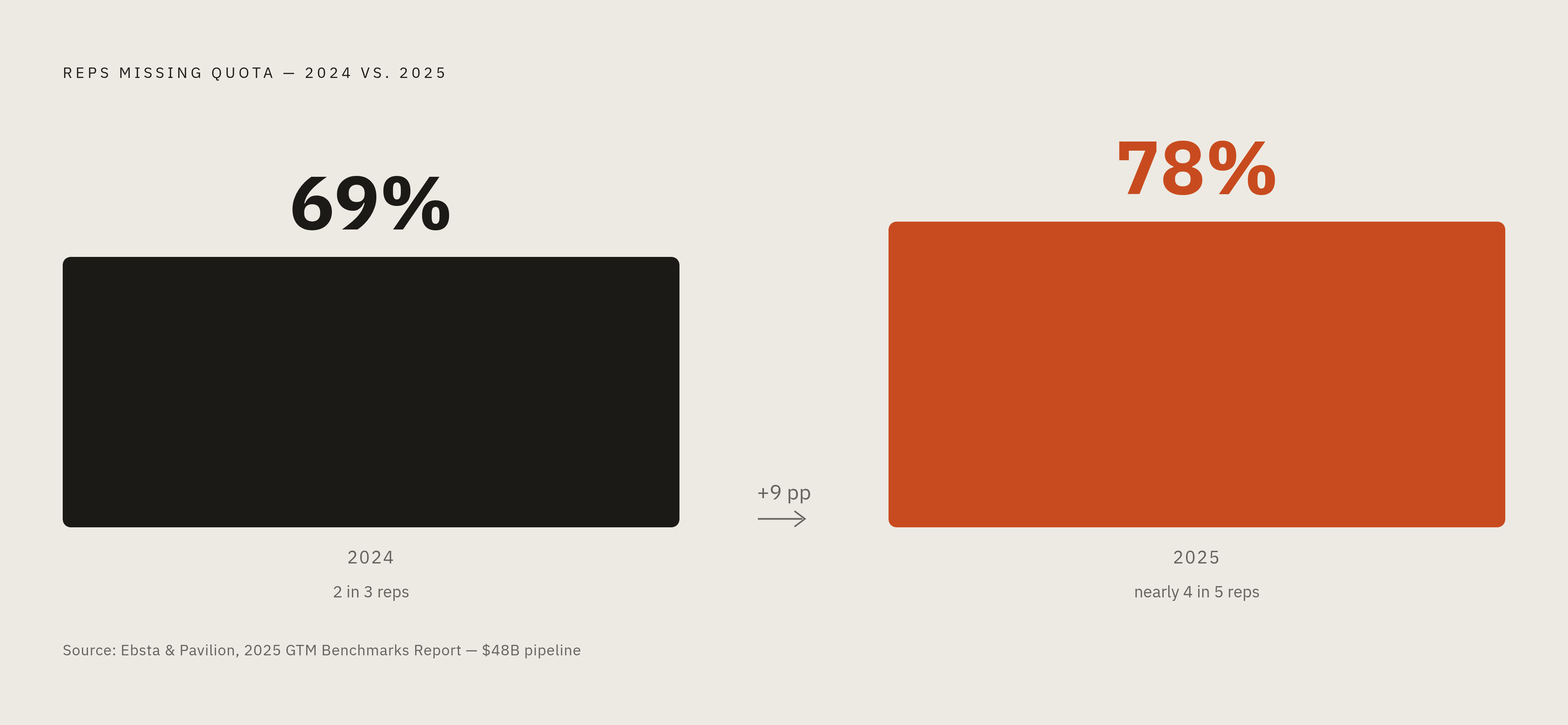
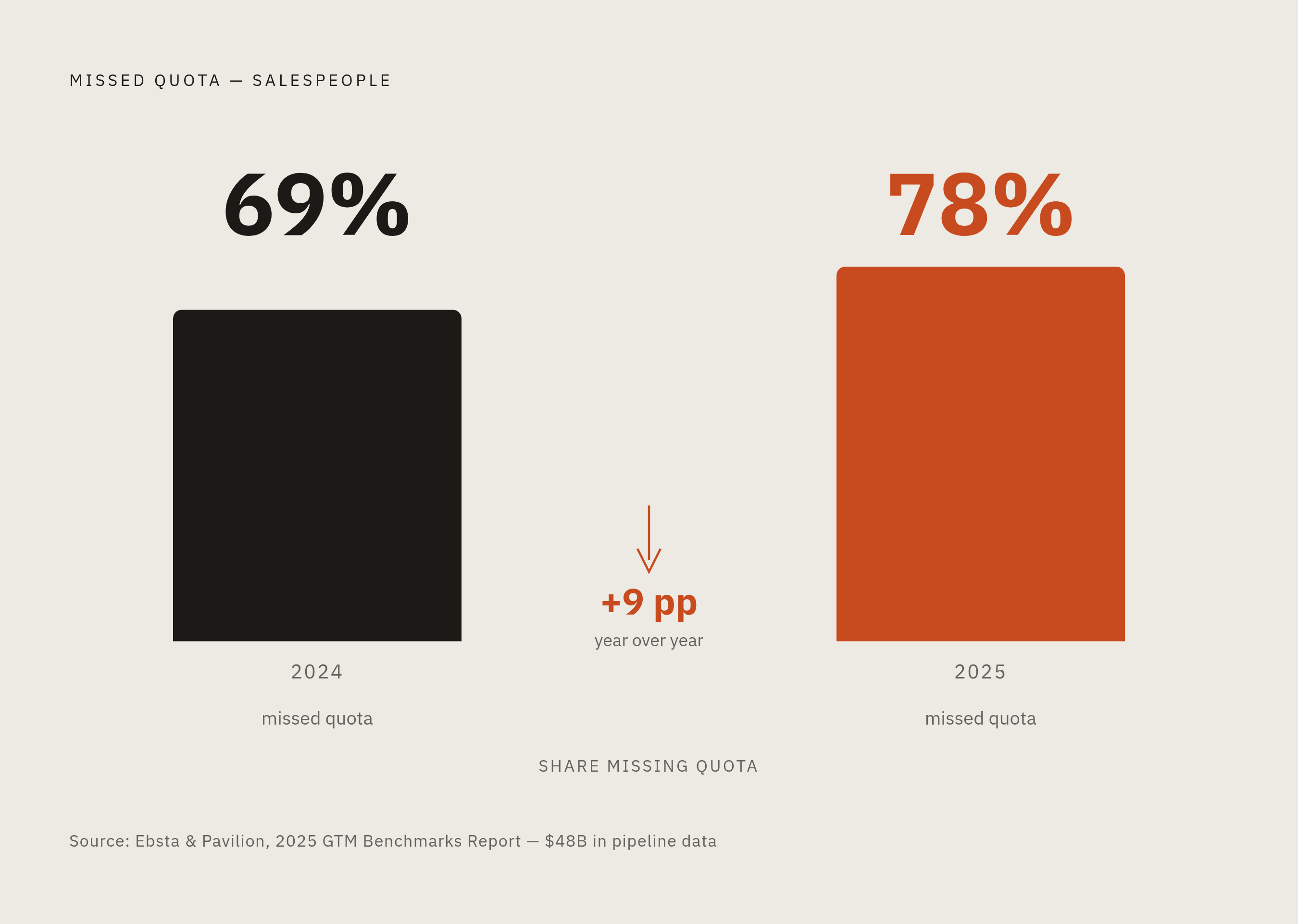
The numbers back this up, and they're not subtle. Per Ebsta and Pavilion's 2025 GTM Benchmarks Report, which pulled from $48 billion in pipeline data, 78% of salespeople missed quota in 2025. That's up from 69% in 2024. Effort didn't drop, but the gap between effort and outcome just got wider, which is a nice way of saying reps are working just as hard for worse results.
Here's the part that surprises people: almost every company already has "some enablement," and nobody's starting from zero. The problem is the architecture underneath the program. Disorganized content alone costs sales reps up to 440 hours a year hunting for the right asset, which is basically eleven work weeks spent playing Where's Waldo with a battlecard. Training happens once at onboarding and then vanishes like it owes rent. Marketing and sales operate on two different definitions of "done." And according to the Sales Enablement Collective's 2025 Landscape Report, only 51% of enablement professionals even agree with their own C-suite on which KPIs matter. Half the room is grading a different test.
The root cause is almost always the same: when nobody owns a stage on purpose, it defaults to whoever has spare bandwidth that week. Which, in practice, means it defaults to no one.
What sales enablement actually covers — and what it does not
Enablement, at its core, means equipping customer-facing teams with the content, training, tools, and insight they need to move a buyer forward. That's it. That's the whole definition.
What it is not is a longer list, and worth spelling out because most of the confusion in this space comes from people using "enablement" as a catch-all.
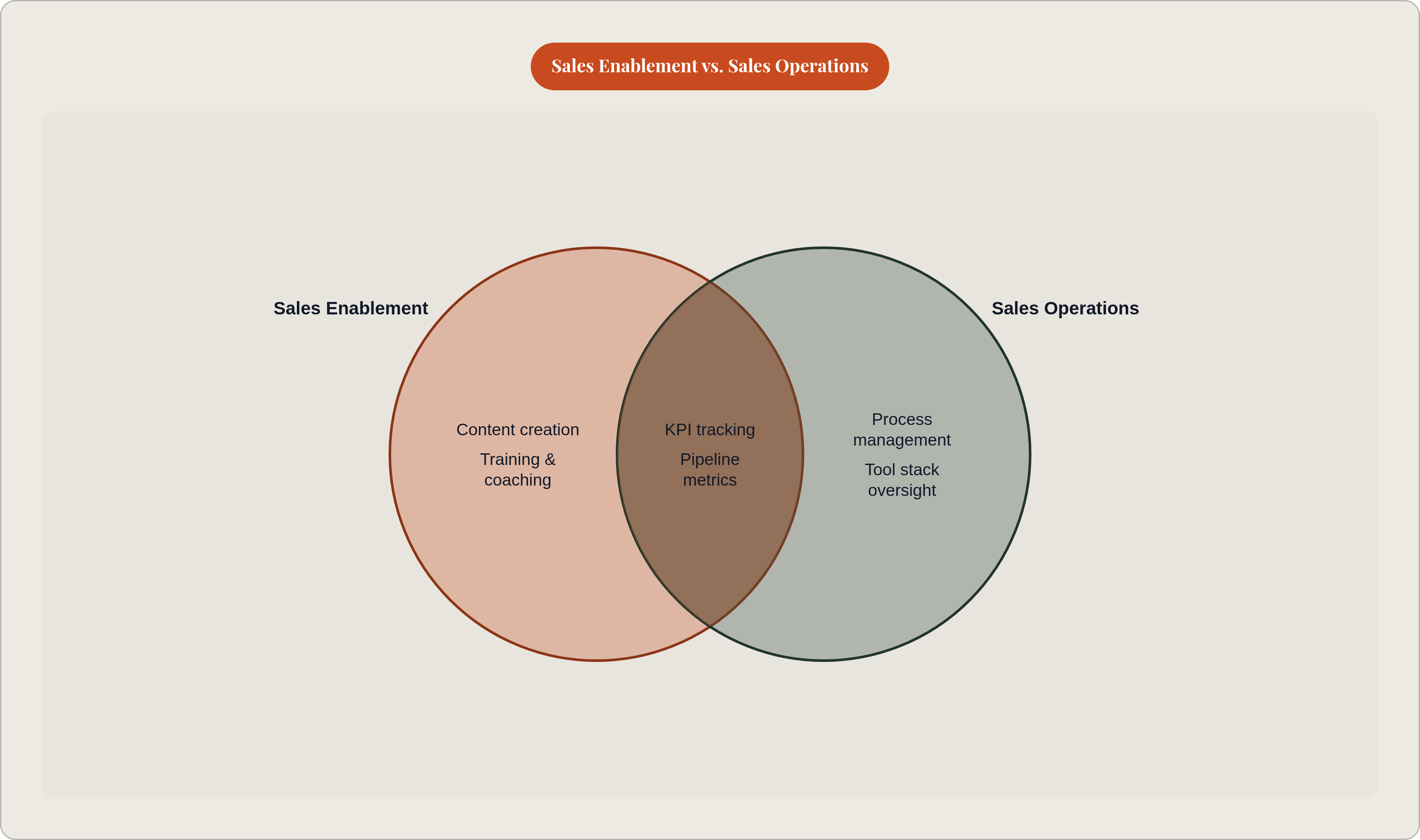
Training is one stage of five, not the entire operation. Content is an input that feeds the system, not the output the system produces. And enablement is often confused with sales operations, even though the two get lumped together constantly. Ops manages process and data, while enablement changes what a rep actually does on a call. Different jobs, different muscles.
Worth noting too: the smartest orgs have stopped treating this as sales-only. They apply the same stage logic to marketing, customer success, and partner teams under something people now call "revenue enablement." Same five stages, same ownership questions, just a wider cast of characters.
And the urgency here is real, not theoretical. Forrester's 2025 B2B predictions say more than half of large B2B deals over seven figures will move through digital self-serve channels. Younger buyers, Millennial and Gen Z, bring an average of 10 external influencers into a decision before a rep ever gets a call on the calendar. Show up unprepared to that conversation and you've already lost, you just haven't been told yet.
The thing to hold onto for the rest of this piece: enablement is a process with stages, built well before it becomes a department with a headcount. The department, if you get one, comes later.
The five stages of the sales enablement process in sequence
These five stages run in a loop once they're built, sure. But they have to be built in order the first time, or the whole structure wobbles.
Stage 1: Needs assessment and goal-setting. Figure out where deals are actually dying. Where reps stall, what content they can't find, which objections make them freeze. Set goals tied to pipeline and revenue, not to how many pieces of content got produced or how many training hours got logged. The output here is a gap map: here's what reps can do, here's what the buyer journey demands, here's the distance between them.
Stage 2: Role and responsibility alignment. Decide who owns what before anyone starts building anything. Content, training, coaching, measurement, each needs a name attached, and this covers the full revenue team, not just sales reps. Marketing, customer success, and RevOps all have a stake. The output is a responsibility matrix that survives someone quitting or getting promoted, which, let's be honest, is the actual test of whether a process is real.
Stage 3: Content creation and organization. Two lanes running in parallel. Internal content keeps reps sharp: messaging briefs, competitor battlecards, pricing sheets, training decks. Buyer-facing content moves the deal: one-pagers, case studies, ROI calculators, demo scripts. The key detail people miss is that content needs to map to deal stage, not funnel stage. What a rep needs on a first discovery call is nothing like what they need when a buyer's comparing three vendors side by side in a spreadsheet. And none of this matters if there's no system that makes it findable. Build the best battlecard in the world and bury it in a shared drive nobody opens, and you've built nothing. Some platforms exist partly to solve exactly that distribution gap, connecting content to the moments and deal stages where reps actually need it.
Stage 4: Training and deployment. Product knowledge, methodology, objection handling, and knowing how to actually use the content in a live call instead of reading it off a tab. The classic failure is one-time onboarding training with zero reinforcement afterward. Skills decay fast without repetition, the same way a language you learned in college evaporates if you don't use it. Sales managers are the highest-leverage lever here, but only if they're actually equipped with coaching guides, call review templates, and performance data. Telling a manager "coaching is part of your job" without giving them tools is like telling someone to fix a car with good intentions. 84% of executives say AI has strengthened their enablement strategy, and AI-assisted coaching and call review are becoming the standard way top teams close this reinforcement gap.
Stage 5: Measurement, iteration, improvement. Track quota attainment, ramp time, content usage, win/loss ratios. Skip the vanity stuff like "training completion rate," which measures attendance, not competence. Companies with a formal enablement function report an average 6.7% bump in quota attainment and 12.5% higher revenue growth, according to salesforge.ai, and those numbers are worth calibrating against. Then close the loop: feedback from reps and behavior from buyers should keep updating the content and training. That loop is what turns this from a one-time project into something that compounds.
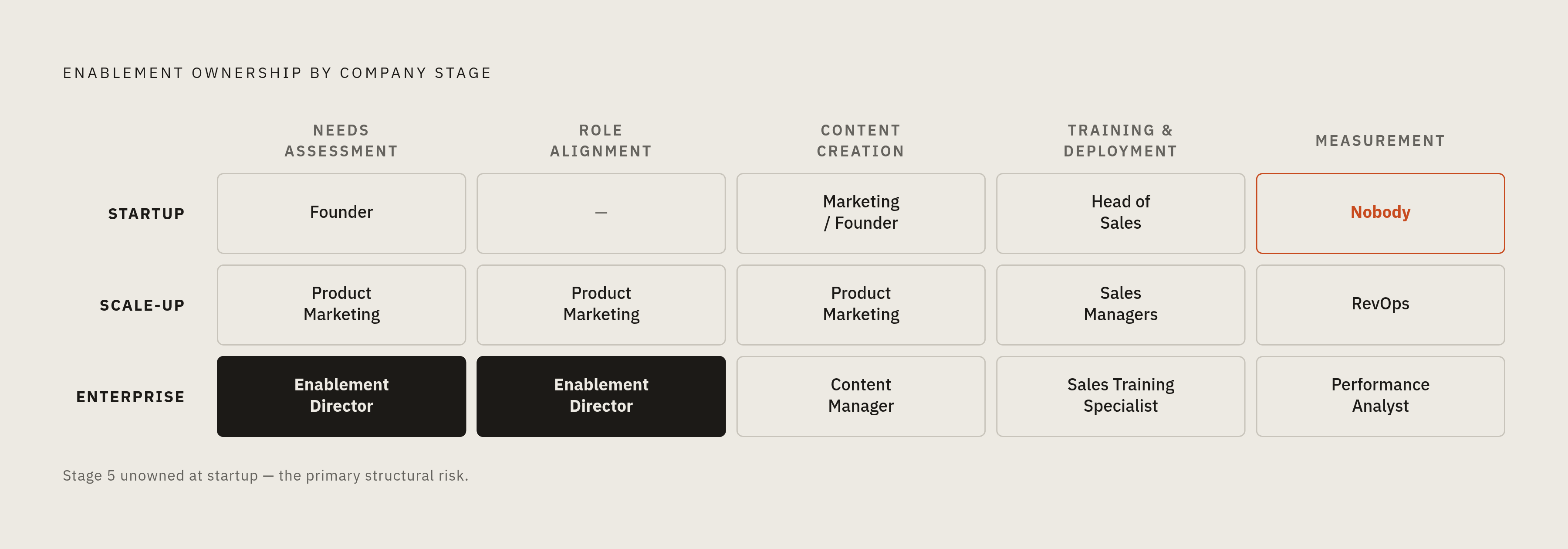
How ownership of each stage shifts from startup to scale-up to enterprise
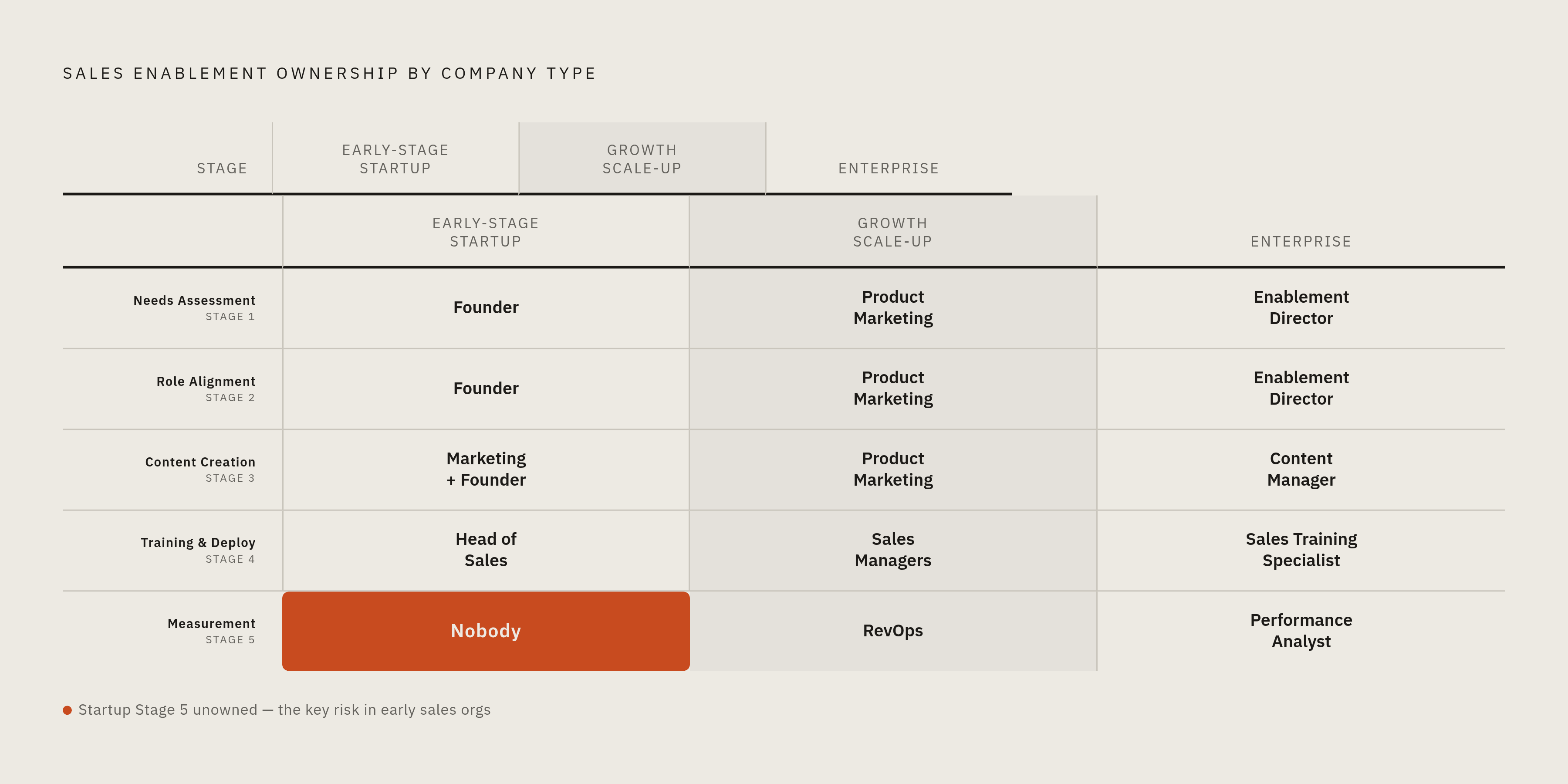
Early-stage startup. Ownership is scattered, and honestly, it has to be. The founder, the first sales hire, and whoever's running marketing that week split the work informally. The founder usually owns Stage 1, since they've been on every early call and know the buyer better than anyone. Content (Stage 3) lands with marketing, or with whichever founder happens to write well. Training (Stage 4) is the head of sales running ride-alongs and deal reviews in real time. Stage 5, measurement, usually belongs to nobody, which is the single biggest risk sitting quietly in the corner of a young sales org. The breaking point comes when reps start losing deals to gaps the founder can see clearly but can't personally patch fast enough.
Growth-stage scale-up. This is where ownership starts to formalize, and Product Marketing usually steps up first, since they already own positioning, messaging, and competitive intel, and those feed straight into Stages 1 through 3. A RevOps function, even a single person wearing five hats, starts to own Stage 5, because measurement gets too important to leave to vibes once pipeline grows past a certain size. Sales managers stay critical for Stage 4 reinforcement, and without a dedicated enablement hire, they're the only ongoing coaching mechanism the org has. The tell that it's time for a real hire: Product Marketing keeps building content, and sales keeps ignoring it, and nobody can quite explain why.
Enterprise, mature organization. A Sales Enablement Manager or Director now owns strategy across all five stages, reporting into revenue or GTM leadership. Specialized roles branch out underneath: a Content Manager runs Stage 3 end to end, a Sales Training Specialist owns Stage 4 design and delivery, a Performance Analyst owns Stage 5's KPI tracking and tool stack. Product Marketing keeps its lane on positioning and messaging, feeding into Stage 3 rather than owning it outright. Clear, senior-level ownership across GTM and RevOps is what makes execution fast and programs actually stick instead of dissolving after the first reorg. The enablement team's role is to connect sales, marketing, and RevOps, so the five stages run as one system instead of five separate departments doing their own thing and hoping it adds up.
The content and intelligence layer that most ownership models leave out
Buyers don't send up a flare announcing where they are in their decision. They just behave their way through it, quietly, and reps usually find out too late to matter.
Research across more than 4,000 buyers found that 94% of buying groups have already ranked their preferred vendor before ever speaking to a salesperson, and first contact with a rep happens roughly 61% of the way through the buyer's journey. By then, the shortlist is basically locked. That's not a funnel stage, that's a closing door.
For content, this means the highest-value assets aren't the ones sitting at the top of the funnel, they're the ones that reach a buyer while the shortlist is still being formed: competitor battlecards, direct comparison pages, objection-handling guides built for mid-cycle conversations. For training, it means reps need more than product knowledge. They need to recognize in-market signals and know what to do with them. A buyer quietly comparing three vendors on a review site is having a completely different mental conversation than a buyer still in early education mode, even if both show up as "leads" in the same CRM view.
Signal quality varies too, and it's worth knowing the tiers. First-party signals, site visits, content downloads, pricing page activity, are highly accurate but limited in reach. Second-party signals, like activity on review platforms or competitor comparisons, carry high purchase intent because the buyer is explicitly evaluating. Third-party signals, broader topic surges across content networks, reach further but need to be layered with other data before you trust them.
Here's the gap almost nobody in enablement owns: routing those signals to the right rep, with the right content, at the right moment. It falls into the crack between sales and marketing, and both sides usually assume the other one's handling it. Catching a buyer mid-evaluation, especially one actively weighing you against a competitor, is one of the highest-leverage moments in the entire sales process. Building a real owner for that moment into your enablement structure is what separates teams that react to buyers from teams that get there first.
What the measurement stage actually requires — and why it is usually done last but matters most
The common mistake is measuring activity instead of outcome. Content pieces produced, trainings completed, tools deployed, these all feel like progress, but none of them tell you whether a rep closed more business because of it.
Part of the challenge is sheer clutter. The average B2B sales org runs close to 10 different tools to support its sales strategy. The issue isn't a lack of data, there's plenty of it. The issue is getting a coherent signal out of a stack that fragmented over several years of "let's just add this tool too."
Break the KPIs down by stage and it gets clearer. Stage 1 succeeds if the gap assessment matches what reps actually report on the ground, not just what leadership assumes. Stage 3 succeeds if reps are finding and using the content, and at the deal stages it was built for. Stage 4 succeeds if you can see behavioral change: better call quality scores, stronger objection handling, faster time-to-competency for new hires. Stage 5, the meta-level, succeeds on quota attainment trends, revenue growth, and shrinking ramp time.
The C-suite alignment problem sits underneath all of this. That 51% alignment stat from earlier means roughly half of enablement teams are measuring against KPIs their own leadership doesn't fully buy into. Without agreement up front, measurement turns into a report nobody reads instead of a lever anyone pulls.
And the gap between top and bottom performers is stretching, not shrinking. Per Ebsta and Pavilion, top performers now close deals 11 times faster than lower performers, up from 8.9 times the year before. Measurement is how you figure out what your best reps are doing differently and actually copy it, instead of just admiring it from a distance.
One practical note that gets ignored constantly: Stage 5 needs to be designed during Stage 1, not bolted on after the program's already running. Retrofitting measurement onto an existing process is like trying to install a smoke detector after the kitchen's already on fire.
Signals that your current ownership model has outgrown your company's stage
A few friction points show up reliably when ownership hasn't kept pace with growth, and they're worth checking against right now.
Reps quietly building their own decks because they don't trust what's in the shared drive: that's a Stage 3 ownership gap. New reps taking noticeably longer to ramp than expected: Stage 4 reinforcement gap. Marketing producing content that sales just ignores: a Stage 2 problem, meaning roles were never actually agreed on in the first place. Leadership unable to answer a simple "is enablement working?": Stage 5 ownership gap. And high-intent buyer signals reaching marketing's dashboard but never making it to the rep in time to act: that's the intelligence layer failing to connect to content and training at all.
There are also three predictable trigger points where the whole model needs to shift. Startup to scale-up happens when the sales team outgrows what a founder can personally coach, and Product Marketing has to formalize the enablement work it's been doing informally. Scale-up to enterprise happens when Product Marketing is stretched across launches, positioning, and enablement all at once, which is usually the exact moment a dedicated enablement manager becomes the obvious next hire. Enterprise to full revenue enablement happens when the scope stretches into customer success and partner channels, and one team just can't cover it without becoming a real function with a director at the top.
Staying in the wrong model too long isn't a soft, forgivable mistake. It shows up as misaligned content, frustrated reps, and missed quotas that stack on top of each other quarter after quarter. That's a revenue drag you can actually measure, not a vague cultural issue you can wave away in an all-hands.
Building the enablement infrastructure that connects content to pipeline
Three layers need to work together, or the whole thing collapses into the same disorganized mess it was trying to fix.
The content layer has to be mapped to deal stage and conversation type, not just funnel position, and organized so reps can find the right asset in the exact moment they need it, not twenty minutes later after a frantic Slack search. The training layer has to reinforce constantly, with managers actually equipped to coach instead of just told to. And the intelligence layer has to route buyer signals, first-party, second-party, and third-party, to the rep who can act on them, fast enough for it to matter.
None of these layers fix anything on their own. A brilliant battlecard nobody finds is worthless, and a trained rep with no updated content is unarmed. A perfect intent signal that never reaches a human is just a number on a dashboard somewhere.
The companies pulling ahead right now are the ones who figured out who owns each of these five stages, matched that ownership to where the company actually is today, and built the connective tissue between content, training, and pipeline before they needed it. Everyone else is still trying to figure out why the deck from Q1 has three different versions floating around and nobody remembers which one is correct.